


Taipei City's wireless network was yesterday named the largest and densest WiFi network in the world.
The city's efforts in Wi-Fi development were recognized by JiWire, a Wi-Fi hotspot authority which maintains the world's most complete directory of verified public Wi-Fi hotspots.
Taipei Mayor Ma Ying-jeou (馬英九) pledged more advanced infrastructure and applications when receiving the award from the chief executive officer of JiWire, Kevin McKenzie.
McKenzie said: "We couldn't believe it when we were asked to come out and verify this large network: 4,200 access points in such a massive population with 90 percent coverage."
Despite the wireless network's high rate of coverage, only 30,000 of Taipei's 2.6 million residents have agreed to pay for the service, also known as Wifly, provided by Q-Ware Systems and Services Corp, the Internet provider that built and runs the network.
According to Chang Sheng (
Free trials of Wifly ended in January, and users now pay either NT$399 per month as a subscriber, or prepaid rates of NT$500 a month or NT$100 a day.
The low usage of the wireless service has drawn the attention of international media, with the New York Times running an article this week questioning Taipei's ability to attract more subscribers.
Acknowledging the low usage rate, Ma said the city and its partners were exploring ways to attract more subscribers, including a tiered pricing system that would charge different prices for different services and for new devices such as wireless phones and PDAs.
Meanwhile, Vice President Annette Lu (呂秀蓮) addressing the 2006 Digital Cities Convention Taipei yesterday, said central government would designate more than NT$300 billion (US$9.2 billion) to build up wireless services nationwide.
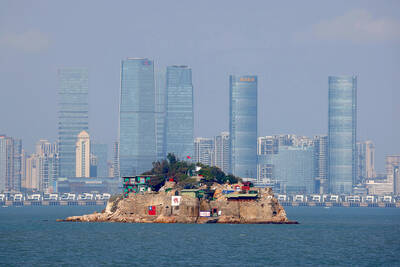
The Chinese Communist Party (CCP) is pushing for residents of Kinmen and Lienchiang counties to acquire Chinese ID cards in a bid to “blur national identities,” a source said. The efforts are part of China’s promotion of a “Kinmen-Xiamen twin-city living sphere, including a cross-strait integration pilot zone in China’s Fujian Province,” the source said. “The CCP is already treating residents of these outlying islands as Chinese citizens. It has also intensified its ‘united front’ efforts and infiltration of those islands,” the source said. “There is increasing evidence of espionage in Kinmen, particularly of Taiwanese military personnel being recruited by the
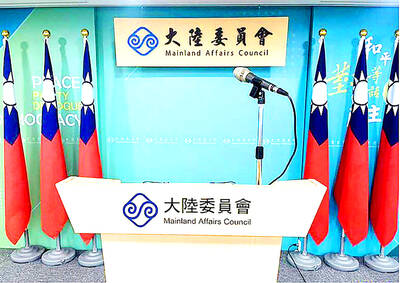
ENTERTAINERS IN CHINA: Taiwanese generally back the government being firm on infiltration and ‘united front’ work,’ the Asia-Pacific Elite Interchange Association said Most people support the government probing Taiwanese entertainers for allegedly “amplifying” the Chinese Communist Party’s propaganda, a survey conducted by the Asia-Pacific Elite Interchange Association showed on Friday. Public support stood at 56.4 percent for action by the Mainland Affairs Council and the Ministry of Culture to enhance scrutiny on Taiwanese performers and artists who have developed careers in China while allegedly adhering to the narrative of Beijing’s propaganda that denigrates or harms Taiwanese sovereignty, the poll showed. Thirty-three percent did not support the action, it showed. The poll showed that 51.5 percent of respondents supported the government’s investigation into Taiwanese who have

Left-Handed Girl (左撇子女孩), a film by Taiwanese director Tsou Shih-ching (鄒時擎) and cowritten by Oscar-winning director Sean Baker, won the Gan Foundation Award for Distribution at the Cannes Critics’ Week on Wednesday. The award, which includes a 20,000 euro (US$22,656) prize, is intended to support the French release of a first or second feature film by a new director. According to Critics’ Week, the prize would go to the film’s French distributor, Le Pacte. "A melodrama full of twists and turns, Left-Handed Girl retraces the daily life of a single mother and her two daughters in Taipei, combining the irresistible charm of

South Korean K-pop girl group Blackpink are to make Kaohsiung the first stop on their Asia tour when they perform at Kaohsiung National Stadium on Oct. 18 and 19, the event organizer said yesterday. The upcoming performances will also make Blackpink the first girl group ever to perform twice at the stadium. It will be the group’s third visit to Taiwan to stage a concert. The last time Blackpink held a concert in the city was in March 2023. Their first concert in Taiwan was on March 3, 2019, at NTSU Arena (Linkou Arena). The group’s 2022-2023 “Born Pink” tour set a


 RSS
RSS