

Homosexuals will now be officially listed and protected under the Domestic Violence Prevention Law (
Two lawmakers cited the movie Brokeback Mountain in arguing for the change.
The existing law defines "domestic" as "husband and wife relations, spouses and ex-spouses, parents, family members, or blood and non-blood relatives."
Legislators from the Judiciary Committee questioned that definition, asking whether homosexuals were included in those categories and protected by the law.
Minister of the Interior Lee Yi-yang (
According to the Civic Law (
Taiwan Solidarity Union Legislator Kuo Lin-Yung (郭林勇) said that homosexuals had long been neglected in a society where heterosexual marriages were dominant.
Although gay marriages are not yet legal in the country, more attention should be paid to gay rights, Kuo said.
"They [homosexuals] have been derided, persecuted and constrained in the past, but now they have begun to speak out, allowing their problems to surface and be known," he said. "Therefore, they must now be equally protected by the law."
The amended law should explain clearly that homosexual couples are included under the category of "family members," so that social workers, police and other authorities would understand, Kuo added.
He said gay relationships were often more intense and gay individuals may easily become victims of domestic violence. Without protection from the law, many end up committing suicide because they have no way to seek help, he added.
Democratic Progressive Party (DPP) Legislator Huang Sue-ying (黃淑英) added that the concept of "family" traditionally referred to heterosexual couples and that the decision made at the review session was a breakthrough for gay rights.
Huang said the new amendments should add that members of families could be composed of any sex.
Both Kuo and Huang said the award-winning movie Brokeback Mountain had positively influenced the public to be more aware of homosexual issues and problems.
The review session also made progress toward canceling a handling fee for protection orders. A NT$1000 (US$31) handling fee has posed a problem for many victims of abuse, who could not afford to apply for protection.

The donation of offshore patrol vessel Kinmen to the Philippines includes provisions that protect Taiwanese fishers and facilitate security cooperation across the First Island Chain, officials said yesterday. The comment was made during the Cabinet’s comprehensive administrative report at the legislature after Chinese Nationalist Party (KMT) Legislator Hsu Yu-chen (許宇甄) expressed concerns about the decision to give a ship to a country whose coast guard had in 2013 fired on a Taiwanese trawler and killed its captain without provocation. The Cabinet should lay out the safeguards that have been established to prevent the Philippine government from using the Kinmen to harass, expel
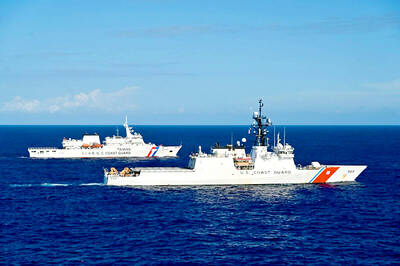
GROWING TIES: The CGA is planning a goodwill mission to the Philippines, in what would be the first time since 1975 a Taiwanese paramilitary vessel has visited the country The Coast Guard Administration (CGA) plans to significantly expand its participation in international security cooperative frameworks and its operational capabilities, a budget proposal for next year showed. The budget indicates a transformation of the CGA from a maritime law enforcement arm into a national defense and intelligence gathering entity capable of tackling larger regional security matters. The proposal showed that personnel from the coast guard’s Intelligence Division and Special Action Support Center are to participate in high-level national security talks with the US. As the CGA has dealt with China’s rising “gray zone” threats around Taiwan, it has become a valuable asset to
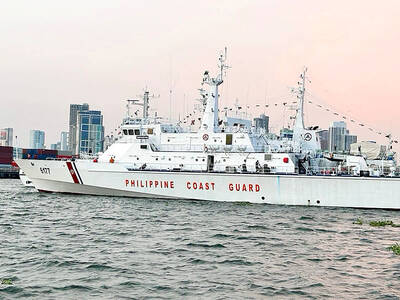
A patrol vessel donated by the Coast Guard Administration (CGA) to the Philippines was commissioned into the Philippine Coast Guard (PCG) on Friday, a Philippine non-governmental organization said. The CGA on Sept. 16 confirmed media reports that Taiwan had donated a retired 500-tonne patrol vessel to the Philippines. The Manila-based We Protect Our Seas (WPS) foundation, which served as an intermediary in the transfer, said that the vessel was formerly the CGA’s 500-tonne petrol vessel Kinmen (CG123). The WPS, in a statement issued on Friday, said the vessel, renamed as the BRP Sarangani, had been commissioned into the PCG the
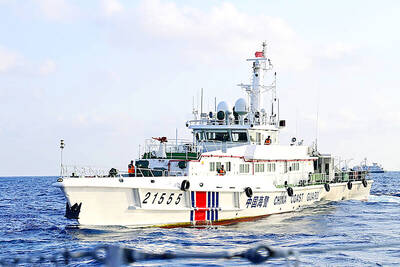
‘GRAY ZONE’ TACTICS: Beijing sent two China Coast Guard vessels to escort a ‘supposedly private research ship,’ a Philippine Coast Guard spokesman said The Coast Guard Administration (CGA) yesterday confirmed that it had recently deployed three patrol vessels to waters in Taiwan’s overlapping exclusive economic zone with the Philippines to monitor three Chinese vessels. CGA Deputy Director-General Hsieh Ching-chin (謝慶欽) said the agency regularly monitors Chinese vessels around Taiwan, and that the deployment south of Oluanpi (鵝鑾鼻), Taiwan proper’s southernmost point, was carried out in accordance with standard procedures. He added that the waters fall within the overlapping exclusive economic zones of Taiwan and the Philippines, which extend 200 nautical miles (370km) from their coastlines. Hsieh made the comments when asked about a


 RSS
RSS