


Taiwan's Myanmarese expatriate community has reacted with shock to their government's announcement Monday that it was moving the capital from Yangon to Pyinmana, with speculation rife here that the military regime is acting on astrologers' advice.
"This is crazy. Pyinmana has nothing to boast of. To move the capital to Pyinmana is unthinkable. Imagine the difficulty in rebuilding a capital, let alone the cost!" said U King, 65, a former Yangon lawyer.
U King rejected speculation that the relocation of the capital is to avoid a US seaborne attack similar to that of Iraq.
Like many of his 100,000-strong compatriots in Taipei, U King has a more mystical explanation.
"Myanmar leaders might have sought astrologers' advice and believe the move can improve Myanmar's feng shui [the Chinese belief in energy flows depending on wind and water] of Myanmar" U King said.
"Myanmar leaders are strong believers in feng shui. When Ne Win ruled Myanmar [from the 1960s to the 1980s], he considered relocating the capital for the sake of feng shui," U King said.
U King's views are shared by many other Myanmarese expatriates in Taiwan -- many of them of Chinese descent -- who have emigrated to Taiwan to seek a better life.
Agga Wan Tha, 58, a Buddhist monk in charge of the Therevada Dharma Vihara temple in Chungli (中壢) said the decision to move the capital could be the idea of only a handful of Myanmar leaders.
"Myanmar is run by a military dictatorship. Whatever they say, their subordinates must obey," he said by phone.
"I believe they sought astrologers' advice. Astrology plays an important role in Myanmar politics," the monk said.
"The government has appointed a committee of astrologers who help draft policies and decide on what date a festival is held," he said.
However, U Soe Hla, 67, a former teacher of zoology at the Mandalay University, supports moving the capital to central Myanmar because it is easier for the government to rule the country and develop the economy.
U Soe Hla is the honorary seceretary-general of the Myanmar Expatriates' Association in Taiwan.
Myanmar made the surprise announcement on Monday that it will move the capital from Yangon, capital since Myanmar's independence from Britain in 1948, to Pyinmana.
Information Minister Kyaw Hsan said the move was prompted by a changed situation.
"Pyinmana has become the most appropriate place for the seat of a new city" due to improved communications and transportation systems, he said.
Nine ministries have begun moving to Pyinmana which lies 320km north of Yangon, and the other ministries will follow suit.
Although Myanmar has kept relocation of the capital a secret, some people in among the expatriate community heard about it several months ago.
"I heard it from a friend whose brother-in-law works in the Myanmar government. He said the government planned to move only the important ministries to Pyinmana, and let the less important government units and foreign embassies remain in Yangon," U Kyi Win, 68, said.
He was a high school teacher in Yangon but has been doing business in Taiwan for 23 years.
News that the junta was planning the move first appeared in newspapers in Bangkok and Hong Kong a few months ago.
For instance, Larry Jagan, a Bangkok-based British freelance journalist, in an article carried by the South China Morning Post and the Bangkok Post on July 22, reported that "nervous junta plans to head for the hills," claiming massive construction had been underway for several years.
Government buildings, mansions for officials, national headquarters for ethnic groups, an airport, a hospital, a golf course as well as bunkers and tunnels were being built.
Jagan said the construction of the new capital had been delayed due to shortage of cement and timber. The junta did not want to import construction materials because it wanted to keep its plan a secret.
When Jagan's article appeared on the Internet, many people thought the Myanmar leaders were crazy.
"Nutters always live in fear and jump at shadows. It's what they do best," one reader wrote.
Another reader wrote: "Nobody has been interested in Burma since the Brits left after World War II. Who are these guys worried about?"
The US and other Western nations have not made military threats to Myanmar. They have only imposed sanctions on Myanmar to force it to stop abusing human rights and release pro-democracy leader Aung San Suu Kyi, who has been under house arrest most of the past 16 years.
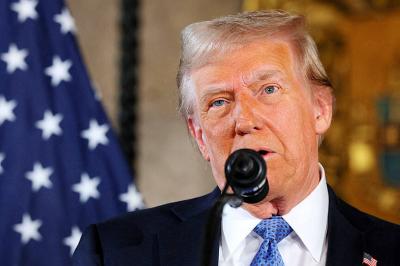
US President Donald Trump said "it’s up to" Chinese President Xi Jinping (習近平) what China does on Taiwan, but that he would be "very unhappy" with a change in the "status quo," the New York Times said in an interview published yesterday. Xi "considers it to be a part of China, and that’s up to him what he’s going to be doing," Trump told the newspaper on Wednesday. "But I’ve expressed to him that I would be very unhappy if he did that, and I don’t think he’ll do that," he added. "I hope he doesn’t do that." Trump made the comments in

NOT AN OPENING: Trump’s violation of international law does not affect China’s consideration in attacking Taiwan; Beijing lacks capability, not precedent, an official said Taiwanese officials see the US’ capture of the president of Venezuela as a powerful deterrent to Beijing’s aggression and a timely reminder of the US’ ability to defeat militaries equipped with Chinese-made weapons. The strikes that toppled Venezuelan President Nicolas Maduro signaled to authoritarian leaders, including Chinese President Xi Jinping (習近平), US President Donald Trump’s willingness to use military might for international affairs core to US interests, one senior official in Taipei’s security circle said. That reassured Taiwan, the person said. Taipei has also dismissed the idea that Trump’s apparent violation of international law could embolden Beijing, said the official, who was not
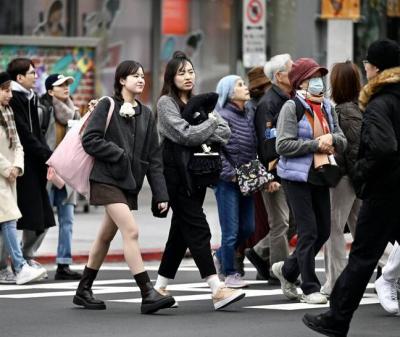
A cold surge advisory was today issued for 18 cities and counties across Taiwan, with temperatures of below 10°C forecast during the day and into tonight, the Central Weather Administration (CWA) said. New Taipei City, Taipei, Taoyuan and Hsinchu, Miaoli and Yilan counties are expected to experience sustained temperatures of 10°C or lower, the CWA said. Temperatures are likely to temporarily drop below 10°C in most other areas, except Taitung, Pingtung, Penghu and Lienchiang (Matsu) counties, CWA data showed. The cold weather is being caused by a strong continental cold air mass, combined with radiative cooling, a process in which heat escapes from
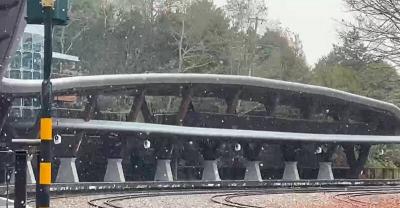
Snow this morning fell on Alishan for the first time in seven years, as a strong continental cold air mass sent temperatures plunging across Taiwan, the Central Weather Administration (CWA) said. The Alishan weather station, located at an elevation of about 2,200m in central Taiwan, recorded snowfall from 8:55am to 9:15am, when the temperature dropped to about 1°C, the CWA said. With increased moisture and low temperatures in the high-altitude Alishan area, the conditions were favorable for snow, CWA forecaster Tsai Yi-chi (蔡伊其) said. The last time snow fell at the Alishan weather station was on Jan. 10, 2018, while graupel fell there


 RSS
RSS