


China's role as the world's largest exporter of fur garments, with direct links to European and Asian countries, including Taiwan, deserves sharp criticism because of its lack of respect for life, animal rights activists from the Environment and Animal Society of Taiwan (EAST) said yesterday.
EAST released a report on the Chinese fur industry in Taipei yesterday. It is the first ever report from inside China's fur farms and is based on field and desk research carried out last year and last month.
EAST worked in conjunction with groups in Switzerland and the UK, including Swiss Animal Protection, Social Progress for Animal Welfare and Care for the Wild International.
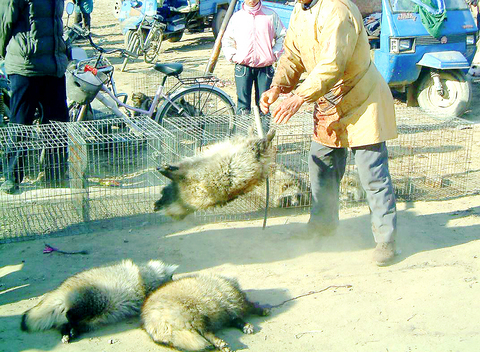
PHOTO: ENVIRONMENT AND ANIMAL SOCIETY OF TAIWAN
At a press conference, video footage taken during researchers' visits to several farms in Hebei Province -- which were raising from 50 to 6,000 animals -- was shown for the first time to the media in Asia.
Animals such as raccoons, foxes, and minks were shown being stunned with repeated blows to the head or by being pounded against the ground. The debilitated animal was then laid on its back or hung upside-down by its hind legs from a hook, and skinning would begin, with a knife inserted in the lower belly.
According to EAST's director, Chen Yu-min (
"We suspect that consumers buying fur products don't know about the brutality involved in the process. Innocent animals suffer for the fashion vanity of humans," Chen said.
According to the report, many animals remained alive after their skin had been stripped off, with breathing, heartbeat, as well as body and eyelid movements all evident for five to 10 minutes.
The report says most Chinese fur farms were established in the past 10 years. Wild species bred for fur include red foxes, Arctic foxes, raccoons, dogs, mink and Rex rabbits.
Wu Hung (
Most animals are killed at about six months old, when they molt for the first time.
Activists said a growing number of international fur traders, processors and fashion designers have gradually shifted business to China, where cheap labor and the absence of restrictive regulations have made it easier to do business and widened profit margins.
Activists said that in the past few years designers have promoted fur in everything from evening wear to sports wear. One fur coat requires the fur of about 80 minks or 25 foxes.
Government statistics in Taiwan suggest that the amount of fur products imported from overseas has increased dramatically, rising from 1,497kg in 2001 to 9,944kg in 2003.
Fur products imported from China, meanwhile, have also increased significantly. In 2003, more than 70 percent of fur products imported were from China. Last year, the percentage rose to 85 percent.
"Why do some consumers in Taiwan, which sits in a sub-tropical area ... need fur products to keep them warm?" Chen said.
Activists said entertainers in show business should take the lead to boycott fur products.
"In China's fur industry, we don't see any spirit to help the weak and aid the needy. Seeing this crime, Taiwan should not become an accomplice," Mary Chen (

FUKUOKA SITUATION: Japanese media reported that the pathogen is expected to be identified by the summer, while the CDC downplayed the idea that it was hMPV A “mysterious cold-like illness” reported in Japan’s Fukuoka Prefecture does not seem to be a new disease, but Japanese authorities have been asked about the situation, the Centers for Disease Control (CDC) said yesterday. The Fukuoka Prefectural Medical Association on Wednesday told a news conference that a “mystery cold” that has become a hot topic on social media is “highly likely to be caused by some kind of viral infection,” Japan’s KBC News reported. “Many people are experiencing symptoms starting with a sore throat, followed by a runny nose, phlegm and a severe cough,” KBC News reported, citing association officials. Health authorities are

Nvidia Corp CEO Jensen Huang (黃仁勳) arrived in Taiwan yesterday ahead of upcoming AI and technology events, saying he plans to meet with clients and Taiwan Semiconductor Manufacturing Co Chairman C.C. Wei (魏哲家) during his visit. After landing at Taipei Songshan Airport, Huang posed for photos with fans and handed out Yakult drinks to reporters and supporters waiting at the scene, saying he has “a lot to do” during the trip. Asked about reports that Nvidia’s planned headquarters site in Taipei’s Beitou Shilin Technology Park could break ground on May 27, Huang said that if the company holds an event, he would

The Ministry of Finance this afternoon announced the winning numbers for the March-April uniform invoice lottery. The winning number for the NT$10 million (US$318,060) special prize is 19531471, and the winning number for the NT$2 million grand prize is 85941329. Three numbers were drawn for the NT$200,000 first prize: 07225810, 20231230 and 83518781. Those with receipts matching the last seven digits of any of the first-prize numbers will win the NT$40,000 second prize, while those matching the last six digits will win the NT$10,000 third prize. Those whose receipts match the last five digits of the first-prize numbers can claim the NT$4,000 fourth prize,

SIX SUBSIDIES: The monthly allowance for older farmers is to increase to NT$10,000, and NT$5,000 is to be given to homemakers under the national pension system, Lai said The government is to implement major welfare policies for disadvantaged groups, including raising the monthly allowance for older farmers to NT$10,000 and providing homemakers with NT$5,000 per month, President William Lai (賴清德) said yesterday. Lai made the remarks during a visit to Wangling Temple in Chiayi County, saying that the planned increases were being introduced amid economic growth and an increase in tax revenue. Touting a policy, in which the government plans to provide a monthly allowance of NT$5,000 for every child under the age of 18 in a bid to address Taiwan’s low birthrate, Lai said that if received for the


 RSS
RSS