


US defense contractor Lockheed Martin says the US army has signed a letter of agreement with Taiwan to sell more than 400 Hellfire missiles in a deal worth US$50 million.
The Ministry of National Defense did not respond to the Lock-heed Martin announcement, citing its standard procedure of not commenting on arms purchases.
The Lockheed statement said the deal would involve the sale of more than 400 AGM-114M blast-fragmentation Hellfire rounds. Hellfire is an air-to-ground, laser-guided, subsonic missile with significant antitank capacity.
It can also be used as an air-to-air weapon against helicopters or slow-moving fixed-wing aircraft.
"The Taiwanese Hellfire purchase comprises the largest part of the US government's Hellfire missile ... contract award to Lockheed Martin. The new contract equates to approximately six months of activity on the Hellfire production line at Lockheed Martin's manufacturing plant in Troy, [Alabama]," the statement said.
"The Taiwan portion represents approximately 70 percent of the rounds to be delivered, between 5-10 percent are earmarked for Israel, with the balance going to the US army. Work on the missiles began earlier this year," it added.
Lockheed Martin said that in Afghanistan and Iraq, Hellfire proved extremely effective against ships, light armor and urban targets.
"Hellfire's lethality and combat-proven performance, coupled with its precision-strike capability, provides Taiwan with the best air-to-ground weapon system in the world," the statement quoted Mark Stenger, director of the Air-to-Ground Missile Systems Program at Lockheed Martin Missiles and Fire Control in Orlando, as saying.
"Taiwan's decision to purchase Hellfire ensures its military's interoperability with the US army, marine corps and special operations forces deployed worldwide," it said.
Military analyst Lee Shih-ping said the missiles could be used to block an amphibious landing on Taiwan in the event of an attack by Chinese troops.
"They are probably laser-guided missiles to be equipped on OH-58D or AH-1W attack helicopters. It is a large supply if you consider how many tanks they can hit," Lee said.
Beijing has strongly protested US arms sales to Taiwan, calling them "the main obstacle" to unification of China.
Washington's largest arms sale to Taiwan involved 150 F-16 warplanes, approved in 1992 by former US president George Bush.
The Legislative Yuan is currently debating a NT$610.8 billion (US$19.2 billion) budget to buy eight diesel submarines, 12 P-3C anti-submarine aircraft and six sets of PAC-III anti-missiles from the US.
US President George W. Bush approved the sale in 2001 to boost Taiwan's defenses, but opposition lawmakers have been blocking passage of the budget, saying the prices are too high and the delivery too late.
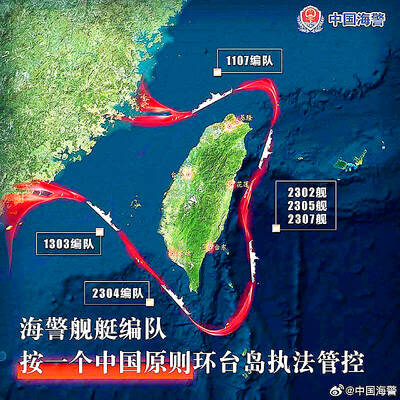
Taiwan would benefit from more integrated military strategies and deployments if the US and its allies treat the East China Sea, the Taiwan Strait and the South China Sea as a “single theater of operations,” a Taiwanese military expert said yesterday. Shen Ming-shih (沈明室), a researcher at the Institute for National Defense and Security Research, said he made the assessment after two Japanese military experts warned of emerging threats from China based on a drill conducted this month by the Chinese People’s Liberation Army’s (PLA) Eastern Theater Command. Japan Institute for National Fundamentals researcher Maki Nakagawa said the drill differed from the
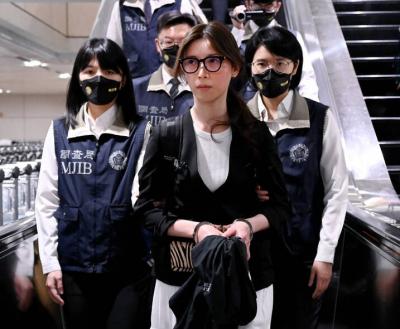
A fugitive in a suspected cosmetic surgery fraud case today returned to Taiwan from Canada, after being wanted for six years. Internet celebrity Su Chen-tuan (蘇陳端), known as Lady Nai Nai (貴婦奈奈), and her former boyfriend, plastic surgeon Paul Huang (黃博健), allegedly defrauded clients and friends of about NT$1 billion (US$30.66 million). Su was put on a wanted list in 2019 when she lived in Toronto, Canada, after failing to respond to subpoenas and arrest warrants from the Taipei District Prosecutors’ Office. Su arrived at Taiwan Taoyuan International Airport at 5am today on an EVA Air flight accompanied by a
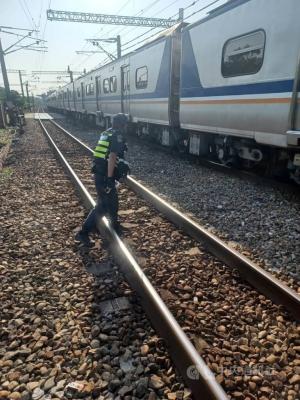
A 79-year-old woman died today after being struck by a train at a level crossing in Taoyuan, police said. The woman, identified by her surname Wang (王), crossed the tracks even though the barriers were down in Jhongli District’s (中壢) Neili (內壢) area, the Taoyuan Branch of the Railway Police Bureau said. Surveillance footage showed that the railway barriers were lowered when Wang entered the crossing, but why she ventured onto the track remains under investigation, the police said. Police said they received a report of an incident at 6:41am involving local train No. 2133 that was heading from Keelung to Chiayi City. Investigators

The Keelung District Prosecutors’ Office today requested that a court detain three individuals, including Keelung Department of Civil Affairs Director Chang Yuan-hsiang (張淵翔), in connection with an investigation into forged signatures used in recall campaigns. Chang is suspected of accessing a household registration system to assist with recall campaigns targeting Democratic Progressive Party (DPP) city councilors Cheng Wen-ting (鄭文婷) and Jiho Chang (張之豪), prosecutors said. Prosecutors yesterday directed investigators to search six locations, including the Chinese Nationalist Party’s (KMT) Keelung office and the residences of several recall campaign leaders. The recall campaign leaders, including Chi Wen-chuan (紀文荃), Yu Cheng-i (游正義) and Hsu Shao-yeh


 RSS
RSS