


Last Thursday the Central Election Commission (CEC) welcomed its new chairman, Chang Cheng-hsiung (張政雄), whose appointment was met with strong oppositions from the pan-blue camp as well as independent lawmakers, as Chang's actions in the past seemed to indicate that he leaned toward a pro-green point of view.
In his inauguration speech, Chang promised that he would remain impartial and strive to maintain fairness during his chairmanship.
According to the statute governing the organization of the CEC, the council should consist of 11 to 19 members, including the chairman, and the tenure of each member is three years. The premier makes the appointments pending the approval of the president.
However, according to the newly passed Organic Standard Law of the Central Government Agencies, which has yet to be promulgated by the president, the appointment of the CEC's chairman and its members requires the approval of the legislature.
Chang, born in 1941, has never been amember of any political party, has been an attorney-at-law for 37 years and is known for his work as defense attorney for the people arrested during the 1979 Kaohsiung Incident.
Although Chang claimed to be independent from any political party, his relationship with the Democratic Progressive Party (DPP) goes back a long way.
Last year, when the DPP hired five prestigious lawyers who were not members of the party to conduct investigations of election bribery among legislators at large, Chang was one of the five attorneys chosen to join the taskforce.
Although he is not a long-term CEC member, his active participation in discussions won him the opportunity to preside over the third televised referendum debate this year. Toward the end of the debate, Chang made a closing remark that the national referendum was in complete agreement with the law. His bold move resulted in an outcry from some viewers.
Furthermore, Chang's name later appeared on a full-page pro-referendum advertisement, along with the names of several former judges and prominent legal professionals.
"The Chinese Nationalist Party (KMT) is strongly opposed to Chang's appointment as the chairman of the CEC. As Chang was in favor of holding the referendum on the same day as the presidential and vice-presidential election, his biased political stance was obvious. His appointment as the chairman of the CEC, an organization which is supposed to be neutral, showed that he was assigned to be the executor of the will of DPP and the Cabinet," KMT Legislator Huang Teh-fu said in a telephone interview.
Independent Legislator Su Ying-kuei (
"Although a government is supposed to be neutral, we do not expect it to be totally so. However, certain government offices, such as the CEC, should particularly illustrate their professionalism and neutrality. The government was irresponsible to allow such a biased person to be picked as the chairman and I am terribly disappointed in our government for making such a decision," Su said.
Su claimed that through his close acquaintance with former CEC chairman Huang Shih-cheng (
Lisa Huang, a lawyer whose father is Huang Shih-cheng, pointed out the qualities needed for CEC leadership.
"Chang will need to be good at dealing with relational matters, as being in a job that deals with election affairs there will be many voices coming from different political parties. On top of that, he also needs to possess strong negotiation skills," said Lisa Huang.
Huang also expressed her best wishes for her father's successor.
"I believe that as long as Chang is able to stay absolutely neutral while executing his task as the CEC chairman, his efforts will be acknowledged by the people," Huang said.
Liao I-ming, assistant professor in the department of government and law at the National University of Kaohsiung, pointed out that the current legal structure of the government leads to controversies such as that surrounding the role of the CEC.
"For the time being, the CEC is under the Cabinet until revisions are made to the Organic Standard Law of the Central Government Agencies. Therefore, lawmakers from all political parties should have realized that the process of law revision is going to be painstakingly time-consuming. Meanwhile, they should be aware of the fact that direct appointment of the chairman of the CEC is necessary," said Liao.
However, Liao also stated that government leaders stumbled by choosing Chang for this job.
"Given the aforementioned situation, wise politicians, namely the president and the premier, may see this office appointment as an opportunity to convey their impartiality as a government. However, their failure to do so is a failure to exercise their political wisdom," said Liao.

UPGRADE: The Kang Ding-class frigate is replacing its Chaparall missiles with Tien Chien II and Hua Yang VLS, which would provide it with long-range, 360° air defense Taiwan plans to produce 1,200 to 1,376 Hai Chien II missiles (海劍二, Sea Sword II) — also known as TC-2N — to serve as the standard air defense system of the navy’s surface combatant fleet, a source said yesterday. Last week, the Hai Chien II, the naval version of the Tien Kung II missile (天劍二, Sky Sword II), completed a live-fire test in waters off the National Chungshan Institute of Science and Technology’s Jiupeng facility (九鵬) in Pingtung County’s Manjhou Township (滿州). The MIM72 Chaparral and other dated air defense missiles that currently arm Taiwanese ships have inadequate range to combat Chinese

REASONS FOR TRAVEL: An assistant professor said that proposed amendments to penalize drivers if they used drugs overseas would not deter people from traveling People who operate a motor vehicle under the influence of marijuana would have their driver’s license revoked, even if they used the substance while overseas, the Ministry of Transportation and Communications said yesterday, citing proposed amendments to the Road Traffic Management and Penalty Act (道路交通管理處罰條例). The amendments would also authorize the government to revoke the licenses of people determined to have used Category 1 or Category 2 narcotics, even if they were not operating a vehicle while under the influence of drugs, as well as ban them from taking the license test for three years, the ministry said. People aged 18 or
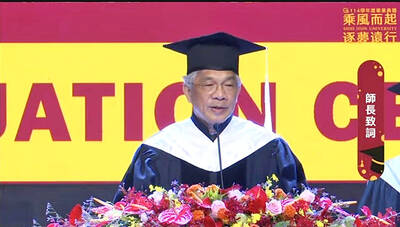
Shih Hsin University President Chen Ching-he (陳清河) yesterday issued a public apology for comments made in his commencement speech last week, stating that he has asked the school to suspend his duties and halt his wages for two months as a show of contrition. At the commencement ceremony on May 30, Chen said, “If you don’t manage your time well, or your own emotions, or your health, then I am telling every one of you — put a quick end to ‘you,’ because the world has no need for ‘you.’” The comments have sparked significant controversy online, and Chen through an open
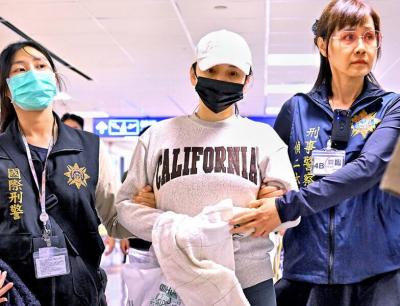
Johanne Liou (劉喬安), a Taiwanese woman who shot to unwanted fame during the Sunflower movement protests in 2014, returned to Taiwan last night after being deported from the US. She is to stand trial in Taiwan for charges involving embezzlement, fraud and drug crimes. The Criminal Investigation Bureau (CIB) said it took her into custody at Taiwan Taoyuan International Airport and would first question her before transferring her to the New Taipei District Prosecutors’ Office. She was arrested upon disembarking a flight from San Francisco that landed shortly before 7pm. Liou absconded to the US in 2019 after jumping bail


 RSS
RSS