


A reliable and robust total-knee prosthesis with a motion pattern closely resembling that of a real knee has been designed by Taiwanese scientists and will soon enter the market in Asia.
The prosthesis will benefit Asian patients who now suffer from discomfort caused by prostheses designed in the west, the National Science Council said yesterday.
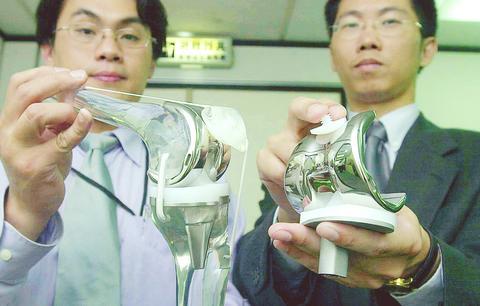
PHOTO: CHIANG YING-YING, TAIPEI TIMES
A three-year scientific research project, sponsored by the council, led to the invention of three new types of total-knee joint prostheses which are more suitable for Asian patients.
According to Cheng Cheng-kung (鄭誠功), a biomedical engineering professor at National Yang Ming University, Asian kneecaps are relatively thinner than that of Westerners.
In addition, the shape of a section of Taiwanese people's shin bone near the knee joint is round, which differs somewhat from that of other people.
"Based on Asian characteristics, we further improved existing total-knee prostheses to minimize discomfort caused by loosening of joints, wear and breakage," Cheng said at a press conference yesterday.
In Taiwan, almost 8,000 operations involving total-knee prostheses are performed annually.
In the past, doctors used prostheses imported from either the US or Europe.
Five years ago, the Mackay Memorial Hospital began to use domestically designed and produced prostheses.
"So far, we have not had any failures," Mackay Memorial Hospital Superintendent Huang Chun-hsiung (
The hospital is involved in governmental research to help design even better total-knee prostheses, which would be more durable and functional.
The research also involves Tzu Chi Hospital.
Yu Tzai-chiu (
"For this reason we need to fix problems all the time, depending on effects we observe in patients," Yu said.
Meanwhile, the team's designs also help lowering the risks during operations caused by blood transfusions, anesthetics or diseases prevalent in older patients.
Applications for patent rights pertaining to the three new total-knee joint prostheses are being processed, the council said.
"The inventions upgrade Taiwan to a higher level in the biotechnology sector," said Tsay Chung-biau (蔡忠杓), director general of the council's department of engineering and applied sciences.
Jason Lin (


Kenting National Park service technician Yang Jien-fon (楊政峰) won a silver award in World Grand Prix Photography Awards Spring Season for his photograph of two male rat snakes intertwined in combat. Yang’s colleagues at Kenting National Park said he is a master of nature photography who has been held back by his job in civil service. The awards accept entries in all four seasons across six categories: architectural and urban photography, black-and-white and fine art photography, commercial and fashion photography, documentary and people photography, nature and experimental photography, and mobile photography. Awards are ranked according to scores and divided into platinum, gold and

More than half of the bamboo vipers captured in Tainan in the past few years were found in the city’s Sinhua District (新化), while other districts had smaller catches or none at all. Every year, Tainan captures about 6,000 snakes which have made their way into people’s homes. Of the six major venomous snakes in Taiwan, the cobra, the many-banded krait, the brown-spotted pit viper and the bamboo viper are the most frequently captured. The high concentration of bamboo vipers captured in Sinhua District is puzzling. Tainan Agriculture Bureau Forestry and Nature Conservation Division head Chu Chien-ming (朱健明) earlier this week said that the
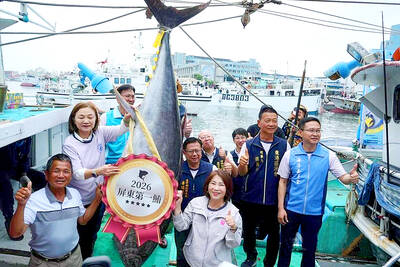
The first bluefin tuna of the season, brought to shore in Pingtung County and weighing 190kg, was yesterday auctioned for NT$10,600 (US$333.5) per kilogram, setting a record high for the local market. The auction was held at the fish market in Donggang Fishing Harbor, where the Siaoliouciou Island-registered fishing vessel Fu Yu Ching No. 2 delivered the “Pingtung First Tuna” it had caught for bidding. Bidding was intense, and the tuna was ultimately jointly purchased by a local restaurant and a local company for NT$10,600 per kilogram — NT$300 ,more than last year — for a total of NT$2.014 million. The 67-year-old skipper
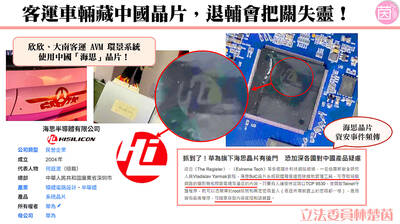
BREACH OF CONTRACT: The bus operators would seek compensation and have demanded that the manufacturer replace the chips with ones that meet regulations Two bus operators found to be using buses with China-made chips are to demand that the original manufacturers replace the systems and provide compensation for breach of contract, the Veterans Affairs Council said yesterday. Democratic Progressive Party Legislator Michelle Lin (林楚茵) yesterday said that Da Nan Bus Co and Shin-Shin Bus Co Ltd have fielded a total of 82 buses that are using Chinese chips. The bus models were made by Tron-E, while the systems provider was CYE Electronics, Lin said. Lin alleged that the buses were using chips manufactured by Huawei subsidiary HiSilicon Co, which presents a national security risk if the


 RSS
RSS