


Liberty Times: You led a delegation to visit Taiwan two years ago. What's your impression of the country?
Hermann Otto Solms: That visit deeply touched me. The cornerstone of Western democratic systems -- the principle of rule of law, separation of administration and legislation, and direct elections -- has become the consensus among the Taiwanese people, attesting to a successful transfer from totalitarian rule to democracy. This visit proved that my original impression of Taiwan was correct.
LT: When first lady Wu Shu-chen (
Solms: First of all, this was a very successful visit. Her charisma, in particular, made a strong impression here. The National Palace Museum's exhibition and other cultural performances and activities featuring Taiwan not only projected a positive and active image for Taiwan, but also called Germans' attention to the problem of Taiwan's international status.
Germans further came to realize the fundamental difference between independent Taiwan, and Hong Kong and Macau, which are under "one country, two systems." This should be a very special experience for the German press and the public.
LT: Your party's parliamentary caucus put forth a proposal in May last year demanding that the government and EU member countries adopt more active and pragmatic attitudes to promote relations with Taiwan. Would you elaborate on this proposal?
Solms: This proposal was mainly advocated by me, with the aim of requiring that the government and EU member countries normalize their relations with Taiwan. For Western countries, Taiwan is already a democracy. There is absolutely no reason for maintaining abnormal relations with Taiwan.
Perhaps this proposal will still face opposition from China. But we must make it clear and with confidence -- Taiwan is already a democratic, independent sovereign state and Europe must deal with Taiwan in an open and aboveboard manner.
Furthermore, any decision to change the status of the relationship between Taiwan and China must be based on a democratic and autonomous foundation. We will review the wording used in the proposal and wait for the right time to bring it to this session.
LT: Whenever Taiwan affairs come up, the German government brings up "one China." Has any decision on the EU's `one China' policy ever been put in writing following a meeting between EU member countries?
Solms: I have never seen any written agreement on the EU's "one China" policy, but I cannot rule out the existence of such an agreement. Although "one China" always has been the point of departure for Germany's and the other EU members' China policies, we still believe that Germany and other EU member countries should coordinate their foreign affairs dealings with Taiwan and develop a normal and substantive relationship with Taiwan. This will not in fact harm our relationship with China. This is the main spirit of our proposal.
LT: The German parliament's Taiwan caucus will visit Taiwan again next month. What are your thoughts on this kind of exchange between German and Taiwanese parliamentarians?
Solms: Many important contact channels are established through this kind of exchange. Old friends also get a chance to chat about past matters. More important, I hope that parliamentarians who have visited Taiwan also will have a chance to visit China. Apart from reporting on Taiwan's actual development, they will also be able to try to convince China that war is not the solution, but that peace and dialogue is the way to go.
Translated by Jackie Lin and Perry Svensson

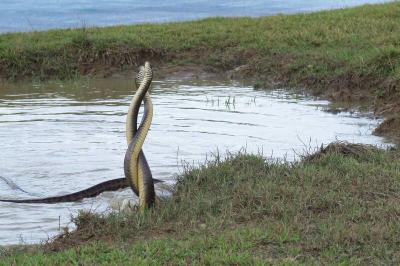
Kenting National Park service technician Yang Jien-fon (楊政峰) won a silver award in World Grand Prix Photography Awards Spring Season for his photograph of two male rat snakes intertwined in combat. Yang’s colleagues at Kenting National Park said he is a master of nature photography who has been held back by his job in civil service. The awards accept entries in all four seasons across six categories: architectural and urban photography, black-and-white and fine art photography, commercial and fashion photography, documentary and people photography, nature and experimental photography, and mobile photography. Awards are ranked according to scores and divided into platinum, gold and

More than half of the bamboo vipers captured in Tainan in the past few years were found in the city’s Sinhua District (新化), while other districts had smaller catches or none at all. Every year, Tainan captures about 6,000 snakes which have made their way into people’s homes. Of the six major venomous snakes in Taiwan, the cobra, the many-banded krait, the brown-spotted pit viper and the bamboo viper are the most frequently captured. The high concentration of bamboo vipers captured in Sinhua District is puzzling. Tainan Agriculture Bureau Forestry and Nature Conservation Division head Chu Chien-ming (朱健明) earlier this week said that the
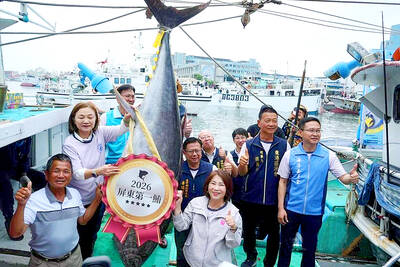
The first bluefin tuna of the season, brought to shore in Pingtung County and weighing 190kg, was yesterday auctioned for NT$10,600 (US$333.5) per kilogram, setting a record high for the local market. The auction was held at the fish market in Donggang Fishing Harbor, where the Siaoliouciou Island-registered fishing vessel Fu Yu Ching No. 2 delivered the “Pingtung First Tuna” it had caught for bidding. Bidding was intense, and the tuna was ultimately jointly purchased by a local restaurant and a local company for NT$10,600 per kilogram — NT$300 ,more than last year — for a total of NT$2.014 million. The 67-year-old skipper
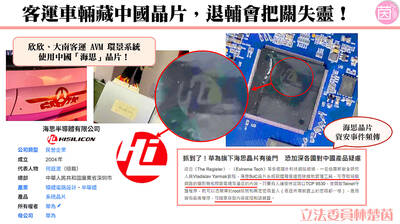
BREACH OF CONTRACT: The bus operators would seek compensation and have demanded that the manufacturer replace the chips with ones that meet regulations Two bus operators found to be using buses with China-made chips are to demand that the original manufacturers replace the systems and provide compensation for breach of contract, the Veterans Affairs Council said yesterday. Democratic Progressive Party Legislator Michelle Lin (林楚茵) yesterday said that Da Nan Bus Co and Shin-Shin Bus Co Ltd have fielded a total of 82 buses that are using Chinese chips. The bus models were made by Tron-E, while the systems provider was CYE Electronics, Lin said. Lin alleged that the buses were using chips manufactured by Huawei subsidiary HiSilicon Co, which presents a national security risk if the


 RSS
RSS