


Spring is the time for tea connoisseurs to gather in Pinglin (
Between the qing-ming and gu-yu periods on the Chinese agriculture calendar, abundant rain falls in the hills of Pinglin, which are decorated with blossoms of all kinds at this time of year.
To further facilitate "tea tourism" in Taipei County, where Pinglin is located, the county government established the Taiwan Museum of Tea several years ago, the first in this country and the largest of its kind in Asia.
Before knowing anything about the spring tea from Pinglin, one must learn something about the evolutionary history of Taiwan's tea growing industry.
According to archives of the tea museum, the Chinese people have a long history of drinking tea. Ever since Lu Yu (陸羽) wrote the first definitive book on the subject, the Chajing (茶經, Tea Classic) 1,200 years ago, tea has been an indispensable drink.
Current annual global tea production is more than 250 tonnes a year, 90 percent of which is fully fermented black tea, 8 percent non-fermented green tea and the remaining 2 percent semi-fermented tea, so-called Oolong tea.
The major locations of tea production are concentrated in Fujian and Guangdong provinces in China and in Taiwan, with Taiwan alone accounting for more than 50 percent of global production.
Taiwan, with its rich natural resources, has more than 20,000 hectares of tea plantations in both flatlands and high-altitude areas.
Each tea has its own distinctive aroma and taste.
The more prominent places of production and their representative tea types include baozhong tea (包種茶), its representative product is wenshan baozhong tea (文山包種茶) from Taipei County's Pinglin township, and Oolong tea (烏龍茶), represented by Pomfong or Eastern Beauty (東方美人茶), produced mostly in Hsinchu and Miaoli.
According to the tea museum, the first tea seedlings were brought by a Chinese tea farmer from Fujian province's Mount Wuyi (
Around 1860, after the corrupt and increasingly weakened Qing dynasty signed the Tianjin Treaty passively with European and American powers -- whose missionaries, navigators and traders found China an untapped new world of wealth and opportunities -- major Chinese ports, including the one in northern Taiwan, the Tamshui port, were forced to be opened to foreign venturers.
Pinglin township was chosen this year as the venue of the annual Taiwan Tea Festival, one of the 12 major folk festivals in Taiwan hosted jointly by local governments and the Tourism Bureau.
The 2003 Taiwan Tea Festival kicked off April 11 in Pinglin, and showcases not just the extravagance of Taiwanese tea culture, but also the tea culture from China, including a nostalgic tea dance derived from central China in the Ming dynasty.
At the festival, which will run until April 20, other flagship teas from other areas around Taiwan, known as Taiwan's 10 major tea species, are also on display and available for purchase. In addition to the Wenshan Paochong tea and Oolong tea, other major species also include Dongding Oolong (凍頂烏龍) tea from Nantou, the Sun Moon Lake black tea from central Taiwan, "Dewdrops" tea from Mount Ali in south-central Taiwan and Harbor tea from Tungkang in the southernmost county of Pingtung.
For those visitors to the tea festival who are not overly fond of tea, like children, the hosts have prepared a great variety of foods, snacks, deserts and sweets made from tea, ranging from tea-flavored boxed lunches, green tea cakes to tea eggs and tea-flavored candies.
Tea and tea products are not the only attractions for visitors in Pinglin. As a matter of fact, the small hilly township is an ancient town with rich deposits of cultural and scenic beauty.
Holiday-makers also go to Pinglin to fish, camp and go hiking because of its scenic rivers and ponds, hills and forests.

NATIONAL SECURITY: Authorities are working to confirm the identities of the military personnel involved and investigating possible illegal conduct and regulatory violations Authorities are probing possible national security implications after Kinmen police and immigration officers on Sunday found a Chinese woman allegedly posing as a tourist while engaging in prostitution involving more than 10 military personnel. The woman, surnamed Chen (陳), has since been deported, authorities said, adding that investigators are still working to confirm the identities of those implicated, as the records only listed code names and aliases. The case stemmed from a report received by the Kinmen District Prosecutors’ Office on Friday last week from the Jinhu Precinct of the Kinmen County Police Bureau. On Sunday, police, along with the National Immigration

GLOBALGIVING: ‘ Caving to external pressure is not acceptable for an organization that has cultivated justice reform and human rights for 30 years,’ one NGO said A slew of non-government organizations (NGOs) have withdrawn from the GlobalGiving fundraising platform after it announced it would use “Chinese Taipei” instead of “Taiwan” from next month. The Taiwan Good Rice Association wrote on Facebook on Friday that it was informed on April 28 via a teleconference call of the change, which was made because the platform wanted to operate in China. Taiwan Good Rice is to terminate all cooperative relationships with GlobalGiving in response to the platform’s “unilateral and non-negotiable” decision to remove references to Taiwan, the NGO said. “Taiwan is in the official name of Taiwan Good Rice Association and the

HEAVY WEATHER: Typhoon Jangmi is due to crash straight into the Ryukyus as airlines look to shift flights to larger aircraft or cancel flights to Okinawa entirely Taiwan’s international air carriers announced flight adjustments over the weekend as Typhoon Jangmi is forecast to hit the Ryukyu Islands today and tomorrow. The Central Weather Administration (CWA) upgraded Jangmi from a tropical storm to a typhoon at 8am yesterday, with the eye located 580km south of Naha city. It was moving north at 19kph. Today, China Airlines’ CI-120, CI-121, CI-122 and CI-123 flights between Taoyuan and Naha, Okinawa, have been canceled as well as CI-132 and CI-133 between Kaohsiung and Naha. EVA Air’s BR-112, BR-113, BR-186 and BR-185 flights between Taoyuan and Naha are also canceled. Low-cost carrier Tigerair Taiwan canceled IT-230,
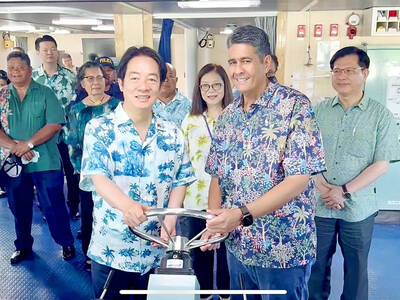
MULTIPRONGED APPROACH: China has sought to pressure Palau across a number of fronts, but the island nation has staunchly resisted overtures to ditch Taiwan Palau has been firm in backing Taiwan despite Chinese pressure that uses tourism economics, cyberattacks and criminal infiltration as tools to threaten the Pacific ally into renouncing its recognition of Taiwan as a sovereign state. The Presidential Office yesterday announced that Vice President Hsiao Bi-khim (蕭美琴) would visit Palau from Saturday to Wednesday next week at the invitation of Palauan President Surangel Whipps Jr. Whipps in April said in an interview that China had outspokenly asked Palau to “denounce Taiwan.” “And we have said: ‘We have no enemies, but nobody tells us who our friends are,’” he said. Whipps has told reporters multiple times


 RSS
RSS