


Primary school kids are using unwieldy Mandarin phonetics in their English-language textbooks after the Ministry of Education ruled out teaching young pupils KK (Kenyon & Knott) symbols, a lawmaker claimed yesterday.
At a press conference, PFP Legislator Sun Ta-chien (
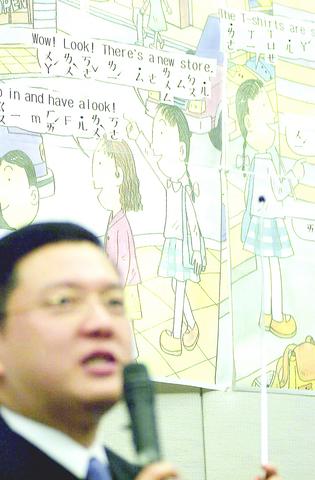
PHOTO: SEAN CHAO, TAIPEI TIMES
With natural phonetics, students learn English through listening to and speaking the language rather than through memorization and using KK phonetic symbols to pronounce English words.
Sun said that the pupils, unable to memorize pronunciation without the help of KK symbols, marked Bopomofo characters under almost every English word in the textbook.
In one example, the pupil jotted down eight Bopomofo characters and two English letters under the English phrase, "Let's go in and have a look."
Taken phonetically, the sentence read: "Lai Tzu Kou m Hai F Erl Lu Ko" -- far from the correct pronunciation of the sentence, Sun said.
"This is only one example in this pupil's English textbook. Examples like this fill the whole book. The student even reads `and' as `m,'" Sun said.
Pointing at other examples in the book, Sun said, "The way this kid assembles Bopomofo symbols to show English pronunciations is really beyond my imagination."
"The pupil is very inventive. But the reason he has resorted to this method is because he has never been taught KK phonetic symbols," Sun said.
"Without other means to help him pronounce English, he can only use this method," he said.
The ministry decided to adopt natural phonetics in primary schools because it considers KK phonetic symbols too difficult for fifth and sixth-graders to grasp.
Sun said that he is very concerned about the future of the nation's English education because more and more primary school students are learning English using Bopomofo.
"The natural phonetics approach is only effective in English-speaking countries. In those countries, students speak correct English without learning KK phonetic symbols because they practice the language in their daily lives," Sun said.
"But Taiwan is not an English-speaking country. Students forget the pronunciations after classes. Why should we copy the teaching methods of English-speaking countries? It is simply unrealistic," Sun said.
Arjay Lin (
"I try very hard to ask my pupils to read aloud after me in every class. We only have one hour for English every week. As we don't teach KK phonetic symbols, most students forget the pronunciations after class," he said.
Deniro Lin (
According to Deniro Lin, the English proficiency of his first-grade students has polarized.
Those who can afford to attend private language schools find KK phonetic symbols boring, whereas students who have never learned the symbols hardly know how to pronounce English, Deniro Lin said.
Meanwhile, Chen Ming-yin (
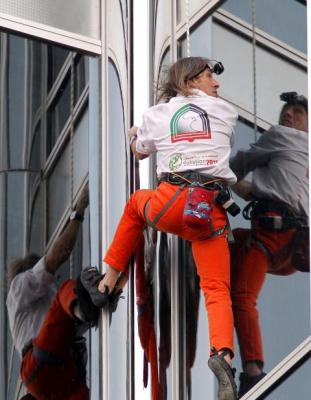
Alain Robert, known as the "French Spider-Man," praised Alex Honnold as exceptionally well-prepared after the US climber completed a free solo ascent of Taipei 101 yesterday. Robert said Honnold's ascent of the 508m-tall skyscraper in just more than one-and-a-half hours without using safety ropes or equipment was a remarkable achievement. "This is my life," he said in an interview conducted in French, adding that he liked the feeling of being "on the edge of danger." The 63-year-old Frenchman climbed Taipei 101 using ropes in December 2004, taking about four hours to reach the top. On a one-to-10 scale of difficulty, Robert said Taipei 101
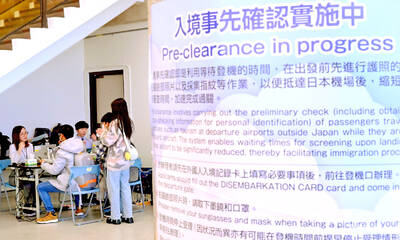
A preclearance service to facilitate entry for people traveling to select airports in Japan would be available from Thursday next week to Feb. 25 at Taiwan Taoyuan International Airport, Taoyuan International Airport Corp (TIAC) said on Tuesday. The service was first made available to Taiwanese travelers throughout the winter vacation of 2024 and during the Lunar New Year holiday. In addition to flights to the Japanese cities of Hakodate, Asahikawa, Akita, Sendai, Niigata, Okayama, Takamatsu, Kumamoto and Kagoshima, the service would be available to travelers to Kobe and Oita. The service can be accessed by passengers of 15 flight routes operated by
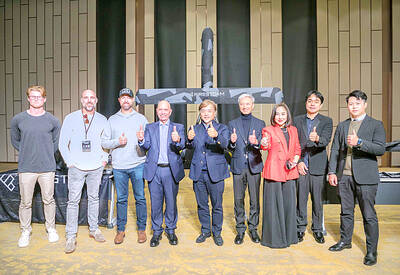
Taiwanese and US defense groups are collaborating to introduce deployable, semi-autonomous manufacturing systems for drones and components in a boost to the nation’s supply chain resilience. Taiwan’s G-Tech Optroelectronics Corp subsidiary GTOC and the US’ Aerkomm Inc on Friday announced an agreement with fellow US-based Firestorm Lab to adopt the latter’s xCell, a technology featuring 3D printers fitted in 6.1m container units. The systems enable aerial platforms and parts to be produced in high volumes from dispersed nodes capable of rapid redeployment, to minimize the risk of enemy strikes and to meet field requirements, they said. Firestorm chief technology officer Ian Muceus said
MORE FALL: An investigation into one of Xi’s key cronies, part of a broader ‘anti-corruption’ drive, indicates that he might have a deep distrust in the military, an expert said China’s latest military purge underscores systemic risks in its shift from collective leadership to sole rule under Chinese President Xi Jinping (習近平), and could disrupt its chain of command and military capabilities, a national security official said yesterday. If decisionmaking within the Chinese Communist Party has become “irrational” under one-man rule, the Taiwan Strait and the regional situation must be approached with extreme caution, given unforeseen risks, they added. The anonymous official made the remarks as China’s Central Military Commission Vice Chairman Zhang Youxia (張又俠) and Joint Staff Department Chief of Staff Liu Zhenli (劉振立) were reportedly being investigated for suspected “serious


 RSS
RSS