


Matsu, once a nightmare assignment for military conscripts, may soon become a tourist haven even though it lacks a key necessity of everyday life in Taiwan -- a chain convenience store.
No longer dominated by the stringent wartime atmosphere that prevailed even after the end of martial law and the withdrawal of most troops from the islands in 1992, Matsu is hoping to spark an economic revival through tourism.
The central government has long been accused of ignoring Matsu's development. Those complaints escalated after two fatal air crashes at the Peikan Airport, one in 1996 and the other in 1997.
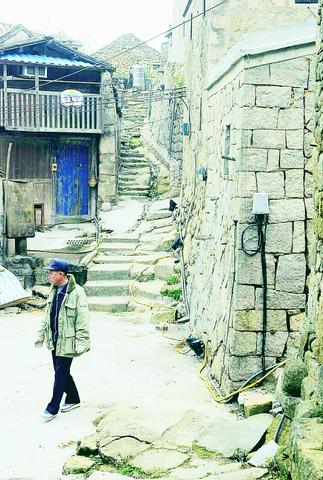
PHOTO: SEAN CHAO, TAIPEI TIMES
The seaside airport had long been considered one of the country worst-designed airports. Mountains encircled it on three sides and two mountains narrowly flanked the lone runway. Both crashes occurred because the planes bumped into a mountain during taking off.
However, not only do the offending mountains no longer exist, there is now a second airport.
As part of the government's bid to boost tourism, the mountains were removed and a new runway was built at the Peikan Airport.
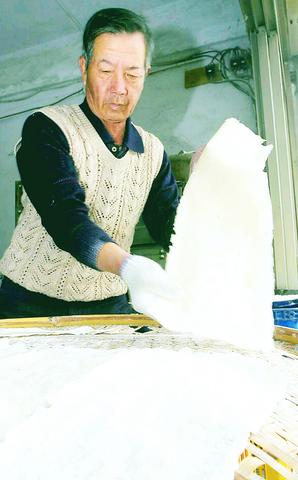
PHOTO: SEAN CHAO, TAIPEI TIMES
A second airport -- the Nankan Airport -- was opened this week and Premier Yu Shyi-kun has said the revamped facility is a sign of the government's efforts to improve the lives of Matsu's residents.
Both the government and travel agencies say the new airport on Matsu's largest island will help open a new chapter of economic development.
The islands that make up Matsu are scattered around the mouth of China's Min River. There are four main islands -- Nankan, Peikan, Tungyin and Chukuang.
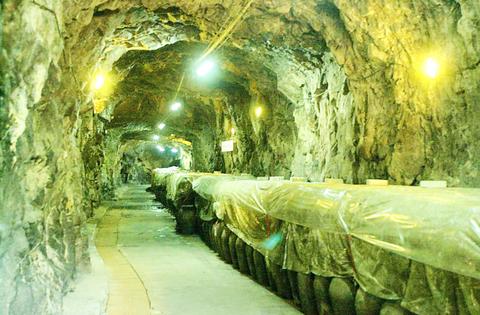
PHOTO: SEAN CHAO, TAIPEI TIMES
Matsu and Kinmen are Taiwan's closest points to China. Martial law remained in force in both areas for 43 years, which also helped ensure that both were estranged from the main island of Taiwan.
However, that isolation also helped Matsu preserve many of its unique features -- its architecture, traditional cuisine, ecological sites and natural landscape.
Matsu is governed by the Liengjiang County Government of Fujian Province -- Taiwan's Fujian of course, not China's.
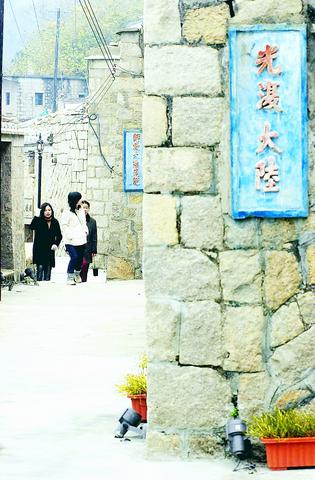
PHOTO: SEAN CHAO, TAIPEI TIMES
The dialect spoken by its people is closer to the dialects to be heard in Fujian in China and are nearly incomprehensible to other Taiwanese.
That linguistic link helps now that Matsu residents can travel directly to China. Following the implementation of the small three links, it only takes about 20 minutes to travel by boat to China. Matsu now imports 80 percent of its vegetables, fruits and groceries from China.
"The bond between residents in Matsu and Fujian [Province] is strong because many of them are relatives," said army Colonel Chen Chang-hua (
"As many people in Matsu and Fujian are relatives, they are able to settle many matters which the government regards as tricky to handle," Chen said.
"There is no hostility between Matsu and China at all," he said.
According to Chen, one of the differences between Kinmen and Matsu is that most of the islands in Kinmen are flat, whereas most of Matsu is mountainous.
He said Matsu's mountainous terrain offer many advantages in defending the islands from a Chinese invasion.
But all those mountains make for some very curvy roads and Matsu's frontline position has forced authorities to adopt an unusual road-building technique.
"There are no straight roads in Matsu at all," a taxi driver said.
"All roads in Matsu are paved with cement," he said. "We cannot pave our roads with asphalt because asphalt roads will burn up if hit by Chinese bombs."
Matsu's mountains also make communication between villages difficult. These has led to people in different villages speaking with different accents.
"I can distinguish which villages people are from simply by their accents," one resident said.
In both Nankan and Peikan, stone houses are built along the mountain slopes. Most of the stone houses are one-story constructions. Residents piled up pieces of granite to serve as walls and sealed the cracks between the stones with cement. The roofs are either wooden or made of tiles.
These stone houses are considered part of Matsu's cultural heritage and the local government is dedicated to preserving them.
The authorities have added a few modern conveniences and turned some of the houses into hotels, restaurants and bars. While tourists enjoy the facilities in these updated buildings, the ancient walls, roofs and yellow bulbs reveal their age.
"I came here [Matsu] four years ago to join the government's project to salvage these stone houses," said Rain Lu (呂致緯), a cultural worker born on Taiwan.
"Working and living here is like a dream. But the dream will end soon because I will be moving back to Taiwan," Lu said.
Lu thinks that Kinmen has become too commercialized since it was opened to outsiders in 1992 and so Matsu must consider how to preserve its traditional features to avoid the same fate.
"While the local government seeks to boost tourism here by promoting the islands' traditional features, it also needs to consider how to strike a balance between commercialization and the preservation of the tradition," Lu said.
One tradition officials seek to preserve is Matsu's history as a frontline fortress.
According to Wang Hua-ti, chairman of the Matsu Art and Cul-ture Association, a Peikan stone house that belonged to a pirate chief around 60 years ago has been transformed to house an exhibition on the battles and rivalry between Taiwan and China.
Traces of a wartime mentality are still prevalent. Patriotic slogans are inscribed on many walls.
"You can perceive the changes in relations between Taiwan and China by the changes in tone in the slogans," Wang said.
According to Wang, the slogans inscribed during the 1960s are more belligerent than those produced after the 1990s.
The local government is promoting a variety of seaside tunnels, iron forts and old cannons as prime tourist attractions, along with the many caves that were once used to store ammunition.
Some of those caves are now used to store the liquor and wines for which Matsu is famous and which are often featured in its traditional cuisine.
Surrounded by the sea, Matsu's cuisine is centered on seafood.
Some of the most popular dishes are fried crocodile-snake eel, parboiled jellyfish, steamed yellow croaker with old wine, radish with seaweed pancake and Jiguang cake. But the three most famous dishes are fish noodles, Matsu pastry and hibiscus pastry.
For nature lovers, Matsu offers several attractions. Tungyin Island is the only place in Taiwan where black tail gulls can be seen. There are also spectacular landscapes created through centuries of erosion caused by wind and waves.
Matsu authorities are confident their islands have a lot to offer visitors -- even if there isn't a 7-Eleven or Family Mart in sight.

REASONS FOR TRAVEL: An assistant professor said that proposed amendments to penalize drivers if they used drugs overseas would not deter people from traveling People who operate a motor vehicle under the influence of marijuana would have their driver’s license revoked, even if they used the substance while overseas, the Ministry of Transportation and Communications said yesterday, citing proposed amendments to the Road Traffic Management and Penalty Act (道路交通管理處罰條例). The amendments would also authorize the government to revoke the licenses of people determined to have used Category 1 or Category 2 narcotics, even if they were not operating a vehicle while under the influence of drugs, as well as ban them from taking the license test for three years, the ministry said. People aged 18 or

GLOBALGIVING: ‘ Caving to external pressure is not acceptable for an organization that has cultivated justice reform and human rights for 30 years,’ one NGO said A slew of non-government organizations (NGOs) have withdrawn from the GlobalGiving fundraising platform after it announced it would use “Chinese Taipei” instead of “Taiwan” from next month. The Taiwan Good Rice Association wrote on Facebook on Friday that it was informed on April 28 via a teleconference call of the change, which was made because the platform wanted to operate in China. Taiwan Good Rice is to terminate all cooperative relationships with GlobalGiving in response to the platform’s “unilateral and non-negotiable” decision to remove references to Taiwan, the NGO said. “Taiwan is in the official name of Taiwan Good Rice Association and the

HEAVY WEATHER: Typhoon Jangmi is due to crash straight into the Ryukyus as airlines look to shift flights to larger aircraft or cancel flights to Okinawa entirely Taiwan’s international air carriers announced flight adjustments over the weekend as Typhoon Jangmi is forecast to hit the Ryukyu Islands today and tomorrow. The Central Weather Administration (CWA) upgraded Jangmi from a tropical storm to a typhoon at 8am yesterday, with the eye located 580km south of Naha city. It was moving north at 19kph. Today, China Airlines’ CI-120, CI-121, CI-122 and CI-123 flights between Taoyuan and Naha, Okinawa, have been canceled as well as CI-132 and CI-133 between Kaohsiung and Naha. EVA Air’s BR-112, BR-113, BR-186 and BR-185 flights between Taoyuan and Naha are also canceled. Low-cost carrier Tigerair Taiwan canceled IT-230,
MULTIPRONGED APPROACH: China has sought to pressure Palau across a number of fronts, but the island nation has staunchly resisted overtures to ditch Taiwan Palau has been firm in backing Taiwan despite Chinese pressure that uses tourism economics, cyberattacks and criminal infiltration as tools to threaten the Pacific ally into renouncing its recognition of Taiwan as a sovereign state. The Presidential Office yesterday announced that Vice President Hsiao Bi-khim (蕭美琴) would visit Palau from Saturday to Wednesday next week at the invitation of Palauan President Surangel Whipps Jr. Whipps in April said in an interview that China had outspokenly asked Palau to “denounce Taiwan.” “And we have said: ‘We have no enemies, but nobody tells us who our friends are,’” he said. Whipps has told reporters multiple times


 RSS
RSS