


Speaking in Taipei yesterday, two Japanese opposition lawmakers joined in the chorus calling for Taiwan's Legislative Yuan to pass a resolution in support of a bill that would require the Japanese government to apologize to and compensate former "comfort women."
"We believe it would be helpful to our push for such a bill if we could get a resolution in Taiwan's legislature to support our move," said Tomiko Okazaki, a lawmaker and member of Japan's Democratic Party.
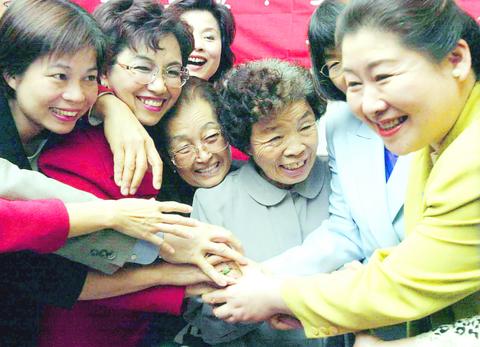
PHOTO: CHIANG YING-YING, TAIPEI TIMES
The term "comfort women" refers to the more than 200,000 women from Taiwan, China, South Korea, North Korea, the Philippines and Indonesia who were forced to serve as sex slaves for the Imperial Japanese Army before and during World War II.
Okazaki made the remarks at a press conference held by KMT Legislator Chiang Yi-wen (
Both these female members of the Diet were present at the press conference at the invitation of Chiang. The decleration of support is intended to influence the Japanese Diet as it gets ready to vote on new bills surrounding the issue of comfort women.
Two former Taiwanese comfort women, in their 70s and 80s, were also present at the press conference.
"We are encouraged by the fact that there are people, both in Taiwan and Japan, who care about us," said Chen Tao (
Okazaki added that she hoped the resolution would be passed by the Legislative Yuan before a special session of the Japanese Diet is called on Oct.18.
According to Chiang, the Japanese government has so far refused to give official compensation to former wartime sex slaves, saying obligations related to wartime atrocities were settled under the 1951 San Francisco Peace Treaty.
But a private Asian Women's Fund was set up in June 1995, funded by private contributions from the Japanese people, to offer each surviving comfort woman ?2 million (about US$17,000) in compensation.
"However, since the fund was liquidated on May 1 this year, the only way to solve the comfort-women issue now is through legislation," said Chiang, adding that most of the surviving women, including those from Taiwan, had turned down the compensation offer because the money came from private donations rather than the Japanese government.
Chiang said that the Tokyo District Court is expected to rule on Oct. 15 on a lawsuit that was filed by nine former comfort women from Taiwan in July, 1999. The suit was filed against the Japanese government and asks for a formal apology and compensation of ?10 million (about US$85,000) each.
"Judging from other cases that had been filed by former comfort women from other countries, we are not optimistic that the court will rule in favor of the comfort women," said Chiang.
Taiwan currently has 37 registered former comfort women.
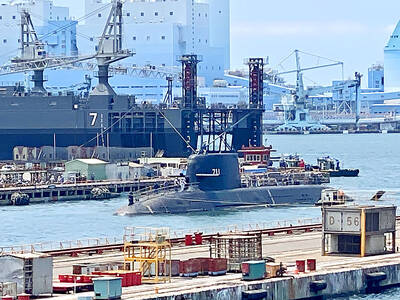
AGING: While Japan has 22 submarines, Taiwan only operates four, two of which were commissioned by the US in 1945 and 1946, and transferred to Taiwan in 1973 Taiwan would need at least 12 submarines to reach modern fleet capabilities, CSBC Corp, Taiwan chairman Chen Cheng-hung (陳政宏) said in an interview broadcast on Friday, citing a US assessment. CSBC is testing the nation’s first indigenous defense submarine, the Hai Kun (海鯤, Narwhal), which is scheduled to be delivered to the navy next month or in July. The Hai Kun has completed torpedo-firing tests and is scheduled to undergo overnight sea trials, Chen said on an SET TV military affairs program. Taiwan would require at least 12 submarines to establish a modern submarine force after assessing the nation’s operational environment and defense

A white king snake that frightened passengers and caused a stir on a Taipei MRT train on Friday evening has been claimed by its owner, who would be fined, Taipei Rapid Transit Corp (TRTC) said yesterday. A person on Threads posted that he thought he was lucky to find an empty row of seats on Friday after boarding a train on the Bannan (Blue) Line, only to spot a white snake with black stripes after sitting down. Startled, he jumped up, he wrote, describing the encounter as “terrifying.” “Taipei’s rat control plan: Release snakes on the metro,” one person wrote in reply, referring
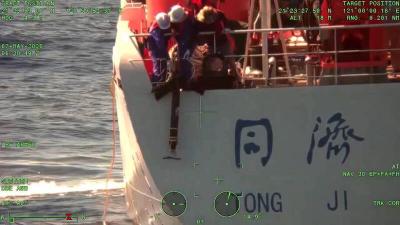
The coast guard today said that it had disrupted "illegal" operations by a Chinese research ship in waters close to the nation and driven it away, part of what Taipei sees a provocative pattern of China's stepped up maritime activities. The coast guard said that it on Thursday last week detected the Chinese ship Tongji (同濟號), which was commissioned only last year, 29 nautical miles (54km) southeast of the southern tip of Taiwan, although just outside restricted waters. The ship was observed lowering ropes into the water, suspected to be the deployment of scientific instruments for "illegal" survey operations, and the coast
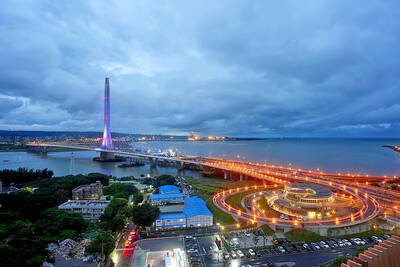
An inauguration ceremony was held yesterday for the Danjiang Bridge, the world’s longest single-mast asymmetric cable-stayed bridge, ahead of its official opening to traffic on Tuesday, marking a major milestone after nearly three decades of planning and construction. At the ceremony in New Taipei City attended by President William Lai (賴清德), Premier Cho Jung-tai (卓榮泰), Minister of Transportation and Communications Chen Shih-kai (陳世凱) and New Taipei City Mayor Hou Yu-ih (侯友宜), the bridge was hailed as both an engineering landmark and a long-awaited regional transport link connecting Tamsui (淡水) and Bali (八里)


 RSS
RSS