


Despite meting out punishments to criminals for 14 years, Judge Lin Hui-huang (
The 43-year-old judge made headlines last week after riling some of his peers by handing down a judgment written in literary language filled with compassion for the defendant.
"Whereas most judges choose to conceal their emotions in their written verdict as if they are afraid to reveal their real thoughts, I simply want to be true to my personal feelings. I write what's in my mind," Lin said.
"So long as the verdict is reached though comprehensive legal debate, I don't consider it improper to write the verdict with emotion, because judges are not God, they are ordinary people made of flesh and blood."
On July 19, the Yunlin District Court judge fined Liu Teng-ho (
In the judgment, Lin wrote: "I looked at the defendant with compassion. I know for him to survive in society, he needs to try harder and struggle much more than we do.
"I am convinced that without this extreme pressure, he would choose to go on with his life with pride. May God have mercy on the humble, so as to allow them to survive on this earth. May the prosecutor have a kind heart to feel for the small and insignificant individual."
In his judgment, Lin detailed the process by which Liu answered questions in court.
"He had a serious stutter and could hardly utter a word. Instead of asking him to speak, I suggested he write down his explanations," Lin wrote of Liu, who was jailed for 21 months in January 1998 for theft.
"[Liu] wrote: `After I came out of jail, I left those bad friends. My stammer has made it very difficult for me to find a job, but I was determined not to be a thief. To make a living, I decided to collect scrap iron and waste paper to sell,'" Lin wrote.
Lin said in the verdict he sympathized with Liu, who he said had to support a wife -- who is also mentally disabled -- and a daughter by selling useless materials.
While critics say Lin's judgment included excessive emotional depictions, which violated what they regarded as a legal principle that every word used in a judgment should pertain to the case, Lin thought differently.
"Most judges write their verdict in conventionally stiff language, which is often incomprehensible to the public," Lin said. "But I prefer to express myself in a more understandable style because I seek to alter the general conception that judges are emotionless or intimidating. They should be as friendly as neighbors."
But those close to Lin believe his humane approach was more associated with his background.
"[Lin] feels for the under-privileged because he comes from that level of society," said Lin Shih-chi (
The judge grew up in a poor family in Yunlin County -- one of the nation's least-developed areas.
His father died when Lin was young, leaving his mother to raise him and two other children on money she earned as a cleaning lady and doing odd jobs.
He initially studied teaching at National Taichung Teachers' College where the tuition was free.
It was not until he sought guidance from his uncle -- who was a lawyer at the time -- that he embarked on his legal career.
His uncle took him under his wing, not only acting as Lin's academic guide but also providing free board to Lin for several years.
Lin graduated from the law department of National Taiwan University, and then passed the national examination for judges in 1986. Two years later, after completing his training at the Judges and Prosecutors Training Institute, Lin finally became a judge.
He served in several district courts in central Taiwan before requesting a transfer to his home county to be close to his mother and to help those in the village where he grew up.
Judicial Yuan President Weng Yueh-sheng (翁岳生), Lin's teacher at university, said that as well as establishing a reputation as a diligent and honest judge, Lin had also contributed a great deal to legal reform.
Dubbed "the Red Guard in the judiciary," a group of reform-minded judges of which Lin is a part have sought to make the judiciary more efficient, improve the quality of judgments and bolster the credibility of judges.
Lin has turned down several times the chance to be a presiding judge, which largely involves administrative affairs, saying "his passion still lies in lawsuits."
The judge has tried to keep out of the media's spotlight since his unconventional verdict caught the public's attention.
"I don't want to become a newsmaker, because judges might loose their credibility if they are tempted by fame or money," said Lin, who declined to have his photograph taken.

US President Donald Trump said "it’s up to" Chinese President Xi Jinping (習近平) what China does on Taiwan, but that he would be "very unhappy" with a change in the "status quo," the New York Times said in an interview published yesterday. Xi "considers it to be a part of China, and that’s up to him what he’s going to be doing," Trump told the newspaper on Wednesday. "But I’ve expressed to him that I would be very unhappy if he did that, and I don’t think he’ll do that," he added. "I hope he doesn’t do that." Trump made the comments in

NOT AN OPENING: Trump’s violation of international law does not affect China’s consideration in attacking Taiwan; Beijing lacks capability, not precedent, an official said Taiwanese officials see the US’ capture of the president of Venezuela as a powerful deterrent to Beijing’s aggression and a timely reminder of the US’ ability to defeat militaries equipped with Chinese-made weapons. The strikes that toppled Venezuelan President Nicolas Maduro signaled to authoritarian leaders, including Chinese President Xi Jinping (習近平), US President Donald Trump’s willingness to use military might for international affairs core to US interests, one senior official in Taipei’s security circle said. That reassured Taiwan, the person said. Taipei has also dismissed the idea that Trump’s apparent violation of international law could embolden Beijing, said the official, who was not
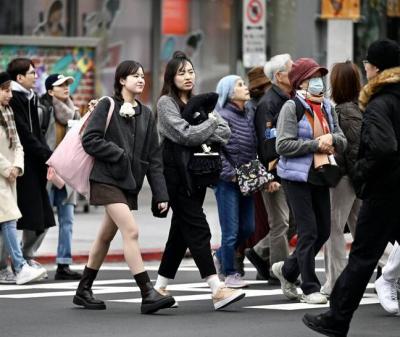
A cold surge advisory was today issued for 18 cities and counties across Taiwan, with temperatures of below 10°C forecast during the day and into tonight, the Central Weather Administration (CWA) said. New Taipei City, Taipei, Taoyuan and Hsinchu, Miaoli and Yilan counties are expected to experience sustained temperatures of 10°C or lower, the CWA said. Temperatures are likely to temporarily drop below 10°C in most other areas, except Taitung, Pingtung, Penghu and Lienchiang (Matsu) counties, CWA data showed. The cold weather is being caused by a strong continental cold air mass, combined with radiative cooling, a process in which heat escapes from

Snow this morning fell on Alishan for the first time in seven years, as a strong continental cold air mass sent temperatures plunging across Taiwan, the Central Weather Administration (CWA) said. The Alishan weather station, located at an elevation of about 2,200m in central Taiwan, recorded snowfall from 8:55am to 9:15am, when the temperature dropped to about 1°C, the CWA said. With increased moisture and low temperatures in the high-altitude Alishan area, the conditions were favorable for snow, CWA forecaster Tsai Yi-chi (蔡伊其) said. The last time snow fell at the Alishan weather station was on Jan. 10, 2018, while graupel fell there


 RSS
RSS