


A major Tibetan Buddhist leader, the Karmapa, is urging China to release the teacher and two personal attendants he left behind in Tibet in 1999, Radio Free Asia (RFA) reported.
"I appeal to the Chinese government and the Tibetan Autonomous Region government that those arrested may be released quickly, and that they may be spared harsh treatment while in prison," the Karmapa told RFA's Tibetan service.
"I am greatly disappointed and also worried," he said. "I escaped to pursue my religious studies, and not to achieve political goals."
The Karmapa's personal attendants, Lama Thupten and Lama Panam, and his teacher, Lama Nyima, have been detained in recent months inside Tibet, according to sources in Tibet and Dharamsala who spoke on condition of anonymity.
Lama Panam was detained in March in Tibet's Kham Prefecture, while Lama Thupten was arrested in January while trying to flee to India, the sources said. Lama Nyima was arrested in June, in Kongpo, they said.
The 17th Karmapa, born Ugyen Trinley Dorje and named head lama of Tsurphu Monastery near Lhasa, was enthroned with Beijing's blessing in 1992, when he was only seven years old.
In a major embarrassment to the Chinese government, he fled Tibet in 1999 and arrived in Dharamsala, India, in January 2000 -- still in his teens.
The Dalai Lama, Tibet's spiritual leader in exile, is "greatly concerned and offered extensive prayers," the Karmapa said.
"Lama Nyima had been my teacher and I am very grateful. Whatever I learned is from his teaching and guidance. Thupten was my cook and he was extremely devoted," he said.
Lama Nyima and Lama Thupten played critical roles in aiding the Karmapa in his escape to India, he said, and they alone knew of his plan in advance. Lama Nyima locked himself in the Karmapa's residence, pretending to be the Karmapa in retreat, while Thupten continued to cook for the Karmapa as if he were still there.
According to one source, Lama Nyima is detained in Kongpo and has staged a hunger strike in prison.
On orders from Mao Zedong, Chinese troops invaded and annexed Tibet in 1950 in what Beijing calls a "peaceful liberation" from feudalism. Chafing under Chinese rule, Tibetans staged an uprising in 1959. When it failed, the Dalai Lama and nearly 100,000 of his followers were forced to flee across the Himalayas to northern India and Nepal.
The Dalai Lama, born Tenzin Gyatso, won the 1989 Nobel Prize for Peace in recognition of his long-running, nonviolent opposition to Chinese rule.
Radio Free Asia (RFA) broadcasts news, information, and cultural programming to Asian listeners who lack regular access to full and balanced reporting in their domestic media.

UPGRADE: The Kang Ding-class frigate is replacing its Chaparall missiles with Tien Chien II and Hua Yang VLS, which would provide it with long-range, 360° air defense Taiwan plans to produce 1,200 to 1,376 Hai Chien II missiles (海劍二, Sea Sword II) — also known as TC-2N — to serve as the standard air defense system of the navy’s surface combatant fleet, a source said yesterday. Last week, the Hai Chien II, the naval version of the Tien Kung II missile (天劍二, Sky Sword II), completed a live-fire test in waters off the National Chungshan Institute of Science and Technology’s Jiupeng facility (九鵬) in Pingtung County’s Manjhou Township (滿州). The MIM72 Chaparral and other dated air defense missiles that currently arm Taiwanese ships have inadequate range to combat Chinese

REASONS FOR TRAVEL: An assistant professor said that proposed amendments to penalize drivers if they used drugs overseas would not deter people from traveling People who operate a motor vehicle under the influence of marijuana would have their driver’s license revoked, even if they used the substance while overseas, the Ministry of Transportation and Communications said yesterday, citing proposed amendments to the Road Traffic Management and Penalty Act (道路交通管理處罰條例). The amendments would also authorize the government to revoke the licenses of people determined to have used Category 1 or Category 2 narcotics, even if they were not operating a vehicle while under the influence of drugs, as well as ban them from taking the license test for three years, the ministry said. People aged 18 or
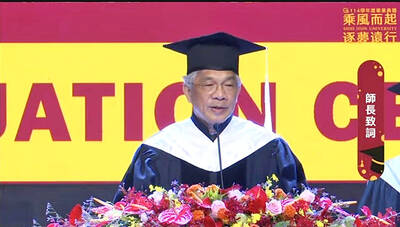
Shih Hsin University President Chen Ching-he (陳清河) yesterday issued a public apology for comments made in his commencement speech last week, stating that he has asked the school to suspend his duties and halt his wages for two months as a show of contrition. At the commencement ceremony on May 30, Chen said, “If you don’t manage your time well, or your own emotions, or your health, then I am telling every one of you — put a quick end to ‘you,’ because the world has no need for ‘you.’” The comments have sparked significant controversy online, and Chen through an open
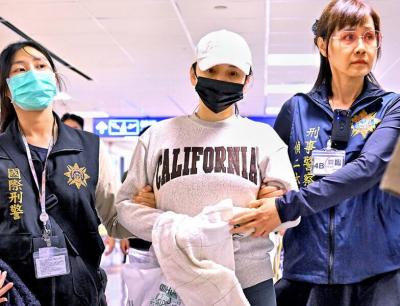
Johanne Liou (劉喬安), a Taiwanese woman who shot to unwanted fame during the Sunflower movement protests in 2014, returned to Taiwan last night after being deported from the US. She is to stand trial in Taiwan for charges involving embezzlement, fraud and drug crimes. The Criminal Investigation Bureau (CIB) said it took her into custody at Taiwan Taoyuan International Airport and would first question her before transferring her to the New Taipei District Prosecutors’ Office. She was arrested upon disembarking a flight from San Francisco that landed shortly before 7pm. Liou absconded to the US in 2019 after jumping bail


 RSS
RSS