


Premier Yu Shyi-kun may sign a free-trade agreement (FTA) with Panama during his 13-day trip to Central America with the hope of strengthening bilateral economic and trade relations with its diplomatic ally, an official at Taiwan's embassy in Panama said yesterday.
"It would be to the advantage of Panama to sign the free-trade accord because it would not only make it easier for Panama to export goods to Taiwan but also attract Taiwanese businesspeople to invest in Panama," said Chen Ming-shih (陳銘師), an economic counselor at Taiwan's embassy in Panama.
Panama would become the first country among Taiwan's Central American and South American allies to sign such a pact in the wake of Taiwan's accession to the WTO on Jan. 1 this year.
Taiwan's ambassador to Panama, David C.Y. Hu (胡正堯), said that the signing of a free-trade pact with Panama would reduce the differences between the two countries' industries.
"Panama's trade superiority lies in financial services, wharf facilities and free-trade zones, while Taiwan's lies in exports of industrial and information-technology products," he said.
That Taiwan and Panama will forge a FTA does not come as a surprise because the two countries have been holding a series of consultations to discuss the matter for the past few months.
The negotiations reached a climax on June 17 when Meliton Arrocha, vice minister of foreign trade in Panama, arrived in Taiwan for a five-day visit to hold talks with officials from the Ministry of Economic Affairs on the possibilities of forging such an accord.
It was the first negotiation on free-trade-zone issues for the two countries since May 1999. Talks were put on hold while Taiwan sought entry into the WTO.
During his visit, Arrocha said that signing a free-trade accord would not only contribute to bettering business and trade between Panama and Taiwan, but would also help reduce Panama's trade deficit with Taiwan.
Taiwan exported US$24.2 million worth of products to Panama last year, while Panama sold some US$11.6 million worth of goods to Taiwan, according to Arrocha.
"The trade imbalance in favor of Taiwan is even larger when trade from the Colon Free Trade Zone are counted," he said.
Taiwan's exports to the Colon Zone exceeded US$500 million last year.
Yu is scheduled to lead a 60-strong delegation -- that will include government officials, business and cultural leaders and the media -- to Haiti, Panama, Costa Rica and Belize between Aug. 5 and Aug. 17.
The delegation will have a two-day stopover in New York en route to Haiti and a one-day stopover in Los Angeles on its return trip.
The journey, which is being billed as culture-oriented, will be Yu's first official visit since he took office on Feb. 1.
It is also part of Taiwan's effort to consolidate relationships with its diplomatic allies, especially following the recent defection of Nauru.
Taiwan terminated its 22-year-old diplomatic ties with Nauru on Wednesday after the tiny South Pacific island state established formal relations with China.
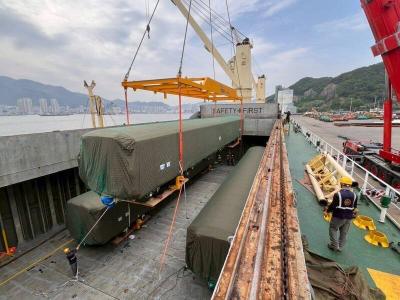
The first of 10 new high-capacity trains purchased from South Korea’s Hyundai Rotem arrived at the Port of Taipei yesterday to meet the demands of an expanding metro network, Taipei Rapid Transit Corp (TRTC) said yesterday. The train completed a three-day, 1,200km voyage from the Port of Masan in South Korea, the company said. Costing NT$590 million (US$18.79 million) each, the new six-carriage trains feature a redesigned interior based on "human-centric" transportation concepts, TRTC said. The design utilizes continuous longitudinal seating to widen the aisles and optimize passenger flow, while also upgrading passenger information displays and driving control systems for a more comfortable
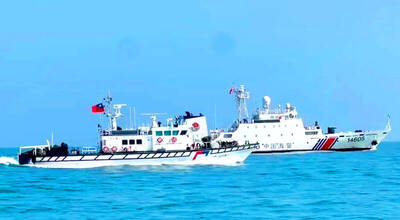
Instead of focusing solely on the threat of a full-scale military invasion, the US and its allies must prepare for a potential Chinese “quarantine” of Taiwan enforced through customs inspections, Stanford University Hoover fellow Eyck Freymann said in a Foreign Affairs article published on Wednesday. China could use various “gray zone” tactics in “reconfiguring the regional and ultimately the global economic order without a war,” said Freymann, who is also a nonresident research fellow at the US Naval War College. China might seize control of Taiwan’s links to the outside world by requiring all flights and ships entering or leaving Taiwan
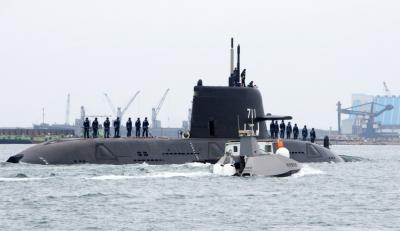
Taiwan's first indigenous defense submarine, the SS-711 Hai Kun (海鯤, or Narwhal), departed for its 13th sea trial at 7am today, marking its seventh submerged test, with delivery to the navy scheduled for July. The outing also marked its first sea deployment since President William Lai (賴清德) boarded the submarine for an inspection on March 19, drawing a crowd of military enthusiasts who gathered to show support. The submarine this morning departed port accompanied by CSBC Corp’s Endeavor Manta (奮進魔鬼魚號) uncrewed surface vessel and a navy M109 assault boat. Amid public interest in key milestones such as torpedo-launching operations and overnight submerged trials,
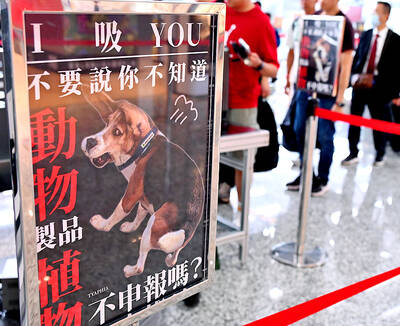
Quarantine awareness posters at Taiwan Taoyuan International Airport have gone viral for their use of wordplay. Issued by the airport branch of the Animal and Plant Health Inspection Agency, the posters feature sniffer dogs making a range of facial expressions, paired with advisory messages built around homophones. “We update the messages for holidays and campaign needs, periodically refreshing materials to attract people’s attention,” quarantine officials said. “The aim is to use the dogs’ appeal to draw focus to quarantine regulations.” A Japanese traveler visiting Taiwan has posted a photo on X of a poster showing a quarantine dog with a


 RSS
RSS