


The 7th annual meeting of the Taiwan Britain Business Council (TBBC) took place in Taipei on 18 and 19 April. This year's event was very upbeat and a record number of attendees participated.
The Taiwanese representation, led once again by Co-Chairman Leslie Koo, comprised of over 80 representatives from three key sectors which were the focus for this year's event: ICT, Biotechnology and Infrastructure. Financial and professional services were also covered.
The UK side, chaired by Martin Barrow, comprised of around 70 representatives from companies and multipliers including: BT, Logica, AEA Technology, Balfour Beatty, Atking Rail, GSK, Rolls Royce, HSBC, Deloitte & Touche to name but a few.
On 18 April representatives from the ICT and Biotech groups followed an organised programme of visits to ITRI. The Infrastructure Group undertook a visit to a high speed rail site where they were appraised of future developments surrounding the various sites. This area was idenified as a good opportunity where Taiwanese and British companies might collaborate in order to develop the existing land around the five high speed rail sites.
At the Plenary itself many topics were discussed including: 3rd country collaboration, intelligent buildings and various opportunities for collaboration in infrastructure and related convergance in ICT.
The Information and Communications Technology (ICT) sub-group yet again lived up to expectation by providing a full and exciting agenda with record breaking attendance focusing on Mobile Broadband, Locations Based Services and Digital Content.
The session included key addresses by Chunghwa Telecom and the Institute for Information Industries (III) on the Taiwanese side and British Telecom, and Xexco for the UK.
Of particular interest were the developments within the European Union for research and development collaboration between European and non-European countries that has paved the way for Taiwanese companies to operate as full partners in European R&D projects.
With the fast pace of developments within the these sectors, there is a recognition that to remain globally competitive companies must collaborate to survive.
The close relationships that have been established between UK and Taiwanese companies over the years, through the continued efforts of the TBBC will ensure the continued success for UK and Taiwanese partnerships well into the future.

FREEDOM OF NAVIGATION: The UK would continue to reinforce ties with Taiwan ‘in a wide range of areas’ as a part of a ‘strong unofficial relationship,’ a paper said The UK plans to conduct more freedom of navigation operations in the Taiwan Strait and the South China Sea, British Secretary of State for Foreign, Commonwealth and Development Affairs David Lammy told the British House of Commons on Tuesday. British Member of Parliament Desmond Swayne said that the Royal Navy’s HMS Spey had passed through the Taiwan Strait “in pursuit of vital international freedom of navigation in the South China Sea.” Swayne asked Lammy whether he agreed that it was “proper and lawful” to do so, and if the UK would continue to carry out similar operations. Lammy replied “yes” to both questions. The

Two US House of Representatives committees yesterday condemned China’s attempt to orchestrate a crash involving Vice President Hsiao Bi-khim’s (蕭美琴) car when she visited the Czech Republic last year as vice president-elect. Czech local media in March last year reported that a Chinese diplomat had run a red light while following Hsiao’s car from the airport, and Czech intelligence last week told local media that Chinese diplomats and agents had also planned to stage a demonstrative car collision. Hsiao on Saturday shared a Reuters news report on the incident through her account on social media platform X and wrote: “I
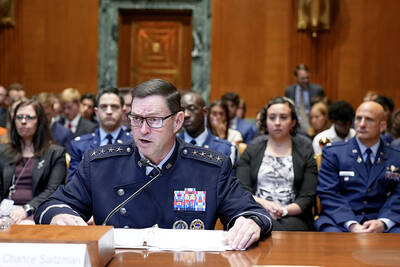
SHIFT PRIORITIES: The US should first help Taiwan respond to actions China is already taking, instead of focusing too heavily on deterring a large-scale invasion, an expert said US Air Force leaders on Thursday voiced concerns about the Chinese People’s Liberation Army’s (PLA) missile capabilities and its development of a “kill web,” and said that the US Department of Defense’s budget request for next year prioritizes bolstering defenses in the Indo-Pacific region due to the increasing threat posed by China. US experts said that a full-scale Chinese invasion of Taiwan is risky and unlikely, with Beijing more likely to pursue coercive tactics such as political warfare or blockades to achieve its goals. Senior air force and US Space Force leaders, including US Secretary of the Air Force Troy Meink and
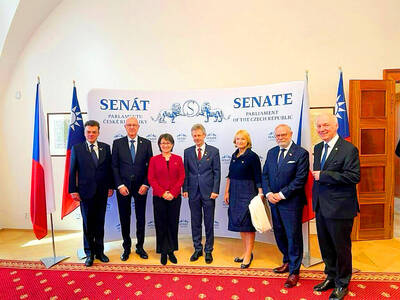
Czech officials have confirmed that Chinese agents surveilled Vice President Hsiao Bi-khim (蕭美琴) during her visit to Prague in March 2024 and planned a collision with her car as part of an “unprecedented” provocation by Beijing in Europe. Czech Military Intelligence learned that their Chinese counterparts attempted to create conditions to carry out a demonstrative incident involving Hsiao, which “did not go beyond the preparation stage,” agency director Petr Bartovsky told Czech Radio in a report yesterday. In addition, a Chinese diplomat ran a red light to maintain surveillance of the Taiwanese


 RSS
RSS