


It gives me great pleasure to extend greetings to the readers of Taipei Times and all of our friends in Taiwan on the Swiss National Day on August 1.
The Swiss declaration of independence, signed and sealed in early August 1291, marked the birth of the Swiss Confederation. A long-standing democratic and federalist tradition, political stability, tolerance of linguistic and cultural minorities, humanitarian commitment, wonderful scenery, chocolate, watches, banks: these are words, even stereotypes, which are often used when the subject of Switzerland is raised abroad. Growing mutual dependence on other countries and the increasing importance of international collaboration in all possible fields in order to fulfill current demands are the today's major political and economical challenges for any country, especially for Switzerland.
Economic and trade ties between Switzerland and Taiwan have witnessed a rapid growth and cultural exchanges between people of both countries have greatly increased over the recent years.
It can be noted that both economies have many similarities in common with regard to the surface (Switzerland 41'284 km2; Taiwan 36'000 km2), arable land (about 75 % of the surface is mountainous in both places) and the lack of raw materials (both have practically no raw material available). In both economies the small and medium-sized companies are the backbone of the industry, which is geared to a high degree of export activities. In international trade both economies have vital interests in WTO matters. The two industries are complementary to each other and therefore are not in any direct competition. Swiss products can benefit from a very favorable image in the Taiwanese market and the product labeling "Made in Switzerland" stands high for quality and reliability in the market.
Trade
The trade and economic relationship between Switzerland and Taiwan have experienced a very promising upswing since the middle of the 1980s. Bilateral trade practically quadrupled within 15 years. In 2002, bilateral trade exceeded US$ 1.1 bio. Total exports from Switzerland amounted to US$ 737 mio. and imports from Taiwan reached US$ 376 mio. In the above figures indirect trade via Hong Kong, which represents an amount of well over US$ 60 mio. is not included. One should also take into consideration that these figures do not reflect the high volume of orders placed by a fast increasing number of Taiwanese entrepreneurs with investments activities abroad such as in mainland China and South-East Asia.
Taiwan is now one of the major commercial partners of Switzerland in Asia, ranking 4th in 2002 after Japan, Hong Kong and mainland China, and also one of its leading Asian suppliers of goods. Conversely, Swiss companies have benefited from the economic success of Taiwan and increasing wealth of the Taiwanese.
For Taiwan, Switzerland is the most important European trading partner outside of the European Union. Per capita, it has one of the highest import share of Taiwanese products. Switzerland may be regarded as a small market in relations to its size of the population, but with regard to its purchasing power it may represent a sizable market for Taiwanese products. With the quality conscious consumers in mind, it may also be used by technology-innovative Taiwanese companies as a test market to introduce new products into the European market.
In the period of the last 20 years, Switzerland has consistently recorded a trade surplus with Taiwan.
Exports from Switzerland
The main areas of competence of Swiss companies are investment goods (machinery, medical and precision products) and consumer products (watches, pharmaceuticals, foods). Switzerland is above all a traditional exporter of machinery and equipment. It is therefore not surprising that industrial products represent over 40 % of Swiss exports to Taiwan. At the beginning of the upswing of trade exchanges, Swiss textile machinery were heavily in demand and accounted for 35 % of the total at its peak. In the meantime, the importance of exports of textile machines has declined and been replaced by other machinery such as machine-tools and production equipment for the semi-conductor and other industries. Swiss technology has been in strong demand to assist in the upgrading of the local industries. Taiwan has become one of the 12 largest export market for Swiss watches (in the high-priced category it ranks even among the top 5). Pharmaceuticals came in second with 31 % and watches third with 16 % of the total.
Imports from Taiwan
Similarly, in the past Taiwan used to ship mainly textile products and small machinery to Switzerland. In the meantime, over two thirds of Taiwanese exports are made of products in the high-tech field, machinery, electronic equipment, and especially computers. Other exports include bicycles, industrial components, plastic and textiles products. As a typical OEM manufacturer, branding of Taiwan-made products is, however, not strongly established in the Swiss market. The Swiss market, with its divers linguistic and cultural background and high purchasing power as well as demanding customers could be ideal for Taiwanese companies as a challenge to be used as a test market for their brands, which are to be launched later in the European market at a larger scale.
Investments
Switzerland is also a leading country in the field of foreign direct investment. The relationship between Switzerland and Taiwan is based not only on trade but also on investment and industrial partnerships. The first Swiss company to set up an office in the services sector was as early as 1949. The largest increase of Swiss investors in Taiwan (some with local partners) occurred during the past 20 years. As of last year, some 100 Swiss companies are present in the market with their own manufacturing plants, subsidiary, branch or representative offices in various sectors of industry and services. Many of them use the island as a platform for their regional operations and activities. Switzerland is the 4th largest European investor in Taiwan providing jobs to thousands of local employees. Relatively few Taiwanese companies are located in Europe and only a handful in Switzerland. They have themselves restricted to sales and marketing. As Taiwanese firms are increasingly internationalized, they will be able to expand their presence in Europe. Switzerland, which is located at the heart of Europe, offers reliable infrastructure and telecommunication networks to serve all European markets and provides one of the best business environment and location. Areas of particular interest could be the set up of sales/marketing offices as European/regional headquarters and/or the development of high-tech products and services by using Switzerland as a base for the European activities.
Tourism
Many Taiwanese tourists have long ago discovered Switzerland as their preferred European destination. Was it not a dream for many Taiwanese to travel once to travel to Switzerland and see it by themselves? It all started in 1987 when travel restrictions for trips abroad were liberalized. Outbound tourism to Switzerland increased tremendously over the past 15 years and peaked with a total of approx. 50'000. "Switzerland Tourism" has continuously been active to promote the Swiss vacation experience in Taiwan, especially for visitors with more individual tastes.
Education
Switzerland has also become a study place for many Taiwanese students. The world famous Swiss hotel management schools, which are active in a niche market, offer attractive programs for Taiwanese students. But, there also a number of excellent boarding schools for the younger students to prepare them for the university entries. Certain emphasis are also placed on technical and postgraduate students to study in one of the 12 Swiss universities, particularly the renowned Technology Institutes of Zurich/Lausanne. Scientific exchanges in selected projects between universities in Switzerland and Taiwan have been going on for many years and will be enhanced in the future.
The Trade Office of Swiss Industries (TOSI), established in 1982, has been engaged in organizing numerous events to promote trade, investment, tourism, education and science exchanges and is committed to further promote economic and trade exchanges between Switzerland and Taiwan. Mr. Jose Feer is the Director of TOSI.
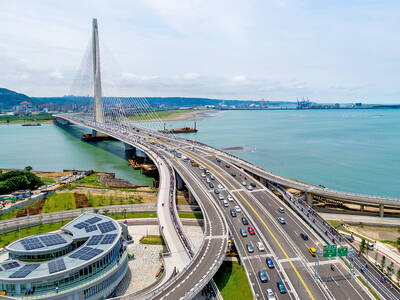
The Ministry of Transportation and Communications yesterday inaugurated the Danjiang Bridge across the Tamsui River in New Taipei City, saying that the structure would be an architectural icon and traffic artery for Taiwan. Feted as a major engineering achievement, the Danjiang Bridge is 920m long, 211m tall at the top of its pylon, and is the longest single-pylon asymmetric cable-stayed bridge in the world, the government’s Web site for the structure said. It was designed by late Iraqi-British architect Zaha Hadid. The structure, with a maximum deck of 70m, accommodates road and light rail traffic, and affords a 200m navigation channel for boats,
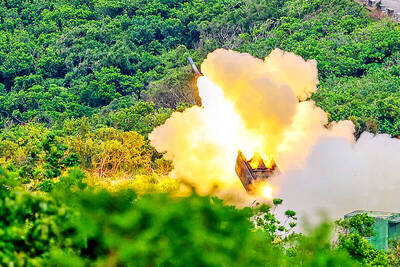
PRECISION STRIKES: The most significant reason to deploy HIMARS to outlying islands is to establish a ‘dead zone’ that the PLA would not dare enter, a source said A High Mobility Artillery Rocket System (HIMARS) would be deployed to Penghu County and Dongyin Island (東引) in Lienchiang County (Matsu) to force the Chinese military to retreat at least 100km from the coastline, a military source said yesterday. Taiwan has been procuring HIMARS and Army Tactical Missile Systems (ATACMS) from the US in batches. Once all batches have been delivered, Taiwan would possess 111 HIMARS units and 504 ATACMS, which have a range of 300km. Considering that “offense is the best defense,” the military plans to forward-deploy the systems to outlying islands such as Penghu and Dongyin so that
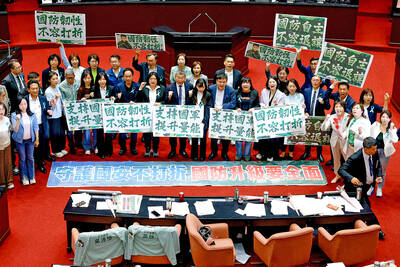
WHAT WAS ALL THAT FOR? Jaw Shaw-kong said that Cheng Li-wen had pushed for more drastic cuts and attacked him, just for the outcome to be nearly identical to his bill The legislature yesterday passed a supplementary budget bill to fund the purchase of separate packages of US military equipment, with the combined amount of spending capped at NT$780 billion (US$24.8 billion). The Chinese Nationalist Party (KMT) and Taiwan People’s Party (TPP) used their legislative majority to pass the bill, which runs until 2033 and has two main funding provisions. One was for NT$300 billion of arms sales already approved by the US for Taiwan on Dec. 17 last year, the other was for NT$480 billion for another arms package expected to be announced by Washington. The bill, which fell short of the NT$1.25
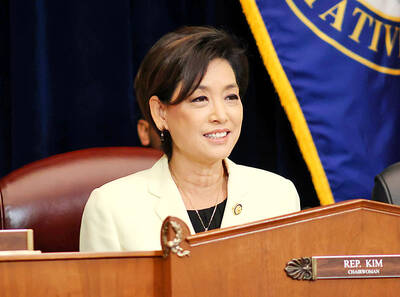
‘CLEAR MESSAGE’: The bill would set up an interagency ‘tiger team’ to review sanctions tools and other economic options to help deter any Chinese aggression toward Taiwan US Representative Young Kim has introduced a bill to deter Chinese aggression against Taiwan, calling for an interagency “tiger team” to preplan coordinated sanctions and economic measures in response to possible Chinese military or political action against Taiwan. “[Chinese President] Xi Jinping [習近平] has directed the People’s Liberation Army to be ready to invade Taiwan by 2027. China has a plan. America should have one too,” Kim said in a news release on Thursday last week. She introduced the “Deter PRC [People’s Republic of China] aggression against Taiwan act” to “ensure the US has a coordinated sanctions strategy ready should


 RSS
RSS