


A new freedom has reached German companies and consumers this summer. The government of Chancellor Gerhard Schroder has revoked Germany's Act of Discounts, ("Rabattgesetzt") which prohibited discounts and rebates for the last 70 years. This legislation was unique among European nations, and its abolition paves the way for better competition and market access for firms of all countries.
The "Reichs Discounts Act" was first enacted in May 1933 by the National Socialists to regulate what the "Reichs" economists called "the unpleasant state of competition."
During the Nazi era German tradesmen were meant to be protected against competition from Jewish business people and therefore, the Act of Discounts made it illegal for a company to reduce the price of a good by more than 3 percent from its initial price.
In the 1950s the Legislature decided not to abolish the law after reaching the conclusion that it contained no inherent National Socialist ideology, despite its original purpose.
From then on small- and middle-sized companies benefited most from these regulations as they protected them against hard-price competition from big retail companies.
As a result, Consumer Councils and big retail companies have been arguing for the law's elimination for decades, but until recently without success. The failure was mainly due to the ability of the smaller and medium-sized companies to effectively lobby German politicians. The most recent example of this coming in 1994.
But today the internet is putting new pressure on the German economy and legislation. The Act's regulations did make sense as long as choice was limited and consumers less sophisticated.
In the time of e-commerce, however, the old laws designed to protect German trade now seemed to create substantial disadvantages for German trade and companies based in Germany.
While German companies respected the Act, foreign companies did not think they were breaking the law by distributing their products by internet under conditions accepted in the rest of Europe. The most famous example is the internet company Letsbuyit.com based in Amsterdam, which operates in 13 European countries. The on-line retailer allows groups of costumers to buy products on its web site in bulk.
Thereby, the charged price for a product decreases as the number of shoppers who enlist to buy that product increases.
One year ago German judges decided that this violates the old German Act of Discount. But there was one problem: Letsbuyit.com did not violate EU Law. The problem of the Act of Discount was thus not only its being outdated, it did not blend with EU's e-commerce directive either, because it lead to unequal treatment of e-business models in different member states.
In a uniting Europe, the EU's e-commerce directive allows e-commerce companies to operate anywhere in the EU according to the laws of the country where they are headquartered.
Germany has still to transfer the directive into German Law but the government's new e-commerce Law is due to be discussed in the so-called "second reading" in the parliament this month.
In the context of the e-commerce directive the Act of Discount had even seemed to become a threat for jobs and taxes in Germany.
German e-tailers that were not allowed to sell discounted products at home could simply move or relocate abroad and carry on as before.
But German Fair Trade Law and Competition Law, which can be compared with Taiwanese Fair Trade Law, still rules fair competition in Germany.
And after all, the 68 year existence of the Act might have bred a culture in Germany where it is considered impolite, or worse uncivilized, to question the price.
That's why German newspapers like the mass-circulated "Bild" has begun to tell German consumers to haggle.
So, let's see if the abolition of Discount Act won't change German shops into a Turkish bazaar -- or even a Taiwanese nightmarket!
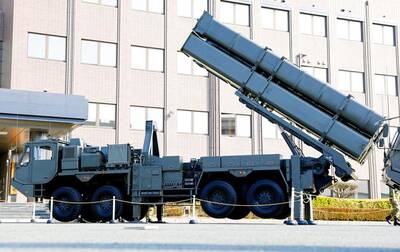
Japan has deployed long-range missiles in a southwestern region near China, the Japanese defense minister said yesterday, at a time when ties with Beijing are at their lowest in recent years. The missiles were installed in Kumamoto in the southern region of Kyushu, as Japan is attempting to shore up its military capacity as China steps up naval activity in the East China Sea. “Standoff defense capabilities enable us to counter the threat of enemy forces attempting to invade our country ... while ensuring the safety of our personnel,” Japanese Minister of Defense Shinjiro Koizumi said. “This is an extremely important initiative for

Chinese Nationalist Party (KMT) Chairwoman Cheng Li-wun (鄭麗文) today accepted an invitation from Chinese President Xi Jinping (習近平) to lead a delegation to China next month, saying she hopes to promote the peaceful development of cross-strait relations and bring stability to the Taiwan Strait. “I am grateful and happy to accept this invitation,” Cheng said in a statement from the KMT chairperson’s office. Cheng said she hopes both sides can work together to promote the peaceful development of cross-strait relations, enhance exchange and cooperation, bring stability to the Taiwan Strait and improve people’s livelihoods. At today's news conference, Cheng said any efforts to

MORE POPULAR: Taiwan Pass sales increased by 59 percent during the first quarter compared with the same period last year, the Tourism Administration said The Tourism Administration yesterday said that it has streamlined the Taiwan Pass, with two versions available for purchase beginning today. The tourism agency has made the pass available to international tourists since 2024, allowing them to access the high-speed rail, Taiwan Railway Corp services, four MRT systems and four Taiwan Tourist Shuttles. Previously, five types of Taiwan Pass were available, but some tourists have said that the offerings were too complicated. The agency said only two types of Taiwan Pass would be available, starting from a three-day pass with the high-speed rail and a three-day pass with Taiwan Railway Corp. The former costs NT$2,800

The nation’s fastest supercomputer, Nano 4 (晶創26), is scheduled to be launched in the third quarter, and would be used to train large language models in finance and national defense sectors, the National Center for High-Performance Computing (NCHC) said. The supercomputer, which would operate at about 86.05 petaflops, is being tested at a new cloud computing center in the Southern Taiwan Science Park in Tainan. The exterior of the server cabinet features chip circuitry patterns overlaid with a map of Taiwan, highlighting the nation’s central position in the semiconductor industry. The center also houses Taiwania 2, Taiwania 3, Forerunner 1 and


 RSS
RSS