


Australia midfielder Jackson Irvine says soccer’s credibility as a force for good has been undermined by the game’s global governing body, accusing FIFA of making a mockery of its human rights policy.
In an interview with Reuters, Irvine took aim at FIFA’s decision to give its inaugural Peace Prize to US President Donald Trump at the World Cup draw in December for “promoting peace and unity around the world.”
The US, which is co-hosting the World Cup with Canada and Mexico, launched a military strike on Venezuela a month after the draw, kidnapping its president, and alongside Israel, began a war on Iran on Feb. 28.
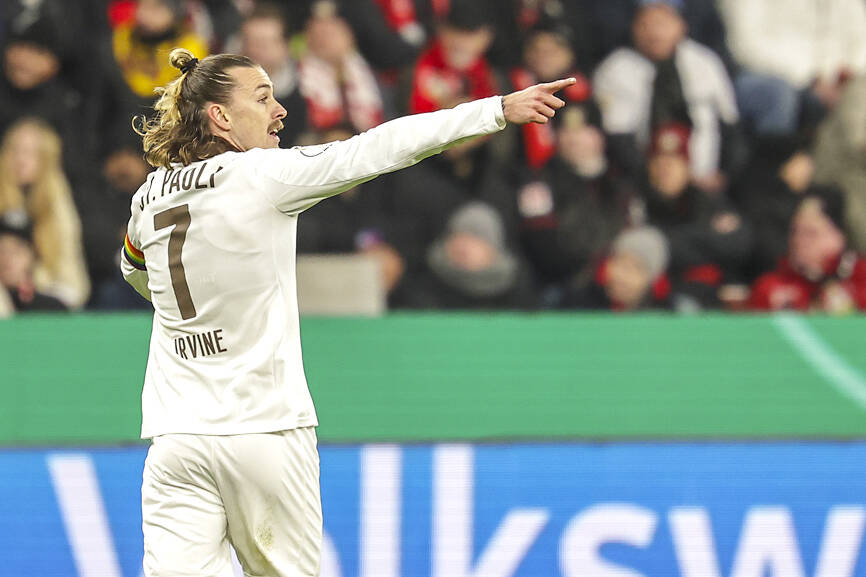
Photo: EPA
“As an organization, you would have to say decisions like the one that we saw awarding this peace prize makes a mockery of what they’re trying to do with the human rights charter and trying to use football as a global driving force for good and positive change in the world,” Irvine said.
“Decisions like that feel like they just set us back in the perceived market of what football currently is, especially at the top level where it’s becoming so disconnected from society and the grassroots of what the game actually is and means in our communities and in the world,” he added.
Human rights groups and activists have widely condemned the awarding of the Peace Prize to Trump. Norway’s soccer federation on Monday called for FIFA to abolish it to avoid politics.
FIFA published its first human rights policy in 2017. Its Human Rights Framework for the 2026 World Cup includes provisions for host cities to promote inclusion, protect freedom of expression and prohibit discrimination during the summer tournament.
However, rights groups have said FIFA needs to do more to press the US to address the risks of human rights abuses for athletes, fans and workers, pointing to a hardline immigration crackdown and deportation drive pursued by the Trump administration.
Irvine, who has earned 80 caps for Australia and captained the team, plays in the Bundesliga for St. Pauli, a club renowned for its progressive culture.
The 33-year-old has long been vocal about human rights concerns and was a driving force in the Australian team’s protest against Qatar’s human rights record before the 2022 World Cup.
Irvine and 15 other Australia players raised concerns in a video about migrant worker conditions in Qatar and called for decriminalization of same-sex relationships in the Gulf nation.
Four years on, Irvine has similar concerns about human rights in the US and the treatment of LGBTQ groups and other communities.
“It’s not an issue just in the Middle East, in America we’re seeing more and more of the rights of these communities ... being taken away all over the country,” he said. “We have to sincerely hope that we see a lot of open support in that space as well.”
Players have used World Cups as a platform to promote causes including anti-racism and gender equality, but FIFA has banned political, religious and personal slogans and imagery from kit.
FIFA blocked the captains of seven European teams from wearing rainbow armbands on the field during the 2022 tournament to protest Qatar’s laws against same-sex relationships.
Players at the 2023 Women’s World Cup in Australia and New Zealand were given a choice of eight FIFA-approved armbands to promote social causes such as gender equality, inclusion and anti-violence.
FIFA has not confirmed whether players would be offered approved armbands for the World Cup.
Irvine said he hoped armbands and other symbols for advocacy would be welcomed at the tournament, and that players would be given leeway to express themselves.
However, he said he would understand if athletes were wary about the potential blowback for making a stand.
“You’ve got a group who are unbelievably supportive and really love to see people in these positions speak up about issues that they care about,” he said. “And on the other side, the opposite, the polarization has gone further. People really actively dislike players trying to bring politics into sport.”

Greek swimmer Kristian Gkolomeev was the only athlete to “beat” a world record on Sunday at the Enhanced Games, winning the men’s 50m freestyle at the divisive competition where athletes were free to take performance-enhancing substances. His time of 20.81 seconds — which is not considered official — came in the final event of the night in Las Vegas, sparing the blushes of organizers who made claims that multiple world records would be surpassed due to a sophisticated doping regime. Gkolomeev, who was wearing a synthetic “supersuit” long banned at events such as the Olympics, outpaced Australia’s Cameron McEvoy’s 20.88 set in
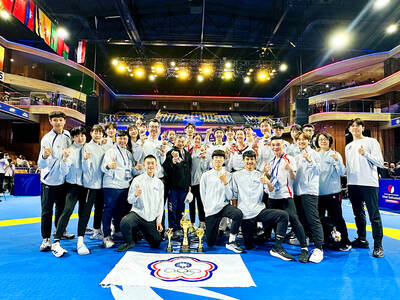
VICTORY ABROAD: The team took home a fistful of medals and secured spots for the autumn’s Asian Games, scheduled for September in Nagoya Taiwan’s women’s team captured the overall title at the Asian Taekwondo Championships in Mongolia on Sunday, finishing with two golds, one silver and one bronze medal. The strong showing, led by gold medalists Wang Chieh-ling and Chang Jui-en secured the full quota of available spots for Taiwan at the Asian Games in Nagoya, Japan, in September. Wang opened Taiwan’s medal run by winning gold in the women’s under-46kg class on Thursday, the first day of competition. Liu Yu-yun later earned a silver in the under-49kg class. On the final day on Sunday, Chang won Taiwan’s second gold medal in the under-62kg event, and

The manager of the Yomiuri Giants, one of Japan’s most popular baseball teams, resigned yesterday after he was arrested for allegedly physically attacking his teenage daughter. Shinnosuke Abe allegedly grabbed the 18-year-old and forced her to the floor at their home in central Tokyo on Monday evening, reported national broadcaster NHK and Kyodo News, citing unnamed police sources. “Leaving like this really means I’m causing you a lot of trouble, and I feel truly sorry about that,” Abe told a hastily arranged news conference, his eyes red with tears. The former star catcher, who is among baseball-obsessed Japan’s most recognized sports figures,
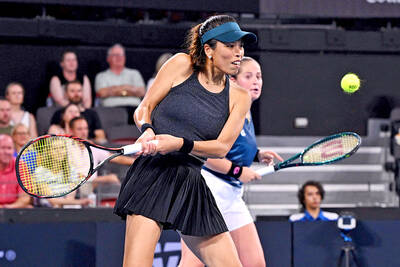
Taiwanese tennis star Hsieh Su-wei on Wednesday advanced to the second round of the mixed doubles at the French Open, after she and German partner Mark Wallner defeated Slovenian Andreja Klepac and Briton Lloyd Glasspool in straight sets, despite temperatures exceeding 32°C in Paris, while Taiwan’s top men’s doubles player Ray Ho also reached the second round. Hsieh, who made it to the semi-finals in the mixed doubles at Roland Garros in 2024, and Wallner defeated Klepac and Glasspool 6-3, 7-5 in just more than an hour, converting three of five break points, while holding their opponents to just one conversion


 RSS
RSS