


Blink and you might miss Indian speed climber Deepu Mallesh scaling a wall higher than five buses in five seconds.
India, a country known for its fondness of cricket, has seen climbing surge in popularity, but those who want to compete internationally have had to crowdfund with minimal government recognition or help.
Some have had to quit the sport they love.
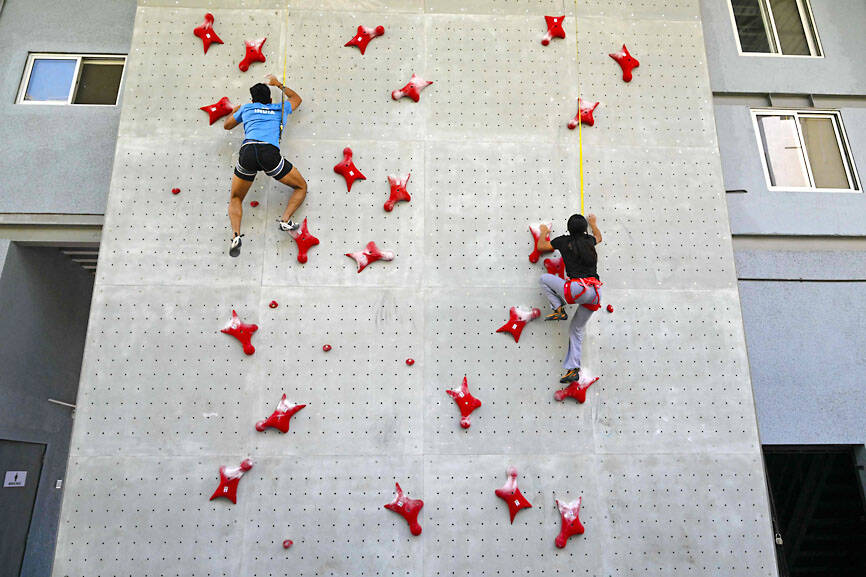
Photo: AFP
“What I like most about climbing is how raw and honest it is,” said 28-year-old Mallesh, who has competed for India internationally and dreams of being the first Indian climber to qualify for the Olympics.
“It’s just you, the wall and the clock,” he said.
Mallesh works part-time as a climbing instructor while pursuing his goal of reaching the 2028 Los Angeles Olympics.
“I have to somehow make some money. That is the only way for me to survive in this sport,” he said.
The Indian Mountaineering Foundation says there are tens of thousands of people who sport-climb regularly, with more than a dozen climbing gyms opening in the last decade.
The rise in those picking it up as a professional career is slow — high costs and scarce sponsorship deals hold back many.
There are about 3,500 climbers who compete across various levels in the country and among them, about 60 participate internationally annually.
Mallesh did not win at the world championship in China this month, but at 5.39 seconds he set a national record in men’s speed climbing, and qualified for the upcoming Asian Games.
Mallesh only manages to compete with support from the foundation.
In the past, he raised the money to compete by crowdfunding. Two years ago he collected about 1 million rupees (US$10,617) to attend six international competitions.
“I have had to miss competitions because I could not gather the requisite amount,” he said, adding “If I get proper funding and proper support I might see my career through till the Olympics. Otherwise, I will have to find something else to do.”
Since 2002, Indians have won close to 70 medals in international climbing competitions, including in the Asian youth championships.
Among those is Joga Purty, who won silver in 2024. Purty said she was lucky because she was sponsored by the Tata conglomerate.
“If I didn’t have this I also would be one of those who quit the sport,” she said.
A decent pair of shoes and a harness cost about 10,000 rupees each. A chalk bag, used to dust the hands for grip, costs 5,000 rupees.
“The shoes also will only last three to six months, sometimes even less depending on the athlete’s use,” she said. “And we have to carry an extra pair of shoes.”
There is little government support for the sport; the foundation’s Keerthi Pais said the organization aims to get the sport recognized under the National Sports Governance Act.
“This recognition will help them continue their climbing career,” Pais said.
Mallesh said wider recognition “would definitely help”.
“It’s not just about validation, it directly impacts support, funding, infrastructure and sponsorship opportunities,” he said.
Pais said government support to make it easier to build climbing gyms would help too.
“That will be the game-changer... this is how it will grow.”
Mumbai-based Shaiv Gandhi from The Indian Bouldering Company gym said facilities such as his have been a catalyst for growth. “I think the two biggest things that the commercial climbing gym help with is awareness... and the infrastructure in order to train for the sport,” the 30-year-old said. “We already have a program where we have told our instructors to keep an eye out for budding talent... if anyone you think has potential, let them climb. It’s on me.”

Greek swimmer Kristian Gkolomeev was the only athlete to “beat” a world record on Sunday at the Enhanced Games, winning the men’s 50m freestyle at the divisive competition where athletes were free to take performance-enhancing substances. His time of 20.81 seconds — which is not considered official — came in the final event of the night in Las Vegas, sparing the blushes of organizers who made claims that multiple world records would be surpassed due to a sophisticated doping regime. Gkolomeev, who was wearing a synthetic “supersuit” long banned at events such as the Olympics, outpaced Australia’s Cameron McEvoy’s 20.88 set in
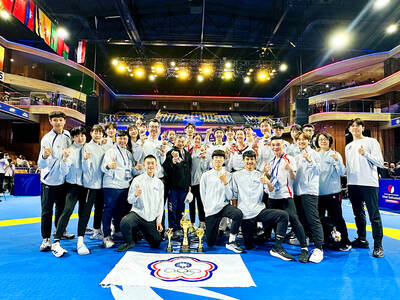
VICTORY ABROAD: The team took home a fistful of medals and secured spots for the autumn’s Asian Games, scheduled for September in Nagoya Taiwan’s women’s team captured the overall title at the Asian Taekwondo Championships in Mongolia on Sunday, finishing with two golds, one silver and one bronze medal. The strong showing, led by gold medalists Wang Chieh-ling and Chang Jui-en secured the full quota of available spots for Taiwan at the Asian Games in Nagoya, Japan, in September. Wang opened Taiwan’s medal run by winning gold in the women’s under-46kg class on Thursday, the first day of competition. Liu Yu-yun later earned a silver in the under-49kg class. On the final day on Sunday, Chang won Taiwan’s second gold medal in the under-62kg event, and

The manager of the Yomiuri Giants, one of Japan’s most popular baseball teams, resigned yesterday after he was arrested for allegedly physically attacking his teenage daughter. Shinnosuke Abe allegedly grabbed the 18-year-old and forced her to the floor at their home in central Tokyo on Monday evening, reported national broadcaster NHK and Kyodo News, citing unnamed police sources. “Leaving like this really means I’m causing you a lot of trouble, and I feel truly sorry about that,” Abe told a hastily arranged news conference, his eyes red with tears. The former star catcher, who is among baseball-obsessed Japan’s most recognized sports figures,
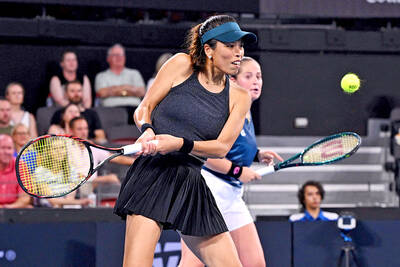
Taiwanese tennis star Hsieh Su-wei on Wednesday advanced to the second round of the mixed doubles at the French Open, after she and German partner Mark Wallner defeated Slovenian Andreja Klepac and Briton Lloyd Glasspool in straight sets, despite temperatures exceeding 32°C in Paris, while Taiwan’s top men’s doubles player Ray Ho also reached the second round. Hsieh, who made it to the semi-finals in the mixed doubles at Roland Garros in 2024, and Wallner defeated Klepac and Glasspool 6-3, 7-5 in just more than an hour, converting three of five break points, while holding their opponents to just one conversion


 RSS
RSS