


Yesterday, voters in Germany’s Rhine-Ruhr region were to be the latest to have their say on a possible bid to host the Summer Olympics in 2036, 2040 or 2044.
About 4 million voters in the former German industrial heartland were expected to cast their ballots, six months after a similar initiative was put to a vote in Munich. The Rhine-Ruhr region — which includes the cities of Cologne, Duesseldorf and Dortmund — is among four bids alongside Berlin, Munich and Hamburg.
Amid a growing backlash against the impact of major events such as the Olympics, authorities are hoping for positive results to illustrate a groundswell of public support.
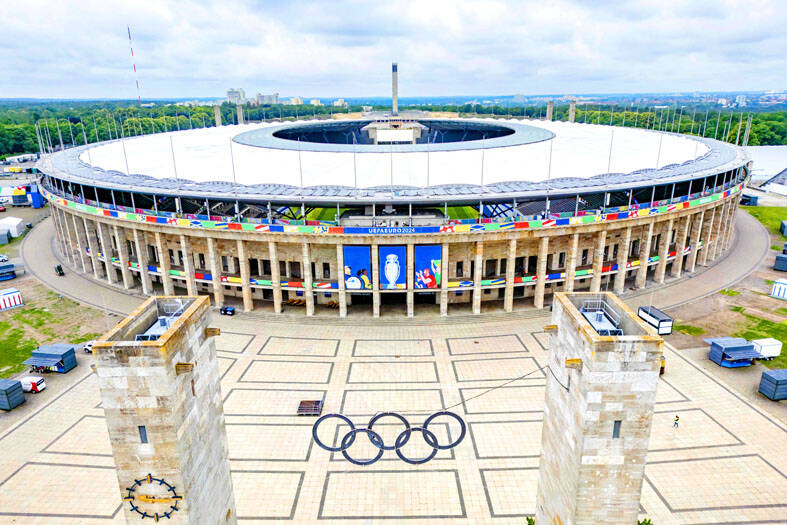
Photo: AFP
The German Olympic Committee (DOSB) would consider the four bids before submitting one to the International Olympic Committee (IOC) in September.
Unlike the usual process, where a country or city puts in a bid for a specific edition of the games, the DOSB is keeping its options open regarding the target year in the hope of a greater shot at success. With Olympic Games often shifting continents from edition to edition, Asia is considered to be a frontrunner for the 2036 edition. Berlin’s bid included potentially hosting the games 100 years after the 1936 edition under Nazi rule. Just three years before the start of the Second World War, then-German chancellor Adolf Hitler tried to use the 1936 games for propaganda purposes. Berlin Mayor Kai Wegner said the anniversary could be used to show “that we no longer stand for dictatorship, exclusion, and mass violence, but that Berlin is now a cosmopolitan, international metropolis, a colorful, diverse city.”
However, not everyone is convinced. German President Frank-Walter Steinmeier said he considers the date “historically problematic,” while indicating he prefers a bid for 2040 or 2044. The last summer Olympics on German soil took place in 1972, in Munich, then part of West Germany. That edition was also shrouded in controversy and tragedy, when Palestinian militants infiltrated the Olympic Village and killed 11 members of the Israeli Olympic team.
After Munich and Rhine-Ruhr, Hamburg would hold a vote on May 31. While the results of the referenda would not be the only factor under consideration for the DOSB, the public consultation has been done amid growing resistance to hosting the Olympics from local groups.
Images of decaying Olympic venues, including in recent host cities Athens and Rio de Janeiro, alongside spiraling costs have drawn public ire. Rather than images of shiny new facilities, modern bids have sought to emphasize low public costs through the re-use of existing infrastructure.
While democratic, the public consultation strategy does not come without risks. In 2015, voters in Hamburg previously rejected a proposal to host the 2024 Summer Olympics, with Munich voters doing the same for the 2022 Winter Olympics two years before.
Holding a referendum is “a good idea” in the current climate, University of Lausanne Olympic expert Jean-Loup Chappelet said.
The Paris Olympics, which largely relied on existing infrastructure, “showed it was possible to host the games without going into too much debt,” Chappelet said.
“It’s not mandated by the IOC, but it’s a significant advantage,” Chappelet said of hosting a referendum. “It’s very important, even more so today than before, because there have been dozens of negative referenda.”

Taiwanese gymnast Tang Chia-hung on Sunday topped the men’s horizontal bar event at the International Gymnastics Federation (FIG) World Cup in Osijek, Croatia, scoring 15.233 to take his third title this season. Tang delivered an outstanding performance in the final, earning a difficulty score of 6.500 and an execution score of 8.633 with a 0.1 stick bonus. His closest competitor was Milad Karimi of Kazakhstan, who finished second with 14.933 points. It was Tang’s third gold medal in the FIG World Cup series this year, following his horizontal bar wins in Azerbaijan on March 8, and in Turkey on March

This year’s Taiwan Athletics Open, which offers Taiwanese athletes an opportunity to compete against their international peers, would be held under a new name after its organizers had earlier announced the event’s cancelation. In a statement issued yesterday, the Chinese Taipei Athletics Association said the competition would still take place on June 6-7 at Banciao Stadium, but under the name “New Taipei City Athletics Open 2026.” The event was given a new name to emphasize its local identity and conform with the international practice of naming World Athletics Tour events after cities, the association said. It said it would soon

Denmark’s double Olympic badminton champion Viktor Axelsen, long a rival of Taiwan’s former world No. 2 Chou Tien-chen, yesterday announced his retirement at age 32, saying back problems meant he could no longer “compete and train at the highest level.” Axelsen, who won gold at the Tokyo Games in 2021 and again in Paris in 2024, had back surgery in April last year and said he had not overcome his physical issues. “Accepting this situation has been incredibly difficult,” he said in a statement. “But I have now reached a point where my body won’t allow me to continue.” Axelsen retires as one

SEASON ENDING: The Nuggets took the third seed in the Western Conference and are to face the sixth-seeded Minnesota Timberwolves in the first round The Denver Nuggets, fueled by 23 first-half points from Nikola Jokic, on Sunday beat the San Antonio Spurs 128-118, notching their 12th straight victory to clinch the Western Conference third seed on the last day of the NBA regular season. On a day when coaches rested dozens of players in preparation for the looming playoffs, three-time NBA Most Valuable Player (MVP) Jokic had to play at least 15 minutes to be eligible for end of season awards, including MVP. The Serbian big man played just over 18, propelling the Nuggets to a 70-56 halftime lead that they would not relinquish


 RSS
RSS