


During the past three Winter Olympics, biathletes had to race at night on icy snow and lighted trails, at venues that had rarely been used, since they were built just for the Games — conditions that made racing more challenging for the athletes.
That all changes with the Milan-Cortina Winter Games.
Biathlon races, which start today, are to run in the afternoon, like they usually are on the international circuit. They would be held at an established, frequently used venue — the Sudtirol Arena in Anterselva, Italy, an annual stop on the World Cup circuit and regular host for the World Championships.
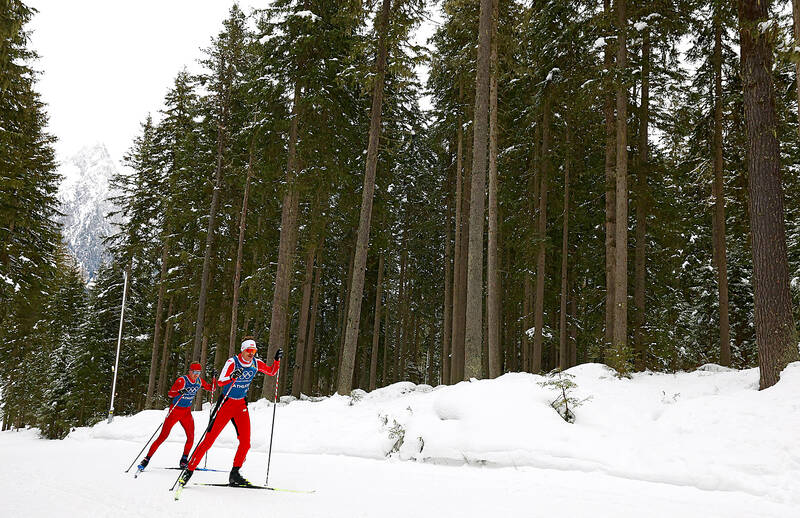
Photo: REUTERS
“There’s definitely an element of familiarity to it that I think probably all of us are finding reassuring right now,” two-time Olympic US biathlete Joanne Reid said during a press conference on Wednesday. “It’s a course that we know. We don’t have to show up kind of sight unseen to a venue, which can definitely happen for the Games.”
Those factors combined with access to familiar food, being closer to home and the boost from tens of thousands of spectators ringing bells and waving flags along the race course would make these Winter Games a much more pleasant, if not exhilarating, experience for biathletes and their teams.
However, the venue has its drawbacks.
The Anterselva biathlon range sits at 1,600m above sea level, making it the highest venue on the World Cup circuit — although it is slightly lower than the venue used during the 2022 Beijing Olympics. A higher elevation means less oxygen for stressed ski muscles. It also impacts a biathlete’s ability to be mentally focused for shooting.
In addition, the range is isolated from other Olympic venues and is the only one-discipline cluster at the Games, said Max Cobb, secretary general of the International Biathlon Union (IBU), the sport’s governing body.
It is an hour-and-a-half to Cortina d’Ampezzo, the main mountain hub of the geographically dispersed Games, two hours to the cross-country skiing venue “and hell and gone to Milano,” he said.
US biathlete Maxime Germain said the location means the team could not make the opening ceremonies in Milan and Cortina because “for us would be like an insane travel and if we want to prioritize our race, it’s like almost impossible to go there, so there’s definitely a bit of regrets for that.”
On the plus side, it has the largest spectator capacity of all competition venues at the Winter Games — 19,000 people — and by October last year, they had sold every ticket that had been made available — more than 100,000, Cobb said.
The IBU projected close to 200,000 fans would attend the biathlon races over the duration of the Games, “cementing its position as Europe’s most-watched winter sport.”
IBU president Olle Dahlin said biathlon would be one of the highlights at the Games.
“Hosting Olympic competitions in the ‘Cathedral of Biathlon,’ and the electric atmosphere that comes with it, will be a once-in-a-lifetime experience for our athletes and showcase the magic of our sport to our ever-growing audience,” he said in a statement.
Armin Auchentaller, head coach of the US biathlon team, said large, loud crowds make racing fun.
“The energy from the spectators adds excitement and motivation on the course, creating an atmosphere that’s inspiring rather than intimidating,” he said. “It’s a special experience to feel that support while competing.”
Racing during the day would also be a welcome change.
“Night races are definitely challenging because the day ends very late,” he said. “After finishing, you still have the post-race routines like cooling down, transport back to the Olympic village, late dinners, physiotherapy or massage, meetings, and post-race talks — all of which take time and push your schedule well past midnight.”
With events in Antholz scheduled for mid-afternoon, the athletes would be in a more natural rhythm, making the recovery and routines are easier to manage.
While the ski trails are familiar to the racers, they are also challenging.
“There are lots of transitions, and the altitude adds an extra layer of difficulty,” Auchentaller said. “The trails never really give you a chance to rest — the amount of time you can spend in a tuck is minimal, so you need to constantly switch gears between different techniques depending on the terrain and the snow conditions.”
Cobb is confident the competitions will run smoothly.
“It’s a very experienced venue,” he said. “We had World Championships there in 2020. We’ve had World Cups there since the 70s, so they are really experienced organizers. We’re really thrilled about it.”

Greek swimmer Kristian Gkolomeev was the only athlete to “beat” a world record on Sunday at the Enhanced Games, winning the men’s 50m freestyle at the divisive competition where athletes were free to take performance-enhancing substances. His time of 20.81 seconds — which is not considered official — came in the final event of the night in Las Vegas, sparing the blushes of organizers who made claims that multiple world records would be surpassed due to a sophisticated doping regime. Gkolomeev, who was wearing a synthetic “supersuit” long banned at events such as the Olympics, outpaced Australia’s Cameron McEvoy’s 20.88 set in

Fred Kerley is competing unaugmented against drug-fuelled athletes at this weekend’s Enhanced Games and still hopes to race in the 2028 Olympics, the suspended former 100m world champion said on Friday. Arguably the biggest name at the divisive event in Las Vegas, where doping is permitted, the US sprinter said he had chosen not to take any of the banned substances including testosterone and steroids that his competitors have been using. “I don’t need it. God gave me fast feet for a reason. And I’m here to showcase my talent,” Kerley said. Kerley last September became the first US competitor and first track
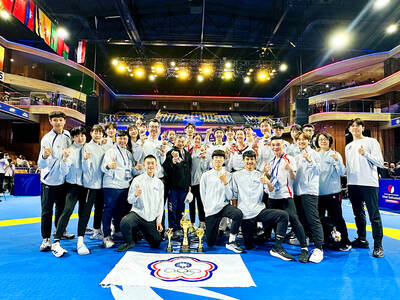
VICTORY ABROAD: The team took home a fistful of medals and secured spots for the autumn’s Asian Games, scheduled for September in Nagoya Taiwan’s women’s team captured the overall title at the Asian Taekwondo Championships in Mongolia on Sunday, finishing with two golds, one silver and one bronze medal. The strong showing, led by gold medalists Wang Chieh-ling and Chang Jui-en secured the full quota of available spots for Taiwan at the Asian Games in Nagoya, Japan, in September. Wang opened Taiwan’s medal run by winning gold in the women’s under-46kg class on Thursday, the first day of competition. Liu Yu-yun later earned a silver in the under-49kg class. On the final day on Sunday, Chang won Taiwan’s second gold medal in the under-62kg event, and

The manager of the Yomiuri Giants, one of Japan’s most popular baseball teams, resigned yesterday after he was arrested for allegedly physically attacking his teenage daughter. Shinnosuke Abe allegedly grabbed the 18-year-old and forced her to the floor at their home in central Tokyo on Monday evening, reported national broadcaster NHK and Kyodo News, citing unnamed police sources. “Leaving like this really means I’m causing you a lot of trouble, and I feel truly sorry about that,” Abe told a hastily arranged news conference, his eyes red with tears. The former star catcher, who is among baseball-obsessed Japan’s most recognized sports figures,


 RSS
RSS