


Flipping and spinning on a studio floor, 17-year-old Royal is a star in China’s breakdancing scene and aiming for gold at the World Championships in Japan this week.
Royal, whose real name is Guo Pu, shot to fame when she won the youth and adult Asian Championships in June.
She is part of a growing Chinese force in breakdancing, which combines acrobatic floor moves, footwork and rhythmic expression to hip-hop or funk, and was included as an Olympic sport for the first time at last year’s Paris Olympics.
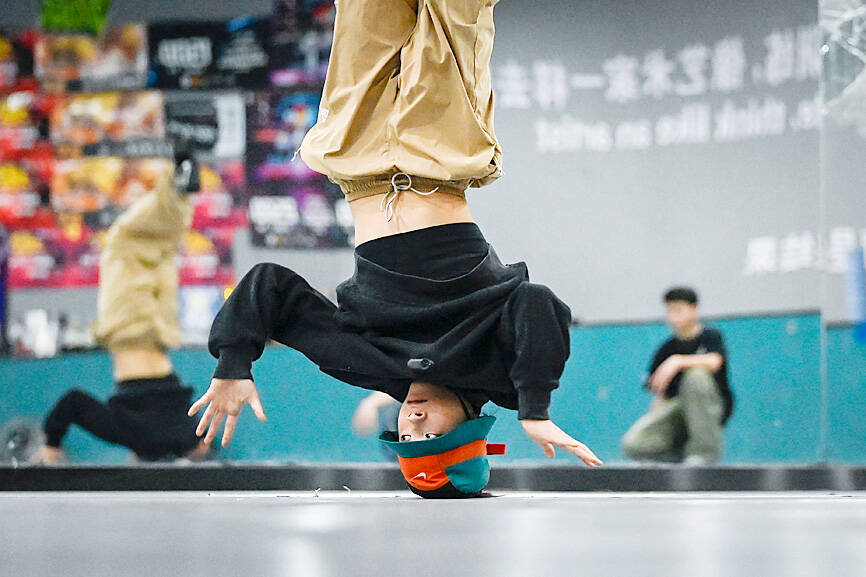
Photo: AFP
“At first my grandmother would not let me dance breaking because back then; breaking’s reputation truly was not very good,” Royal said at the studio where she trains in her hometown of Pingyi, in the eastern province of Shandong.
“But after I achieved some results, she stopped saying anything,” she said with a smile.
Having already won the youth world title in August, Royal would compete alongside other “B-girls” and “B-boys” at the adult World Championships today and tomorrow in Fukuoka, Japan, the country which has long dominated the sport.
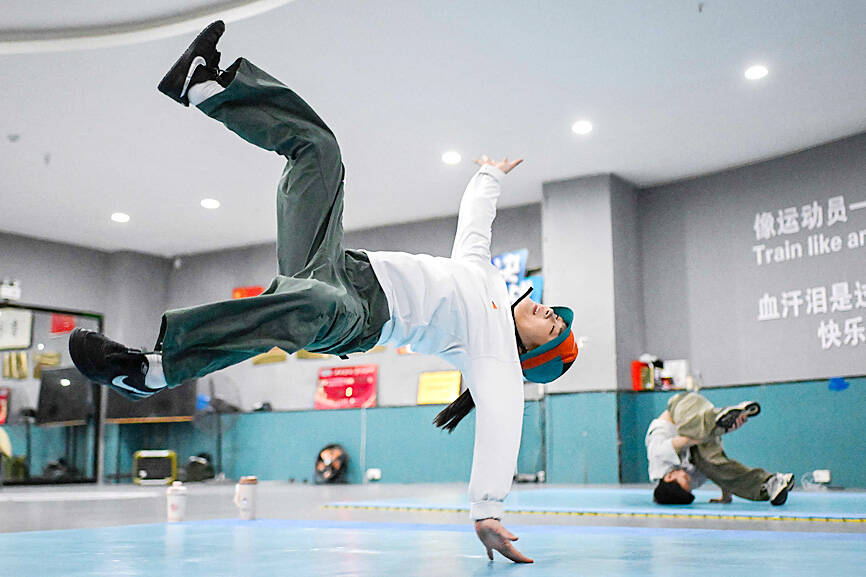
Photo: AFP
“I want to win that gold medal for China and show the world that Chinese breaking is getting cooler and cooler,” she said.
When she was younger, “my mother signed me up for all kinds of extracurricular classes, such as playing instruments, then Chinese dance,” Royal said. “I also participated in a local children’s artistic show for the Chinese New Year. That’s when coach Mike saw me.”
Mike, whose real name is Li Shilong, said Royal “immediately impressed me.”
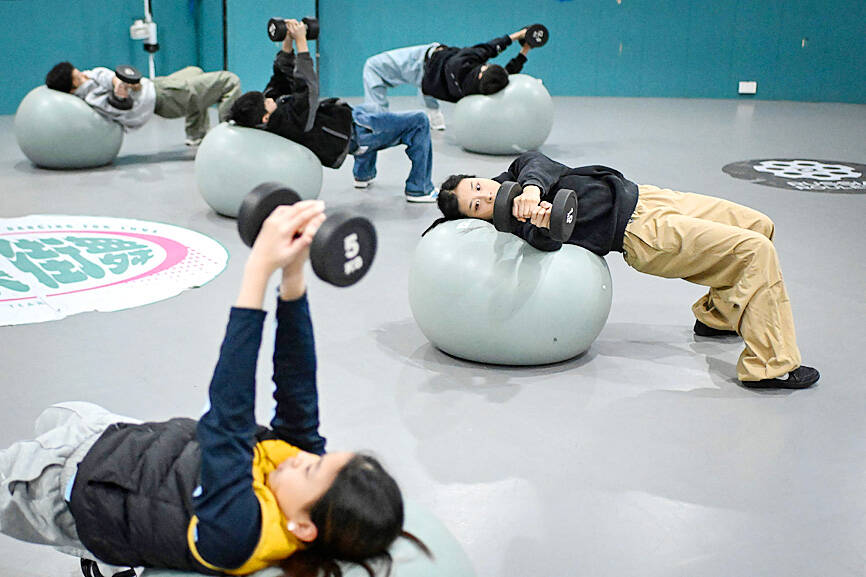
Photo: AFP
“During her performance I saw a light in her eyes... It was a kind of light that shows a real passion, a real drive for dance and for art,” he said. “I felt that this girl might have been born for breaking.”
Royal has put school on hold to dedicate her time entirely to dancing.
Like other top athletes in China, she would benefit from easier access to college thanks to her sporting achievements.
Royal describes herself as “not very talkative” and still “pretty nervous before competitions,” but said she is able to “open up” on stage.
In addition to her Asian and world titles, Royal won gold at this year’s World Games — a top competition for non-Olympic sports.
She has developed a healthy rivalry with fellow Chinese breakdancer Liu Qingyi, known as “671,” who won bronze at the Paris Games.
The country’s next generation of breakdancers looks promising, with China winning five out of six medals at the youth World Championships in August.
“In four years, China has gone from being unknown in the world of breakdancing to ranking among the world’s top three and is now seen as the future of breaking,” said Mounir Biba, a 13-time world champion and head coach of the Chinese team.
“There is talent, there is a lot of potential. There are a lot of young dancers in China,” he said, adding that financial support from the government was helping the sport grow.
Having breakdancing in the Olympics has encouraged the surge of interest in China, Mike said.
“Once a discipline is officially recognized as a sport in China, it’s developed very intensively,” he said.
Authorities see an opportunity to win international honors while parents, reassured by breakdancing’s new respectability, are more willing to let their children practice it.
The Chinese DanceSport Federation organizes numerous competitions, while funds are allocated to training facilities, Mike said.
The only downside is that some Chinese dancers do not necessarily fully understand the culture of breakdancing, which originated in New York in the 1970s, he added.
“The [skill] difficulty level in China is exceptionally high. However, the understanding of dance and the depth of exploration into dance artistry remains insufficient,” he said.
“This is an area where we need to learn from Western nations,” Mike said.
“Breakdancing, and other street dance styles ... their essence is innovation. I believe that by understanding the core of this culture, Chinese children will become more creative,” he said.
Royal is keen to push the sport’s creativity.
“I really want to inspire the next generation of B-girls,” she said. “By passing on the history and the culture of breaking, and developing a style of breaking that’s unique to girls.”

Greek swimmer Kristian Gkolomeev was the only athlete to “beat” a world record on Sunday at the Enhanced Games, winning the men’s 50m freestyle at the divisive competition where athletes were free to take performance-enhancing substances. His time of 20.81 seconds — which is not considered official — came in the final event of the night in Las Vegas, sparing the blushes of organizers who made claims that multiple world records would be surpassed due to a sophisticated doping regime. Gkolomeev, who was wearing a synthetic “supersuit” long banned at events such as the Olympics, outpaced Australia’s Cameron McEvoy’s 20.88 set in

Fred Kerley is competing unaugmented against drug-fuelled athletes at this weekend’s Enhanced Games and still hopes to race in the 2028 Olympics, the suspended former 100m world champion said on Friday. Arguably the biggest name at the divisive event in Las Vegas, where doping is permitted, the US sprinter said he had chosen not to take any of the banned substances including testosterone and steroids that his competitors have been using. “I don’t need it. God gave me fast feet for a reason. And I’m here to showcase my talent,” Kerley said. Kerley last September became the first US competitor and first track
VICTORY ABROAD: The team took home a fistful of medals and secured spots for the autumn’s Asian Games, scheduled for September in Nagoya Taiwan’s women’s team captured the overall title at the Asian Taekwondo Championships in Mongolia on Sunday, finishing with two golds, one silver and one bronze medal. The strong showing, led by gold medalists Wang Chieh-ling and Chang Jui-en secured the full quota of available spots for Taiwan at the Asian Games in Nagoya, Japan, in September. Wang opened Taiwan’s medal run by winning gold in the women’s under-46kg class on Thursday, the first day of competition. Liu Yu-yun later earned a silver in the under-49kg class. On the final day on Sunday, Chang won Taiwan’s second gold medal in the under-62kg event, and

The manager of the Yomiuri Giants, one of Japan’s most popular baseball teams, resigned yesterday after he was arrested for allegedly physically attacking his teenage daughter. Shinnosuke Abe allegedly grabbed the 18-year-old and forced her to the floor at their home in central Tokyo on Monday evening, reported national broadcaster NHK and Kyodo News, citing unnamed police sources. “Leaving like this really means I’m causing you a lot of trouble, and I feel truly sorry about that,” Abe told a hastily arranged news conference, his eyes red with tears. The former star catcher, who is among baseball-obsessed Japan’s most recognized sports figures,


 RSS
RSS