


Olympic figure skaters will perform for a matter of mere minutes at February’s Milan-Cortina Winter Games, but the process of creating and honing their routines takes months of consideration and effort.
The concept, moves and music of a program can make or break skaters’ dreams of Olympic glory, and what is right for one can be a disaster for another.
“You have to choose what suits your strengths best, because that will inevitably score well with the judges,” Canadian pairs skater Deanna Stellato-Dudek said at last week’s International Skating Union Grand Prix of Figure Skating Final in Nagoya, Japan.
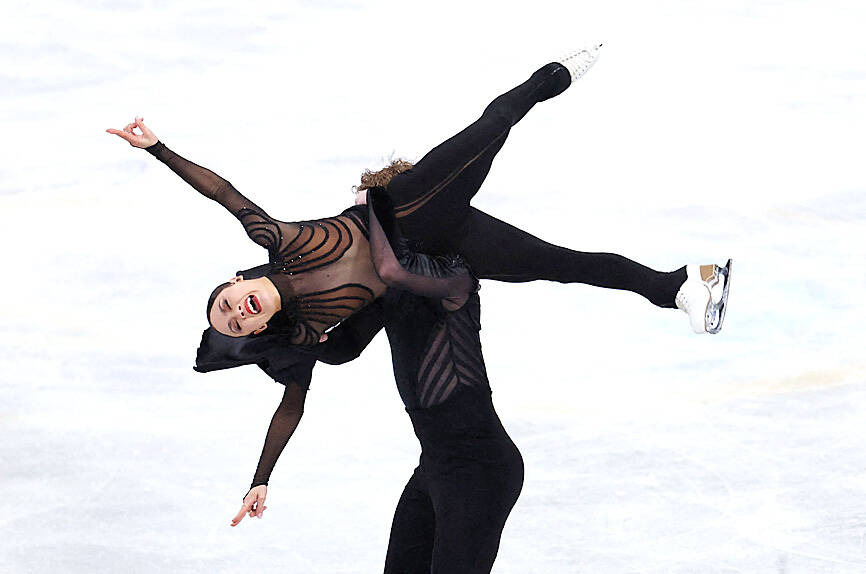
Photo: Reuters
“That’s what we’ve always done — what feels best for us and then hoping that comes across to everybody,” she added.
Skaters typically work with a choreographer and coach to devise their short program and free skate routines, which they would perform at every competition for a season.
Top choreographers such as France’s Benoit Richaud are in demand and can work with several skaters at the same time.
Richaud, a former skater himself who says his work is a calling from God, said “90 percent” of his skaters’ routines comes from his ideas.
“I study them and the way they skate,” said the 37-year-old, an instantly recognizable figure at competitions with his cool demeanor, bald head and round glasses.
“It’s totally based on my feeling and personal emotion. I just know when I see a skater what kind of style, what kind of direction I should give them,” he said.
Richaud said his skaters and their coaches have the final say on a routine, but he likes to “stay in control.”
Other skaters prefer a more collaborative approach and bring their own ideas to the table.
“We have to be on the ice, we have to listen to the music a thousand times a day, so we need to like it,” Italian pairs skater Niccolo Macii said. “We need to have our idea on the ice. We need to feel what we do, because we have to do it all the time.”
A rule change brought in after the 2014 Winter Olympics allowed figure skaters to use music with lyrics for the first time, opening up new possibilities.
An eclectic mix could be heard at the Grand Prix Final, from pop hits by the Rolling Stones to movie soundtracks and classical numbers.
Picking the right music can make a difference in the judges’ scores, but purists such as Richaud refuse to take that into consideration.
“My way of working is never to please anyone, it’s only to do what I feel,” he said. “I am against working in a direction of thinking about ‘I need the judge to like it’ or ‘I need people to like it’.”
“I think it’s not the way we create art, and it’s not how we create true emotion,” he added.
Others, like Italy’s Macii, take a more pragmatic approach.
“We need to work with the mind of the judges,” said the 30-year-old, who finished second in Nagoya with his partner, Sara Conti.
“We need to find a way to express ourselves and to make the people like us — it’s a mix of being us on the ice and acting,” he added.
Macii is amused that people watching figure skating at the Olympics might think he and Conti are performing their routine in competition for the first time.
In reality it has been battle-tested since the start of the season, but even before it gets to that stage, it is constantly evolving.
“Most of the time you start choreographing in April, May, and then you’re not ready to compete until September, October,” said Maxime Deschamps, Stellata-Dudek’s partner.
“And even when you’re there in September, it’s not fully ready,” Deschamps said. “As you train it, it evolves so something that was working the previous week might not work the next week.”

A runner who stopped during a marathon in China to pose doing the splits and another who hoarded energy gels have been banned for two years, the local athletics association said yesterday. The incidents happened during Sunday’s marathon in Sichuan Province’s Chengdu and were widely shared online. Videos showed a female runner stopping suddenly and dropping to the ground in the splits position, holding up her arms in a heart shape as she apparently posed for a photograph. She “committed obstructive fouls during the race, affecting the safe participation of other runners,” the Sichuan Athletics Association said in a statement, which identified
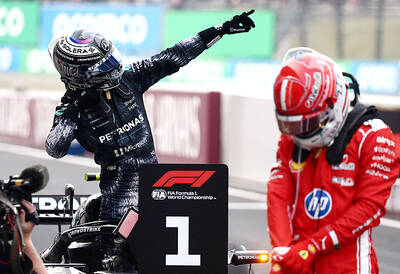
Mercedes’ Kimi Antonelli yesterday vowed to “keep raising the bar” after winning the Japanese Grand Prix to become the youngest driver in Formula One history to lead the championship standings. The 19-year-old Italian took advantage of a mid-race safety car to jump into the lead after a dreadful start from pole position, crossing the line ahead of McLaren’s Oscar Piastri and Ferrari’s Charles Leclerc. Antonelli’s Suzuka victory came two weeks after the first grand prix win of his career in China, and sent him top of the championship standings after three races, nine points ahead of team-mate George Russell. Mercedes are struggling to

Yu Yao-hsing on Tuesday nabbed Taiwan’s only goal in the final round of qualifiers for the 2027 AFC Asian Cup, as they fell 3-1 to Sri Lanka at Taipei Municipal Stadium. Early goals from Sri Lanka in the first half left Taiwan struggling to get on the board, and Christopher Tiao’s own goal at 53 minutes sealed the team’s fate in the third round of qualifiers. While acknowledging that the defeat, Taiwan’s sixth in Group D, was disappointing, head coach Matt Ross said he saw reasons to stay positive about the team’s development. “There were lots of positive signs in terms of the

Teng Kai-wei, the only Taiwanese player on an opening-day roster in this year’s Major League Baseball (MLB) season, took his first win of the year with the Houston Astros in his season debut. Teng entered in relief in the top of the fifth inning against the Los Angeles Angels on Saturday, with the Astros trailing 5-0. He pitched 2-1/3 scoreless innings with two strikeouts, as Houston scored 11 runs during his outing to snatch an 11-9 comeback victory. The win is the Astros’ first of the season and the third of Teng’s MLB career. “It’s my first time pitching for the Astros, so


 RSS
RSS