


Taiwan’s women’s kabaddi team on Monday settled for a silver medal after losing to India 35-28 in the Women’s World Cup final.
Played by two teams of seven, kabaddi is a fast-paced contact sport in which players try to tag opponents and return to their side without being tackled. Matches consist of two 20-minute halves with a five-minute break.
Points are awarded for successful tags, while defenders earn a point for tackling the raider. Tagged or tackled players are temporarily out, but can re-enter when their team scores.
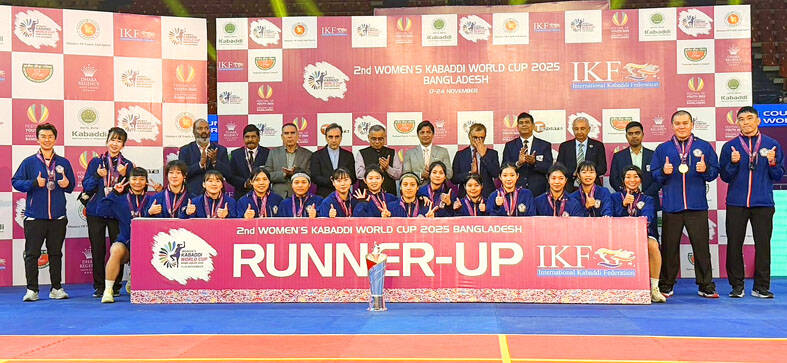
Photo: CNA
In Monday’s final, Taiwan got off to a strong start, taking a 12-9 lead, but a defensive attempt to tackle an opponent backfired when an India player broke free and reached the midline, costing Taiwan four points.
India seized the momentum, sending Taiwan into halftime trailing 20-16.
Taiwan also took a hit from a referee’s decision. Under kabaddi rules, only the defenders who make contact with the raider are supposed to be ruled out if the raider escapes.
Only two Taiwan players had made contact on the play, but after a video review, the referee ruled that four defenders were involved, Taiwan coach Tsai Wei-yang said.
“That decision really hurt our morale,” Tsai said.
In the second half, Taiwan tried to mount a comeback, but India’s towering lineup — including four players taller than 1.8m — gradually pulled away in points, handing Taiwan the defeat.
This marked another narrow loss to India for the Taiwan women’s kabaddi team, following a one-point defeat at the 2023 Asian Games in Hangzhou, China.
“The loss was a bitter one,” Tsai said, but he added that despite settling for silver again, the team’s defense had improved greatly in this World Cup, unlike at the Hangzhou Asian Games, when victories relied almost entirely on offense.
The coach said that the Asian Games to be held in Nagoya, Japan, next year would likely feature the same group of players.
“After returning to Taiwan, we will do more analysis and research to figure out how to overcome India’s lineup,” he said.
The Women’s Kabaddi World Cup was held in Dhaka, Bangladesh, from Nov. 17 to Monday. Eleven countries took part in the tournament.

NO HARD FEELINGS: Taiwan’s Lin Hsiang-ti and Indonesia’s Dhinda Amartya Pratiwi embraced after fighting to a tense and rare 30-29 final game in their Uber Cup match The Taiwanese men’s team on Wednesday fought back from the brink of elimination to defeat Denmark in Group C and advance to the quarter-finals of the Thomas Cup, while the women’s team were to face South Korea after press time last night in the Uber Cup quarter-finals in Horsens, Denmark. In the first match, Taiwan’s top shuttler Chou Tien-chen faced a familiar opponent in world No. 3 Anders Antonsen. It was their 16th head-to-head matchup, with the Dane taking his fourth victory in a row against former world No. 2 Chou, winning 21-14, 13-21, 21-15 in 1 hour, 22 minutes. The

Marta Kostyuk’s maiden WTA 1000 title in Madrid came on Saturday thanks to her power, poise and a pair of unexpected lucky shorts. The world No. 23 beat eighth-ranked Mirra Andreeva 6-3, 7-5 in under 90 minutes to secure the most prestigious trophy of her career, her third professional singles title and second in less than a month after Rouen. Yet as the 23-year-old Ukrainian posed for photographs at the Caja Magica, it was not just the silverware that caught the eye. Held alongside her team and her two dogs, Kostyuk showed off a piece of black men’s underwear, prompting
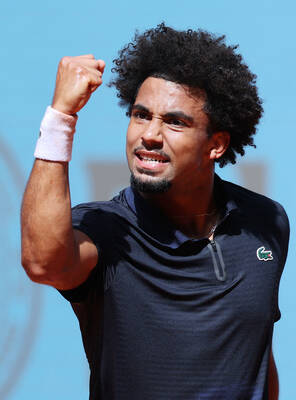
Tennis players are facing an unexpected opponent at the Madrid Open. A stomach virus or food poisoning has affected Iga Swiatek, Coco Gauff, Marin Cilic and others, raising concerns. World No. 1 Aryna Sabalenka avoided an upset by Naomi Osaka on the court on Monday and said she is trying to avoid illness by sticking to a diet of chicken breasts, rice and salad. The rumor among the players was bad shrimp tacos were to blame. Sabalenka knocked on wood for luck and said, “So far, so good. I heard that I have to avoid those tacos,” she laughed, adding “I stick to the

Throwing more than US$5 billion at a divisive new tour and walking away after five seasons does not look like good business, but LIV Golf was not all bad news for Saudi Arabia. Oil-funded LIV, which poached top stars and sent golf’s establishment into a tailspin, helped push the conservative kingdom into global view — one of its key aims, experts said. The exit, confirmed on Thursday after weeks of speculation, does not signal a flight of Saudi money from sport, even after the Middle East war that sparked Iranian attacks around the Gulf, they said. “Saudi Arabia is not


 RSS
RSS