


An amateur soccer league organized by farmers, students and factory workers in rural China has unexpectedly drawn millions of fans and inspired big cities to form their own, raising hopes China can grow talent from the ground up and finally become a global force.
The nation of 1.4 billion people has about 200 million soccer fans, more than any other country, but it has failed to build world-class teams, partly due to a top-down approach where clubs pick players from a very small pool of prescreened candidates.
The professional game is marred by a history of fixed matches, corruption, and dismal performances, with Chinese President Xi Jinping’s dream that China would be a soccer superpower by 2050 appearing as far away as ever.
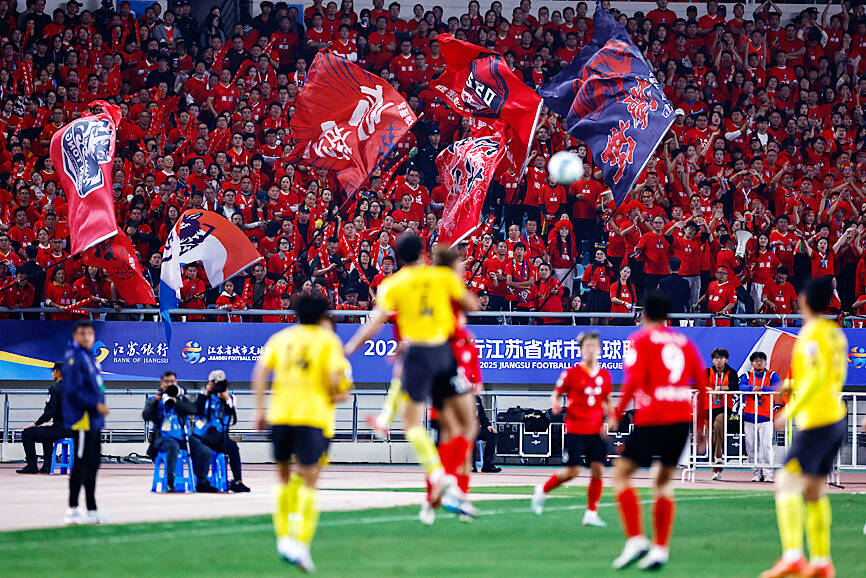
Photo: Reuters
But in 2023, the success of the so-called Village Super League (VSL) turned the page for Chinese soccer history.
The league won legions of fans with its passionate matches, half-time folk performances and prizes of livestock, boosting local tourism and economies, and even winning praise from Xi.
Grassroots soccer “embodies people’s pursuit of a beautiful life and presents a vibrant and flourishing China to the world,” Xi said, the first and only time he mentioned soccer in his New Year messages since coming to power.
The buzz has encouraged big cities to take a chance on amateur leagues in the hopes of replicating the VSL’s commercial success.
The spectator response has been overwhelming.
The final of the inter-city Jiangsu Super League (JSL) on Saturday last week, organized by the provincial sports bureau and 13 city governments, drew 62,329 spectators, just shy of the record 65,769 spectators at a 2012 professional game.
Another 2 million people who could not get the 20 yuan (US$2.81) tickets — compared with as much as 1,000 yuan for seats at China’s top professional league — streamed the final online.
Online viewership for the JSL’s 85 matches surpassed 2.2 billion streams.
Three hours before kick-off, fans marched into the Nanjing Olympic Sports Center Stadium holding banners and colored smoke sticks.
They waved flags and chanted slogans in support of their home teams. Fans from the other 11 cities that did not advance to the final also turned out to represent their defeated teams.
In the dramatic penalty shootout, the city of Nantong narrowly lost to Taizhou.
Taizhou supporter Cai Liang, 39, said he had been unsure of whether to encourage his son to pursue soccer, but his son, whose interest grew after watching Taizhou defeat Zhenjiang in July, had other ideas.
“I’d play football more often,” the 14-year-old said.
The scandal-ridden reputation of the professional game has deterred parents traditionally more focused on putting their children on an academic path from embracing soccer as a career.
Professional soccer players have traditionally come through the very narrow state and national sports school system, meaning talent not evident at a very young age is missed.
The JSL’s success has inspired other provinces to follow suit. Liaoning launched a league last year. Hebei and Inner Mongolia formed theirs in August, while Hunan and Sichuan kicked off theirs in September.
There are early signs the amateur leagues are creating a pathway to the professional game.
Taizhou midfielder Wu Zhicheng, 18, became the first JSL player to enter China’s top professional division in July.
When asked after a prematch training session if more players would follow in Wu’s footsteps, Taizhou coach Zhou Gaoping said she hoped so.
“There will be players advancing to national teams,” said Zhou, the only female coach in the league and a former player on the women’s national team.
The Nanjing Olympic Sports Center was once home to Jiangsu FC, a club that had former England manager Fabio Capello as its coach during the heady days of Chinese football’s gold rush in the years immediately preceding the COVID-19 pandemic.
Backed by cash from Chinese corporations, the Chinese Soccer League attracted world-class talent and coaches from around the globe.
Jiangsu FC won the league in 2020, but ceased operations less than a year later after Nanjing-based retailer Suning Group decided to focus on its core businesses.
“Jiangsu FC regretfully disbanded at its peak and now Jiangsu’s hopes have been reignited by the amateur league,” said Li Jianlin, 33, a Taizhou fan. “Chinese soccer still has a future.”

Greek swimmer Kristian Gkolomeev was the only athlete to “beat” a world record on Sunday at the Enhanced Games, winning the men’s 50m freestyle at the divisive competition where athletes were free to take performance-enhancing substances. His time of 20.81 seconds — which is not considered official — came in the final event of the night in Las Vegas, sparing the blushes of organizers who made claims that multiple world records would be surpassed due to a sophisticated doping regime. Gkolomeev, who was wearing a synthetic “supersuit” long banned at events such as the Olympics, outpaced Australia’s Cameron McEvoy’s 20.88 set in

Fred Kerley is competing unaugmented against drug-fuelled athletes at this weekend’s Enhanced Games and still hopes to race in the 2028 Olympics, the suspended former 100m world champion said on Friday. Arguably the biggest name at the divisive event in Las Vegas, where doping is permitted, the US sprinter said he had chosen not to take any of the banned substances including testosterone and steroids that his competitors have been using. “I don’t need it. God gave me fast feet for a reason. And I’m here to showcase my talent,” Kerley said. Kerley last September became the first US competitor and first track
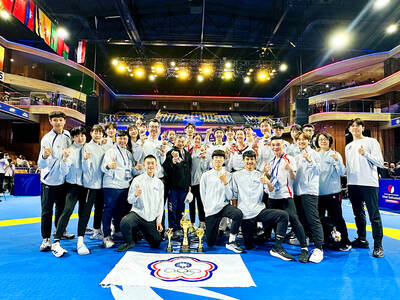
VICTORY ABROAD: The team took home a fistful of medals and secured spots for the autumn’s Asian Games, scheduled for September in Nagoya Taiwan’s women’s team captured the overall title at the Asian Taekwondo Championships in Mongolia on Sunday, finishing with two golds, one silver and one bronze medal. The strong showing, led by gold medalists Wang Chieh-ling and Chang Jui-en secured the full quota of available spots for Taiwan at the Asian Games in Nagoya, Japan, in September. Wang opened Taiwan’s medal run by winning gold in the women’s under-46kg class on Thursday, the first day of competition. Liu Yu-yun later earned a silver in the under-49kg class. On the final day on Sunday, Chang won Taiwan’s second gold medal in the under-62kg event, and

The manager of the Yomiuri Giants, one of Japan’s most popular baseball teams, resigned yesterday after he was arrested for allegedly physically attacking his teenage daughter. Shinnosuke Abe allegedly grabbed the 18-year-old and forced her to the floor at their home in central Tokyo on Monday evening, reported national broadcaster NHK and Kyodo News, citing unnamed police sources. “Leaving like this really means I’m causing you a lot of trouble, and I feel truly sorry about that,” Abe told a hastily arranged news conference, his eyes red with tears. The former star catcher, who is among baseball-obsessed Japan’s most recognized sports figures,


 RSS
RSS