


As Nigerian women dominate sports on the continent, they are facing off not just against top talent abroad, but a domestic atmosphere of mismanagement and pay disparities — and even the risk of repression for speaking out.
Nigeria is fresh off a win at the finals of the Women’s AfroBasket, their fifth-consecutive championship at the continent’s top hardwood tournament, while shortly before the Super Falcons clinched their 10th Women’s Africa Cup of Nations (AFCON) soccer title.
The soccer team’s successes in particular have come in the face of pay disparities compared with their male counterparts — when they get paid at all.
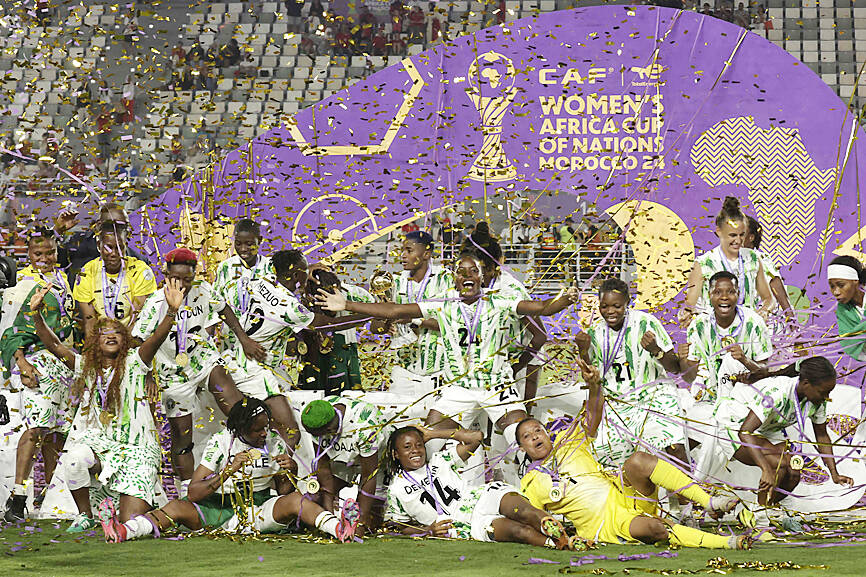
Photo: AFP
The women receive a training camp allowance, but the bulk of their pay comes from per-match bonuses, which vary depending on the team’s results.
POLITICS
Both the women’s basketball and soccer teams have been plagued by late or unpaid match bonuses for years, despite their records as arguably the best teams on the continent.
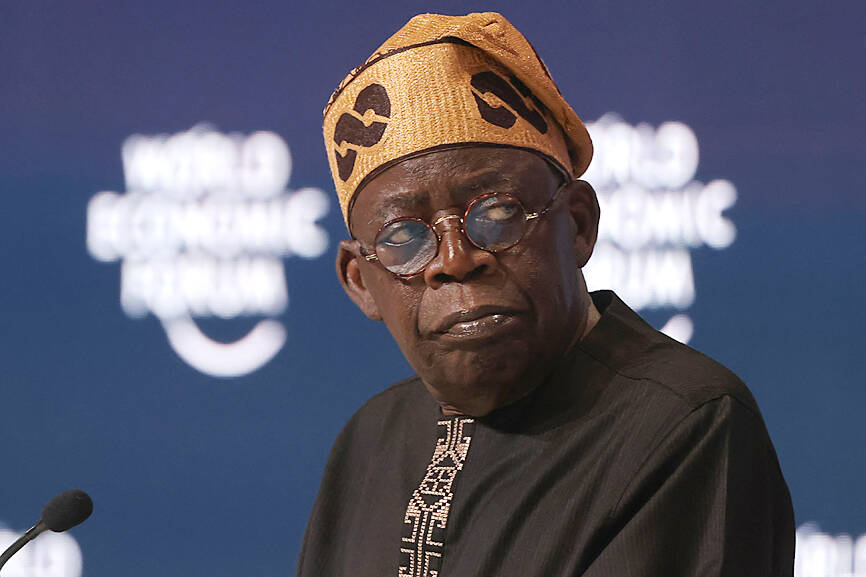
Photo: AFP
However, when the Super Falcons landed in Abuja after their 3-2 WAFCON victory over host Morocco last month, none of the players answered questions shouted by reporters in the news scrum about whether they would ask Nigerian President Bola Ahmed Tinubu, who was welcoming them at his villa, about being paid the same as the men’s team.
Nigerian journalists on the scene said the question was useless: It was far too politically charged.
“If you speak up against what’s going on, you completely lose the possibility of getting what you’re entitled to, you could actually be blacklisted,” said Solace Chukwu, senior editor at Afrik-Foot Nigeria.
Not that there are not clashes: In 2021, basketballers called out the authorities when they topped Africa, protesting against unpaid match bonuses.
The Nigeria Basketball Federation at the time denied any wrongdoing, blaming the issue on clerical errors.
Like the basketball team, the women’s soccer team has found remarkable success, stemming in part from the country’s population of more than 200 million — the largest on the continent, complemented by a widespread diaspora.
They also benefited from early investments in women’s soccer at a time when other African countries focused on men’s teams, Chukwu said, helping the Super Falcons win the first seven editions of the WAFCON, from 1991 to 2006.
Yet they only played a handful of test matches before they landed in Morocco for this year’s competition, cobbled together at the last second.
SPEAKING OUT
The Super Falcons have not been completely silent in the face of mismanagement and disinterest from authorities.
However, rocking the boat too much appears to come with a cost.
“Players who lead or dare to protest ... always risk not being invited or sidelined outright,” said Harrison Jalla, a players’ union official.
After Super Falcons captain Desire Oparanozie — now a commentator — led protests over unpaid wages at the 2019 FIFA Women’s World Cup, she was stripped of her captaincy and was not called up for the 2022 tournament.
Former men’s coach Sunday Oliseh — who himself was let go from the national squad amid protests over backpay in the early 2000s — called the situation a case of “criminal” retaliation.
The Nigerian Football Federation (NFF) at the time denied that it dropped Oparanozie over the protests. The NFF and the Super Falcons did not respond to a request for comment on the allegations that players are afraid to speak out.
SKY IS THE LIMIT
Players still have hopes for women’s sports to expand.
“I think the sky is the limit,” Nigerian point guard Promise Amukamara said in Abuja, fresh off her AfroBasket win. “Obviously, more facilities should be built around Nigeria. I feel like maybe, one year we should host the AfroBasket.”
Aisha Falode, an NFF official, called on the government to “invest in the facilities, invest in the leagues and the players, because the women’s game can no longer be taken lightly.”
INSPIRATION
Despite the challenges, women’s sports are still finding a foothold among younger fans.
Justina Oche, 16, a player at a soccer academy in Abuja, said that the exploits of the team inspired her to pursue a career in the sport.
“They say what a man can do, a woman can do even better,” said the youngster, whose role model is six-time African Footballer of the Year Asisat Oshoala.
“The Super Falcons have again proved this,” she said.

Greek swimmer Kristian Gkolomeev was the only athlete to “beat” a world record on Sunday at the Enhanced Games, winning the men’s 50m freestyle at the divisive competition where athletes were free to take performance-enhancing substances. His time of 20.81 seconds — which is not considered official — came in the final event of the night in Las Vegas, sparing the blushes of organizers who made claims that multiple world records would be surpassed due to a sophisticated doping regime. Gkolomeev, who was wearing a synthetic “supersuit” long banned at events such as the Olympics, outpaced Australia’s Cameron McEvoy’s 20.88 set in

Fred Kerley is competing unaugmented against drug-fuelled athletes at this weekend’s Enhanced Games and still hopes to race in the 2028 Olympics, the suspended former 100m world champion said on Friday. Arguably the biggest name at the divisive event in Las Vegas, where doping is permitted, the US sprinter said he had chosen not to take any of the banned substances including testosterone and steroids that his competitors have been using. “I don’t need it. God gave me fast feet for a reason. And I’m here to showcase my talent,” Kerley said. Kerley last September became the first US competitor and first track
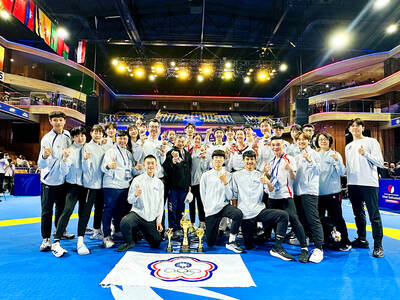
VICTORY ABROAD: The team took home a fistful of medals and secured spots for the autumn’s Asian Games, scheduled for September in Nagoya Taiwan’s women’s team captured the overall title at the Asian Taekwondo Championships in Mongolia on Sunday, finishing with two golds, one silver and one bronze medal. The strong showing, led by gold medalists Wang Chieh-ling and Chang Jui-en secured the full quota of available spots for Taiwan at the Asian Games in Nagoya, Japan, in September. Wang opened Taiwan’s medal run by winning gold in the women’s under-46kg class on Thursday, the first day of competition. Liu Yu-yun later earned a silver in the under-49kg class. On the final day on Sunday, Chang won Taiwan’s second gold medal in the under-62kg event, and

The manager of the Yomiuri Giants, one of Japan’s most popular baseball teams, resigned yesterday after he was arrested for allegedly physically attacking his teenage daughter. Shinnosuke Abe allegedly grabbed the 18-year-old and forced her to the floor at their home in central Tokyo on Monday evening, reported national broadcaster NHK and Kyodo News, citing unnamed police sources. “Leaving like this really means I’m causing you a lot of trouble, and I feel truly sorry about that,” Abe told a hastily arranged news conference, his eyes red with tears. The former star catcher, who is among baseball-obsessed Japan’s most recognized sports figures,


 RSS
RSS