


One is known as “The Monster,” the other “Big Bang.”
The bout between champion boxers Naoya Inoue (30-0-0, 27 KOs) and Junto Nakatani (31-0-0, 24 KOs) is already being billed as Japan’s “fight of the century,” and a date has not even been set.
Sports pundits are hailing what is happening these days as the golden age of Japanese boxing for a country that has produced its share of Hall of Famers.
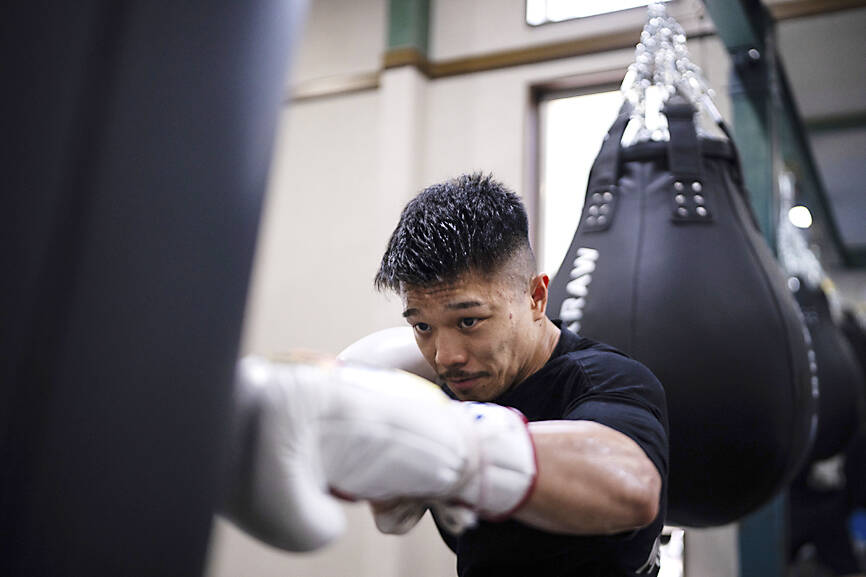
Photo: AP
For a period last year, all four division bantamweight champions were Japanese. The Ring magazine’s latest Top Ten pound-for-pound ranking has three Japanese fighters, including Inoue and Nakatani.
Both Nakatani and Inoue have at least one fight before their dream match, but no one is expecting either of them to lose.
“That’s the way boxing works. Inoue has a story, and I have a story. When these stories clash, people are moved and gain courage. That’s where it is fun,” Nakatani said in an interview at M.T Boxing Gym southwest of Tokyo.
“For me, boxing is what you show in the ring all that you worked for and built every day. It’s a place where you express the life you have lived,” he said.
Nakatani smiles often, exuding a kindness that strikes a contrast to his almost scientific brutality in the ring.
One must keep control, as boxing is a contest of minds and strategies, doing exactly what your opponent does not want you to do, he said.
Earlier this year, Inoue, the first Japanese fighter to be No. 1 in the pound-for-pound rankings, which evaluates boxers taking their weight and size into account, defended his super bantamweight title against Ramon Cardenas at T-Mobile Arena in Las Vegas.
Inoue gave his fans a fright when he was knocked down in the second round, but came back to soundly stop the fight in the eighth.
Inoue, one of only three male boxers in the four-belt era to unify at two weight classes, is scheduled for a September showdown in Tokyo against Murodjon Akhmadaliev of Uzbekistan.
Nakatani’s next opponent is not decided yet, but speculation is rife it might be Cardenas, allowing fans to analyze how Nakatani fares compared with Inoue.
The buzz is spreading to a fan base previously not associated with boxing in Japan, such as women and children.
These are fighters who draw long lines for their T-shirts and other merchandising, inspire manga and pop up on hair product ads.
Boxing fever was hot with the packed crowd of 10,000 at the Ariake Coliseum for the WBC and IBF bantamweight unification title match between Nakatani and Ryosuke Nishida last month.
People are still talking about the fight, in which Nakatani came on fierce from the first round. Nishida’s eye became swollen, his shoulder was dislocated and the fight was stopped after the sixth round.
Nakatani said he would not be taking the same strategy against Inoue. The strategy was carefully planned with his Mexican-American trainer Rudy Hernandez especially for Nishida.
“He is an athlete who has everything. He has outstanding boxing skills and so he is hard to beat, but even then, there are possibilities,” Nakatani said of Inoue, vowing to beat him by knockout.
Inoue, who was at ringside to witness Nakatani’s win, wrote afterward on social media: “Welcome to the super bantamweight battle front. Can’t help but get excited when there’s a Japanese this good.”
Both Nakatani and Inoue started out learning karate as children.
Nakatani’s father sent him to karate school when he was in third grade because he was always playing video games. He later switched to boxing, where he fared better because of the weight classes. He stopped playing games.
Nakatani’s walkout music is a defiant rendition by aging rocker Tsuyoshi Nagabuchi, vowing to give up a smug existence and instead be brave and selfless like the World War II kamikaze pilots.
Nakatani said he chose that song to express gratitude to past generations, who sacrificed so much to give his generation peace. It happens to be one of his dad’s favorite songs.
Nakatani is taking it a step at a time, but he is already thinking about the legacy he will leave behind.
“When the time comes for me to retire, I want to end my career as the kind of boxer whom everybody loves,” he said.

NO HARD FEELINGS: Taiwan’s Lin Hsiang-ti and Indonesia’s Dhinda Amartya Pratiwi embraced after fighting to a tense and rare 30-29 final game in their Uber Cup match The Taiwanese men’s team on Wednesday fought back from the brink of elimination to defeat Denmark in Group C and advance to the quarter-finals of the Thomas Cup, while the women’s team were to face South Korea after press time last night in the Uber Cup quarter-finals in Horsens, Denmark. In the first match, Taiwan’s top shuttler Chou Tien-chen faced a familiar opponent in world No. 3 Anders Antonsen. It was their 16th head-to-head matchup, with the Dane taking his fourth victory in a row against former world No. 2 Chou, winning 21-14, 13-21, 21-15 in 1 hour, 22 minutes. The

Marta Kostyuk’s maiden WTA 1000 title in Madrid came on Saturday thanks to her power, poise and a pair of unexpected lucky shorts. The world No. 23 beat eighth-ranked Mirra Andreeva 6-3, 7-5 in under 90 minutes to secure the most prestigious trophy of her career, her third professional singles title and second in less than a month after Rouen. Yet as the 23-year-old Ukrainian posed for photographs at the Caja Magica, it was not just the silverware that caught the eye. Held alongside her team and her two dogs, Kostyuk showed off a piece of black men’s underwear, prompting
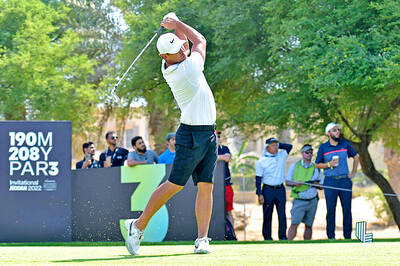
Throwing more than US$5 billion at a divisive new tour and walking away after five seasons does not look like good business, but LIV Golf was not all bad news for Saudi Arabia. Oil-funded LIV, which poached top stars and sent golf’s establishment into a tailspin, helped push the conservative kingdom into global view — one of its key aims, experts said. The exit, confirmed on Thursday after weeks of speculation, does not signal a flight of Saudi money from sport, even after the Middle East war that sparked Iranian attacks around the Gulf, they said. “Saudi Arabia is not

Anastasia Potapova on Wednesday turned tennis heartbreak into history by becoming the first lucky loser to reach a WTA 1000 semi-final with her thrilling 6-1, 6-7 (4/7), 6-3 victory over Karolina Pliskova at the Madrid Open, as Taiwan’s Hsieh Su-wei exited in the women’s doubles quarter-finals. The Russian-born Austrian, who lost in qualifying last week, has capitalized on her unexpected main draw entry and stunned former world No. 1 Pliskova in a roller-coaster clash despite squandering three match points. Potapova’s run has included impressive victories over former French Open champion Jelena Ostapenko and world No. 2 Elena Rybakina. Asked if she had thought


 RSS
RSS