


Zico was instrumental in Japan’s development as a soccer-playing nation and has warned that players are moving to Europe too young, citing his native Brazil as a cautionary tale.
The midfield legend ended his playing career in Japan after helping to launch the professional J.League in 1993 and he also coached the country’s national team from 2002 to 2006.
He maintains a connection to Japan as an adviser to Kashima Antlers, the club he helped build into the country’s most successful and where he has served as a player, coach and technical director for the past 30 years.
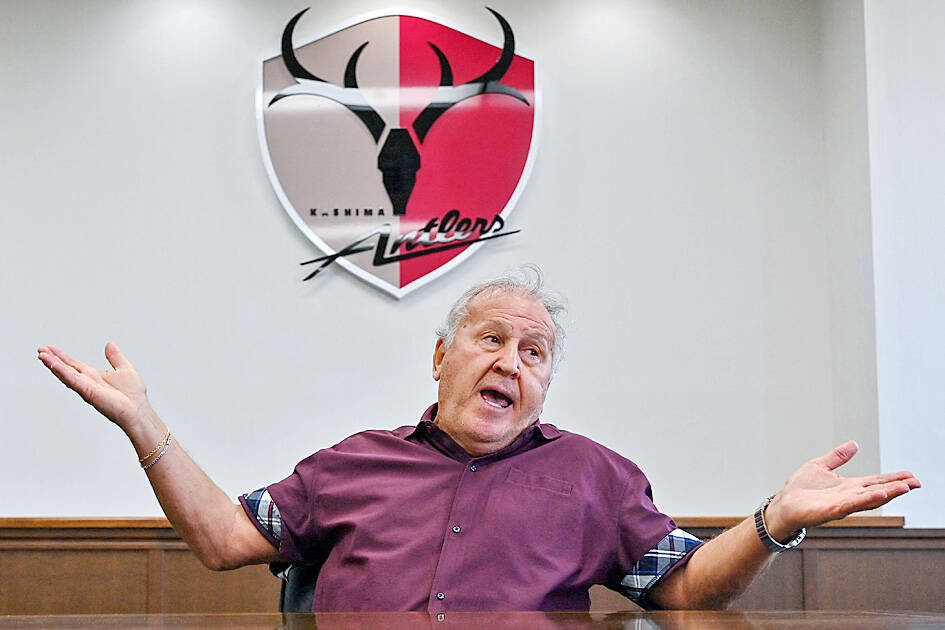
Photo: AFP
During that time, Zico has seen Japan grow from a soccer backwater to regular FIFA World Cup participants, with players thriving at some of Europe’s biggest clubs.
The 72-year-old says Japanese players looking beyond the J.League is a “positive” development — as long as they move at the right time.
He draws similarities with Brazil, where he says some players leave for Europe after only a handful of games in the domestic league.
“Brazilian players go to Europe too soon, losing their Brazilian roots. If a player isn’t resilient, they come back because they haven’t achieved their full potential there,” Zico told reporters in Kashima.
“They leave very early, they don’t play and that’s happened in Germany, it’s happened in Italy, it’s happened in many places,” he added.
“That’s what’s happening to many Japanese players — they go there too early, lack confidence and then they come back,” he added.
Zico said that the trend is still overwhelmingly beneficial for Japan.
He contrasts the situation to the early days of the J.League, when European clubs would sign Japanese players “for marketing reasons.”
Zico says the picture today is also different from his time as Japan coach, during which he won the 2004 Asian Cup and took the team to the 2006 World Cup.
“We had some players in Europe, but they would get half an hour, five minutes, 15 minutes in games — they weren’t starters like they are today, that’s the big difference,” he said. “So when they came back to play for the national team they didn’t bring the same playing rhythm that they have today.”
Zico was one of several international stars drafted in to help the launch of the J.League, which brought professional soccer to Japan for the first time.
The Brazilian, along with England’s Gary Lineker and Germany’s Pierre Littbarski, raised the new league’s profile and helped the sport take root in a country long obsessed with baseball.
High-profile signings are now rare in the J.League, with Spanish World Cup winner Andres Iniesta’s move to Vissel Kobe in 2018 a notable exception.
Zico believes it was “not a coincidence” that Kobe won two straight J.League titles after Iniesta left the club in 2023.
“It’s an investment. Having a player of Iniesta’s level at your club motivates everyone,” he said. “You learn because he’s a winner, it improves the performance of the other players and it motivates the supporters. Everything grows.”
Kashima are atop the J.League, even if the days when they could sign Brazilian World Cup winners like Jorginho and Leonardo are long gone.
Zico joined the club when they were in the semi-professional second division and they have since won the J.League a record eight times and the Asian Champions League once.
Zico visits Kashima regularly to interact with fans and sponsors, as well as working with the club’s youth section.
He said that the club is “like my son.”
“I watched it being born, grow and become what it is now,” he said. “We have been able to take my experience in professional football and put it into practice here. A son is like that — you educate him and watch him go through life.”

Greek swimmer Kristian Gkolomeev was the only athlete to “beat” a world record on Sunday at the Enhanced Games, winning the men’s 50m freestyle at the divisive competition where athletes were free to take performance-enhancing substances. His time of 20.81 seconds — which is not considered official — came in the final event of the night in Las Vegas, sparing the blushes of organizers who made claims that multiple world records would be surpassed due to a sophisticated doping regime. Gkolomeev, who was wearing a synthetic “supersuit” long banned at events such as the Olympics, outpaced Australia’s Cameron McEvoy’s 20.88 set in

Fred Kerley is competing unaugmented against drug-fuelled athletes at this weekend’s Enhanced Games and still hopes to race in the 2028 Olympics, the suspended former 100m world champion said on Friday. Arguably the biggest name at the divisive event in Las Vegas, where doping is permitted, the US sprinter said he had chosen not to take any of the banned substances including testosterone and steroids that his competitors have been using. “I don’t need it. God gave me fast feet for a reason. And I’m here to showcase my talent,” Kerley said. Kerley last September became the first US competitor and first track
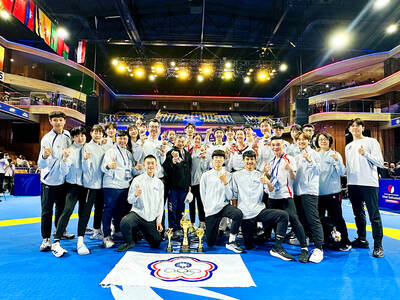
VICTORY ABROAD: The team took home a fistful of medals and secured spots for the autumn’s Asian Games, scheduled for September in Nagoya Taiwan’s women’s team captured the overall title at the Asian Taekwondo Championships in Mongolia on Sunday, finishing with two golds, one silver and one bronze medal. The strong showing, led by gold medalists Wang Chieh-ling and Chang Jui-en secured the full quota of available spots for Taiwan at the Asian Games in Nagoya, Japan, in September. Wang opened Taiwan’s medal run by winning gold in the women’s under-46kg class on Thursday, the first day of competition. Liu Yu-yun later earned a silver in the under-49kg class. On the final day on Sunday, Chang won Taiwan’s second gold medal in the under-62kg event, and
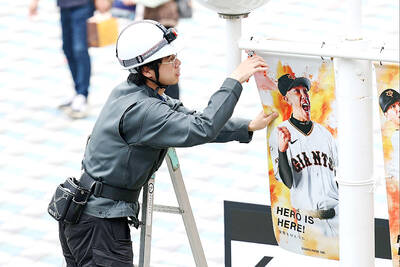
The manager of the Yomiuri Giants, one of Japan’s most popular baseball teams, resigned yesterday after he was arrested for allegedly physically attacking his teenage daughter. Shinnosuke Abe allegedly grabbed the 18-year-old and forced her to the floor at their home in central Tokyo on Monday evening, reported national broadcaster NHK and Kyodo News, citing unnamed police sources. “Leaving like this really means I’m causing you a lot of trouble, and I feel truly sorry about that,” Abe told a hastily arranged news conference, his eyes red with tears. The former star catcher, who is among baseball-obsessed Japan’s most recognized sports figures,


 RSS
RSS