


Japan has ambitious plans to become a basketball powerhouse, but a row involving star player Rui Hachimura and disagreements over the domestic league’s direction mean success is anything but a slam dunk.
Once a minnow on the world stage, Japan qualified for last year’s Paris Olympics and took eventual silver medalists France to overtime in the group phase, helped by a handful of NBA players including Los Angeles Lakers forward Hachimura.
At home, the domestic B. League is enjoying record attendances and revenue, with new arenas being built and ambitions to become the second-best league in the world behind the US’ NBA.
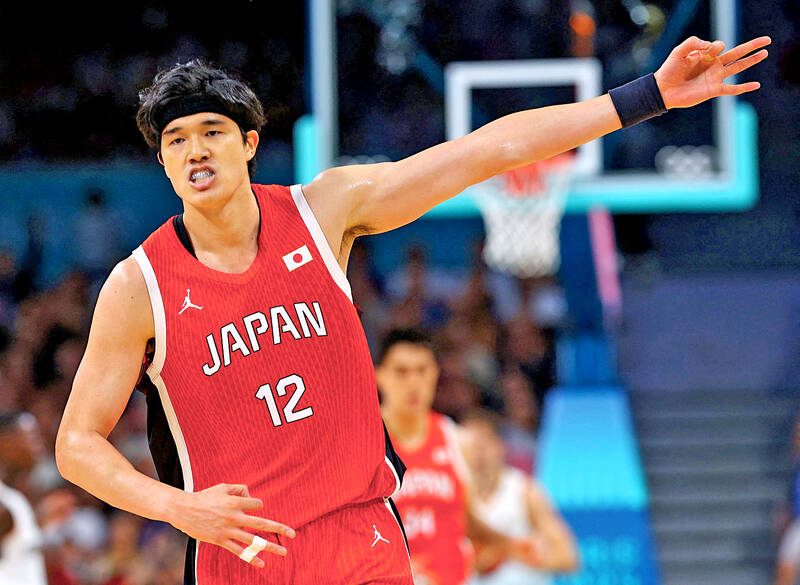
Photo: Reuters
League chairman Shinji Shimada said the B. League’s “mix of sport and live entertainment” offers Japanese fans something different.
“Lots of people watch a B. League game for the first time and say it’s more interesting than football or baseball, and they want to come back,” he said.
The B. League is already catching up on a business scale with leagues in Europe and China, and is taking steps to close the gap on the court, too, he said.
Teams have signed players with NBA experience such as Alize Johnson, who played alongside the “big three” of Kevin Durant, Kyrie Irving and James Harden at the Brooklyn Nets.
Johnson said he knew nothing about the B. League when he was in the NBA, but he would recommend it to other players dropping below the elite level.
“In terms of the money being guaranteed and the lifestyle, how they go about making sure everything is by the book, it makes players feel comfortable knowing there’s not going to be anything fishy going on,” he said.
The B. League has also invested in local talent and last year brought back national team star Yuta Watanabe after six seasons in the NBA.
The 30-year-old, who had never played professionally in Japan before, has struggled with injuries, but he is back in action as the B. League play-offs approach.
Watanabe and Hachimura are the two main faces of Japan’s national team, who captured the public’s imagination at the 2023 FIBA Basketball World Cup in Okinawa when they qualified for the Paris Games.
Japan performed respectably at the Olympics, but the mood soured three months later when Hachimura threatened to quit the team after a scathing attack on Japanese basketball chiefs.
The 27-year-old, by far the country’s most successful player, accused the Japan Basketball Association of having a “profit-first” mentality.
He also aimed a barb at head coach Tom Hovasse, who got the job after leading Japan’s women to silver at the 2021 Tokyo Olympics, saying the American had “not managed at a world level.”
Hachimura has still not said whether he would return, and Watanabe hopes relationships can be mended.
“For him to say that publicly, there must have been a big build-up of stress,” Watanabe said. “The lack of communication became a problem, and I hope that can be fixed properly.”
Watanabe fears that communication issues could also derail the domestic league as it prepares to relaunch as the B. League Premier from the 2026-2027 season.
The league plans to introduce a salary cap and raise the number of overseas players allowed on the court at any one time from two to three.
The plans have brought the league into conflict with the players’ association, who worry that Japanese players would end up with less money and time on the court.
Shimada insists the changes are necessary to raise the overall level and narrow the gap in quality between teams, giving fans more exciting games to watch.
At such a delicate time for Japanese basketball, Watanabe is urging everyone to work together.
“I’m a little worried what fans will think if it’s a Japanese league, but there aren’t many Japanese players on the court,” he said.
“It’s fine for people who want to watch high-level basketball, but for fans who want to support the players, that’s where a gap starts to appear,” he said. “A lot of fans are coming to games now, but I worry if that will continue.”

Greek swimmer Kristian Gkolomeev was the only athlete to “beat” a world record on Sunday at the Enhanced Games, winning the men’s 50m freestyle at the divisive competition where athletes were free to take performance-enhancing substances. His time of 20.81 seconds — which is not considered official — came in the final event of the night in Las Vegas, sparing the blushes of organizers who made claims that multiple world records would be surpassed due to a sophisticated doping regime. Gkolomeev, who was wearing a synthetic “supersuit” long banned at events such as the Olympics, outpaced Australia’s Cameron McEvoy’s 20.88 set in

Fred Kerley is competing unaugmented against drug-fuelled athletes at this weekend’s Enhanced Games and still hopes to race in the 2028 Olympics, the suspended former 100m world champion said on Friday. Arguably the biggest name at the divisive event in Las Vegas, where doping is permitted, the US sprinter said he had chosen not to take any of the banned substances including testosterone and steroids that his competitors have been using. “I don’t need it. God gave me fast feet for a reason. And I’m here to showcase my talent,” Kerley said. Kerley last September became the first US competitor and first track
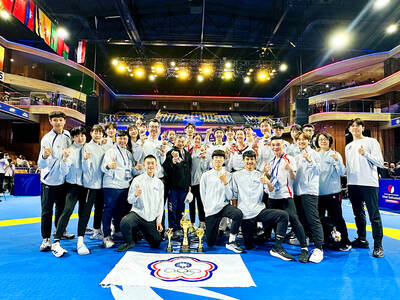
VICTORY ABROAD: The team took home a fistful of medals and secured spots for the autumn’s Asian Games, scheduled for September in Nagoya Taiwan’s women’s team captured the overall title at the Asian Taekwondo Championships in Mongolia on Sunday, finishing with two golds, one silver and one bronze medal. The strong showing, led by gold medalists Wang Chieh-ling and Chang Jui-en secured the full quota of available spots for Taiwan at the Asian Games in Nagoya, Japan, in September. Wang opened Taiwan’s medal run by winning gold in the women’s under-46kg class on Thursday, the first day of competition. Liu Yu-yun later earned a silver in the under-49kg class. On the final day on Sunday, Chang won Taiwan’s second gold medal in the under-62kg event, and
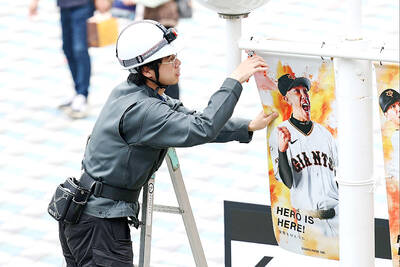
The manager of the Yomiuri Giants, one of Japan’s most popular baseball teams, resigned yesterday after he was arrested for allegedly physically attacking his teenage daughter. Shinnosuke Abe allegedly grabbed the 18-year-old and forced her to the floor at their home in central Tokyo on Monday evening, reported national broadcaster NHK and Kyodo News, citing unnamed police sources. “Leaving like this really means I’m causing you a lot of trouble, and I feel truly sorry about that,” Abe told a hastily arranged news conference, his eyes red with tears. The former star catcher, who is among baseball-obsessed Japan’s most recognized sports figures,


 RSS
RSS