


Mbele Nonhlanhla laced up her silver cleats as her coach shouted encouragement to creaky knees, stiff backs and labored breathing in a dressing room in South Africa’s far north. At 63, wearing jersey No. 10 and sporting brown-dyed hair, the grandmother of seven was far from your typical soccer player when she stepped onto the field for her first international tournament.
“I feel like a superstar,” Nonhlanhla grinned, revealing a missing tooth. “They call me the goal machine.”
Her team, Vuka Soweto, hails from the renowned township of Soweto outside Johannesburg.
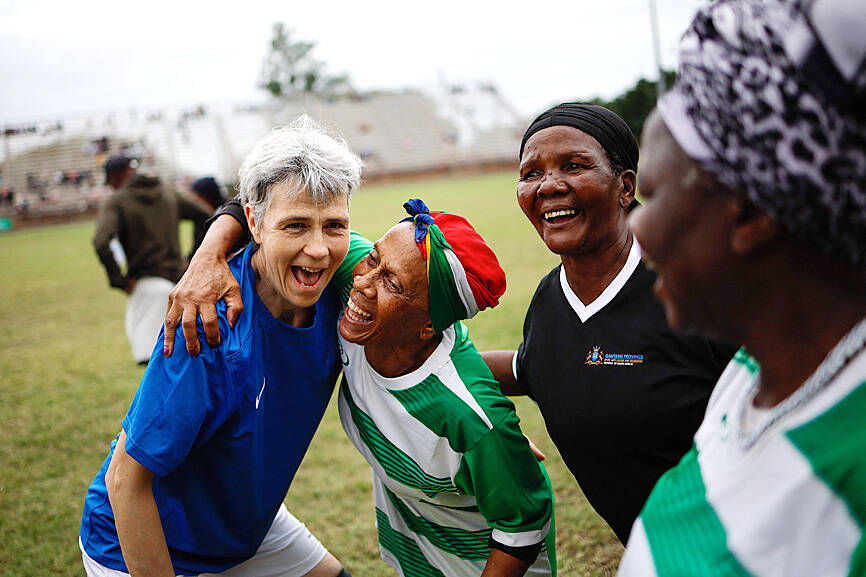
Photo: AFP
It had joined more than a dozen others from across Africa and beyond to compete this week at the Grannies International Football Tournament in the northern province of Limpopo.
The four-day “Grannies World Cup” was held in a stadium with sweeping mountain views.
The 30-minute games were played in two halves at a slow but purposeful pace, between teams from as far as the US, France and Togo.
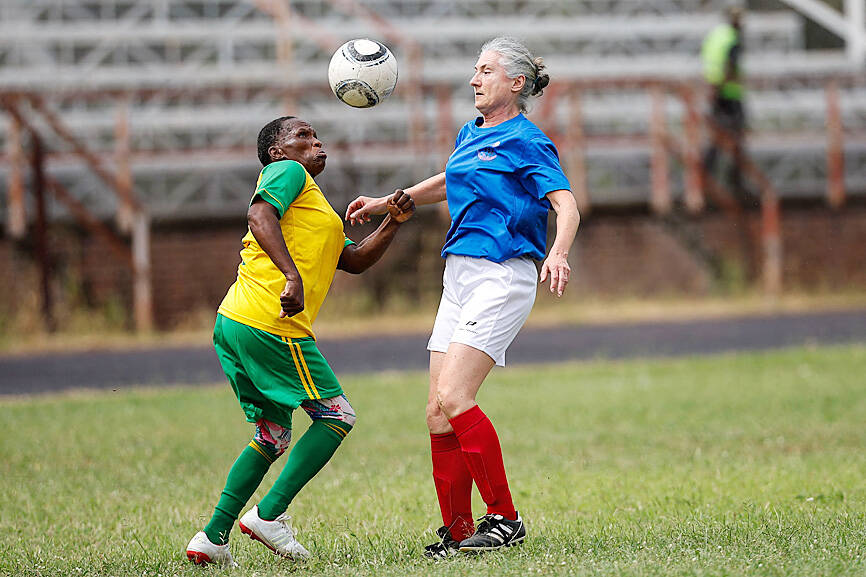
Photo: AFP
“It is all about active ageing. Whether we win, lose or what, it is all about coming here and staying fit,” said 62-year-old South African Devika Ramesar, a mother of two and grandmother of five.
Until this week, the Liverpool fan had never stepped onto a soccer pitch.
Kenyan striker Edna Cheruiyot only had two months to learn the “long list” of soccer rules before Friday, when she scored her only goal.
She took selfies to remember her first ever trip abroad and send to her grandchildren.
“I feel nimble. This is the lightest I have been since my first child in 1987,” Cheruiyot said, adjusting the blue headwrap covering her greying hair.
At 52, she is a youngster within her team, whose oldest player — Elizabeth Talaa — is 87.
The idea for the tournament arose in 2007 to improve the health of local women, said founder Rebecca Ntsanwisi, 57, who is fondly called Mama Beka.
It came out of her sense of personal challenge following a cancer diagnosis that once bound her to a wheelchair.
“The older women need to come together and enjoy. We are neglected,” she said outside the home where she lives with her ageing parents.
She hopes to host the next tournament in Kenya in 2027.
In South Africa alone, about 40 percent of children live in households headed by their grandparents, government statistics show.
That is mainly due to poverty, cultural traditions and urban migration.
However, grandmothers should not be saddled with the responsibility of raising their grandchildren, Ntsanwisi said.
“This is our time to enjoy and relax,” she said. “I will die knowing that I did something.”
Chris Matson, 67, took the advice to heart and traveled from the US to “enjoy every second of the tournament.”
“I did not play when I was little so to do it now is wonderful,” said the bubbly goalkeeper for the American New England Breakers team and winner of the golden glove.
“I have something precious to take home,” she said, cradling her first ever trophy.
However, the team doctors earned their keep.
The aches and pains of the elderly players needed constant checking, South African team medic Diana Mawila said.
Some members of her Vakhegula Vakhegula team had to be monitored for high blood pressure before every game.
Vakhegula Vakhegula means “grandmothers grandmothers” in the local Tsonga language and is a nod to the national men’s team, Bafana Bafana, or “boys boys.”
However, the team disagreed with Mawila’s assessment and burst into heartfelt laughter.
“We are fit,” captain Thelma Ngobeni said, balancing on her head a packet of corn flour that players received after the games.
“It is not about winning or losing. All that matters is that we showed up, had fun and did our best,” she said.
Nonhlanhla’s goal was more ambitious. A dream of making it big in soccer was within reach, she said.
“It’s never too late to achieve your childhood dreams. I don’t see anything stopping me,” she added, walking out of the brick-walled tunnel to face France.
In a scene mirroring professional soccer, the vuvuzela-blowing crowd erupted in applause as teams entered the stadium hand in hand with young mascots and national anthems played.
“I’m halfway there, right?” Nonhlanhla asked.
Former European champions Celtic exited the UEFA Champions League in the qualifiers after a 3-2 penalty shoot-out defeat at Kazakhstan’s Kairat Almaty on Tuesday, following two goalless legs in the playoff tie. Kairat are to compete in the competition proper for the first time, while Norway’s Bodo/Glimt and Cyprus’s Pafos also secured debut appearances after coming through the playoffs. Celtic’s night ended in disappointment as they missed three penalties in the shoot-out, Daizen Maeda failing with the decisive spot-kick. The slugfest of a match went into extra-time with neither side finding the net and few overall chances, echoing the first

Rangers on Wednesday bowed out of the UEFA Champions League playoffs with a humiliating 6-0 defeat at the hands of Club Brugge which piles further pressure on head coach Russell Martin, while SL Benfica secured a place in the competition proper at the expense of Jose Mourinho’s Fenerbahce. The Glasgow giants traveled to Belgium right up against it after losing 3-1 at home in last week’s first leg, when they conceded three times in the opening 20 minutes. They never looked like turning the tie around as Club Brugge took the lead inside five minutes at the Jan Breydelstadion through Nicolo Tresoldi
Australian Alex de Minaur reached the second week of the US Open for the third year in a row with little fanfare on Saturday and said he intended to keep winning until the tournament organizers were forced to give him better billing. Despite being the eighth seed and a quarter-finalist last year at Flushing Meadows, De Minaur’s third-round match against German Daniel Altmaier was scheduled for Court 17 — the smallest of the four stadium venues in the precinct. “It is a little bit of a headscratcher for me. I’m not gonna lie,” he told reporters after progressing 6-7 (9/7), 6-3, 6-4,

Noah Lyles on Thursday warmed up for the upcoming athletics world championships by chasing down Olympic champion Letsile Tebogo to win the 200m at the Diamond League final. Lyles trailed Tebogo at the start, but gradually erased the deficit over the final 100m and pipped the Botswana sprinter to the line by centimeters. Lyles, the Olympic 100m champion and reigning world champion in both the 100m and 200m, clocked 19.74 seconds in a slight headwind. Tebogo was 0.02 seconds behind. It was Lyles’ sixth Diamond League title, a record for track athletes. “Six, that’s a big number,” Lyles said. “Shoot, that’s another record on


 RSS
RSS