


After a decade of making history in soccer, French referee Stephanie Frappart is using her experience to help more women take up the profession.
Frappart was the first woman to referee a men’s Ligue 1 game in France and the first woman to referee a men’s FIFA World Cup match.
The 41-year-old Frappart is working with France’s national postal service, La Poste, on a committee promoting female referees called “Women and Refereeing” in conjunction with its four partner federations: soccer, rugby union, handball and basketball.
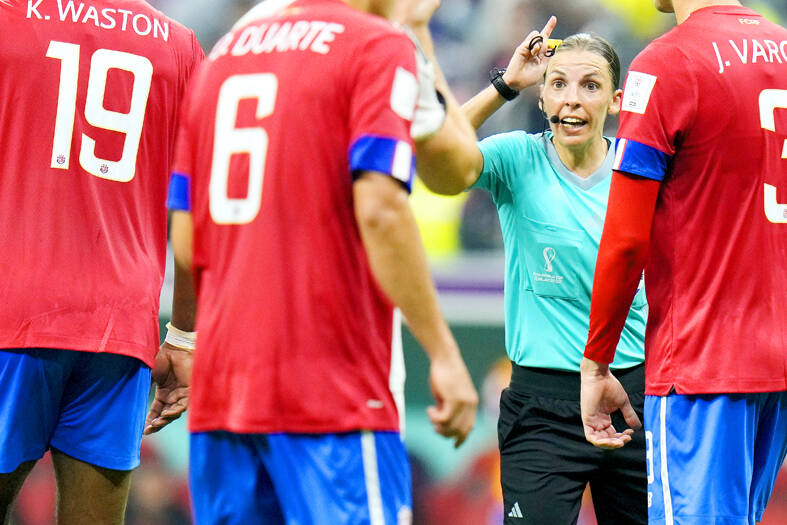
Photo: AP
Their ambition is to increase female match officials in all sports in France, which currently has an estimated 80-20 split for male referees.
“It starts with a change in mentality. Football is played more by men and maybe in handball it’s equal. So to begin with you have to increase the numbers of women playing football, which in turn increases the number of referees,” Frappart said in a telephone interview. “Last season, we had a 14 percent increase compared with the season before and now, halfway through the season, we already have 5 percent more female referees than last season.”
Frappart says the French soccer federation is fully committed to having more female referees and to more women in the sport’s governance, but La Poste’s committee says the main barriers facing aspiring female referees at the outset are lingering sexism and misogyny.
“We remain confronted by certain stereotypes which are difficult to get beyond ... something still anchored in certain cultures and mentalities,” Frappart said. “We have to communicate more on the place women have in football and in society. In media terms, the more women’s soccer is shown on television and the more women’s sport is shown on television, that will change things.”
Frappart was also the first woman to take charge of a men’s UEFA Champions League match, back in 2020.
Across more than a decade officiating in men’s games — including the Coupe de France final and World Cup qualifiers — has Frappart received sexist comments?
“Not from players and coaches, but from people in the stands,” she said. “There have been some chants and comments.”
Frappart became the first woman to take charge of a professional men’s game when she refereed a second-tier French league match in 2014.
Others were more worried that day than she was.
“For me it was a normal progression. It didn’t make me feel particularly emotional, but I remember one of the directors from [soccer club] Brest who asked me: ‘Are you not too stressed?’” she said. “I replied: ‘Well, actually it’s not my first game.’ It was a higher level match, but not my first.”
Five years later, Frappart took charge of a top-tier game between Amiens SC and RC Strasbourg.
Her ascension continued when she refereed Germany versus Costa Rica in 2022 at the men’s FIFA World Cup in Qatar.
She said the context of the tournament shielded her from the impact this was having back home.
“I know in France there was a lot of excitement, but [in Qatar] we were more protected in terms of the media, because I was far away and not in my country. We were in a bubble,” she said. “The moment which had more impact, where you realized the importance of the game, was in Ligue 1. You turned the TV on and you were on it.”
There was another first for Frappart when she headed a trio of female officials for a Ligue 1 game in 2023, along with assistant referees Manuela Nicolosi and Elodie Coppola. Later that year, Rebecca Welch became the first female referee in the English Premier League.
Frappart is optimistic women’s soccer would continue gathering pace.
US defender Naomi Girma last weekend became the first women’s million-dollar transfer when she moved from San Diego Wave to Chelsea.
It is far from the men’s record of US$231 million that Paris Saint-Germain paid for Neymar, and Girma’s salary will not be anything near what Erling Haaland receives from Manchester City after signing a 10-year deal.
Frappart sees it differently.
“You shouldn’t compare what happens in women’s soccer and in men’s soccer, they are two separate entities with a different economy, but what I would say is that it’s good that transfers like these are starting to happen,” Frappart said. “It’s a positive evolution which shows there are human and financial measures for the development of women’s soccer. Some years ago there were no contracts and the players were still amateurs. Now there is genuine progression, we must push for this to continue.”

Memphis Grizzlies forward Brandon Clarke, 29, has died, the NBA team said in a statement on Tuesday, while the family of Jason Collins, the first openly gay man to play in a major US pro sports league, announced the former Grizzlies and Brooklyn Nets player had died after a battle with brain cancer. “We are heartbroken by the tragic loss of Brandon Clarke,” the Grizzlies said in a statement posted on social media. “Brandon was an outstanding teammate and an even better person whose impact on the organization and the greater Memphis community will not be forgotten.” The statement did not provide

Mathys Tel was hero and villain as Tottenham drew 1-1 at home to Leeds United on Monday — a result that leaves their English Premier League future hanging in the balance. The Frenchman broke the deadlock early in the second half to ease the tension at Tottenham Hotspur Stadium, but then gave away a penalty with a reckless attempted clearance. In the dying minutes, Spurs were grateful to Antonin Kinsky, who produced an astonishing save to deny the visitors a win. Tottenham are now two points clear of 18th-placed West Ham United with just two games left this season. The

Houston Astros right-hander Teng Kai-wei, the only active Taiwanese pitcher in MLB, on Sunday suffered his third loss of the season, throwing a season-high 63 pitches in his second start of the year. Teng allowed three earned runs over three innings on five hits in the Astros’ 5-0 road loss to the Cincinnati Reds. He struck out one, walked one, and hit one batter among the 15 hitters he faced, raising his earned run average to 3.12. It was the Astros’ second attempt to use the 27-year-old Taiwanese as a starter, after he had established himself as a reliable bullpen

‘DONE IT ALL’: LeBron James is now out of contract with the Lakers and would head into the off season as a free agent with uncertainty swirling around his future LeBron James on Monday said he would take time to consider his future after the Los Angeles Lakers were swept out of the NBA playoffs by the Oklahoma City Thunder in what could turn out to be the final game of his career. James, 41, delivered a typically defiant performance with 24 points and 12 rebounds, but it was not enough to prevent the Lakers from falling 115-110 as the Thunder completed a 4-0 sweep in the Western Conference semi-finals series. The four-time NBA champion is now out of contract with the Lakers and would head into the off season


 RSS
RSS