


Dubbed a “motorway for cyclists” where avid amateurs can chase Tadej Pogacar up mountains teeming with the highest concentration of professional cyclists per square kilometer in the world, Spain’s Costa Blanca has forged a new reputation for itself in the past few years.
Long known as the ideal summer destination for those in search of sun, sea and sand, the stretch of coast between Valencia and Alicante now has a winter vocation too.
During the season break in December and January, the region experiences an invasion of cyclists.
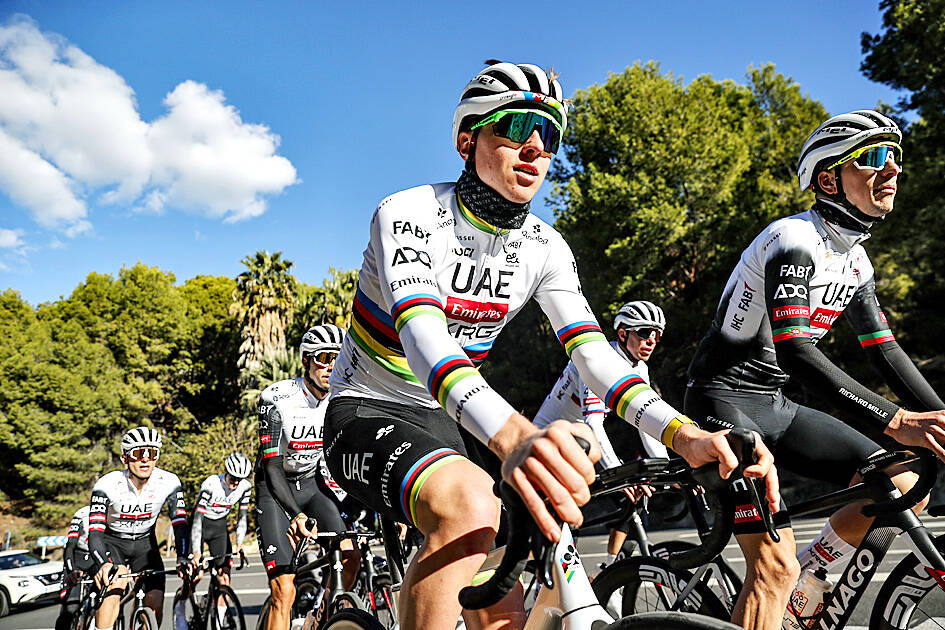
Photo: EPA-EFE
Star names such as three-time Tour de France winner Pogacar, Remco Evenepoel and Julian Alaphilippe flock to the southeast of Spain to take advantage of the Costa’s Mediterranean climate, its little-used roads and its bustling seaside hospitality sector that rolls out the red carpet for them from Calpe to Benidorm.
Sixteen of the 18 men’s World Tour teams have set up their winter quarters there to prepare for the new season, with some riders staying on privately between camps to take advantage of the conditions. Belgian double Olympic gold medalist Evenepoel has even bought an apartment in the area.
“Within a 50km radius, 80 percent of the peloton is here at the same time in December and January, and sometimes even in February. It’s quite unique,” said Philippe Mauduit, race director of Groupama-FDJ.
Add in the women’s teams, outfits from lower divisions and even the juniors, and it can all build quickly into a traffic jam.
“Just yesterday we were doing tests on the Coll de Rates. It was like a motorway for cyclists, there were cyclists everywhere,” said Spanish rider Alex Aranburu, a new arrival at Cofidis.
“Sometimes it’s hard to do the exercises because it’s so crowded,” added Frenchman Valentin Paret-Peintre of Soudal Quick-Step. “There are other cool places to ride in Spain, but everyone comes here. It’s fashionable.”
Rush hour on the Coll de Rates — where Pogacar just set the record ascent — looked like a scene from downtown Manhattan.
As the pros go rhythmically up and down the hill as part of their training exercises, they are tracked by bands of enthusiastic amateurs keen to see their favorite riders.
“They get into the peloton, they follow as long as they can, they turn around because they come across another team. For us, it’s not disruptive. On the contrary, it creates a nice atmosphere,” Mauduit said.
The same point is highlighted by organizers of local cycling tours.
“I get a lot of people writing to me asking if it’s possible to see the pros,” said Iliana Roumenova Ilkova, a former Bulgarian professional ballerina who set up Paradisebike13 to guide enthusiasts around Calpe. “As I know a few of the riders, they tell me where they’re going, so I arrange for us to be there, too. The other day we ran into Pogacar and Alaphilippe, who said hello to me.”
However, there is a flip side to the vast influx of cyclists.
In the village of Parcent, nestled at the foot of the Coll de Rates, “property prices have doubled,” she said.
Hoteliers down by the coast are rubbing their hands.
Thanks to the arrival of cyclists, bolstering the traditional numbers of British and Dutch retirees, accommodation providers are able to stay open all year.
“We’re made very welcome, with beautiful rooms with sea views, a very high standard of catering, meeting rooms, and all this at attractive rates,” Mauduit said.
“And that helps them [hoteliers] to maintain the employment pool,” he added.
The Groupama-FDJ race director also pointed to the Costa Blanca’s accessibility as another advantage.
“We’re halfway between Valencia and Alicante, so that gives you a range of low-cost flights. In December, 120 people go. If you pay 60 euros (US$61.86) for your plane ticket instead of 600 euros, it’s a great help for your budget,” he said.
In Calpe, several teams often stay in the same hotels, which is not necessarily to the liking of all the pros.
For Paret-Peintre, that means he can go riding and have a coffee with friends.
“In competition, I’ll do everything I can to beat them,” the 23-year-old rider said. “But in training or at the hotel, they are first and foremost colleagues.”

NO HARD FEELINGS: Taiwan’s Lin Hsiang-ti and Indonesia’s Dhinda Amartya Pratiwi embraced after fighting to a tense and rare 30-29 final game in their Uber Cup match The Taiwanese men’s team on Wednesday fought back from the brink of elimination to defeat Denmark in Group C and advance to the quarter-finals of the Thomas Cup, while the women’s team were to face South Korea after press time last night in the Uber Cup quarter-finals in Horsens, Denmark. In the first match, Taiwan’s top shuttler Chou Tien-chen faced a familiar opponent in world No. 3 Anders Antonsen. It was their 16th head-to-head matchup, with the Dane taking his fourth victory in a row against former world No. 2 Chou, winning 21-14, 13-21, 21-15 in 1 hour, 22 minutes. The

Jannik Sinner continued his quest to become the first man in history to win five Masters 1000 tournaments in a row with a 6-2, 6-3 victory over Danish qualifier Elmer Moller at the Madrid Open on Sunday. The world leader extended his winning streak to 19 matches, a run that began early March in Indian Wells, and he has captured 24 consecutive victories at the Masters 1000 level, dating back to the Paris Masters last October. Searching for a maiden title at this level on clay, Sinner advanced to the round of 16 at the Caja Magica with a 77-minute performance against

Tennis players are facing an unexpected opponent at the Madrid Open. A stomach virus or food poisoning has affected Iga Swiatek, Coco Gauff, Marin Cilic and others, raising concerns. World No. 1 Aryna Sabalenka avoided an upset by Naomi Osaka on the court on Monday and said she is trying to avoid illness by sticking to a diet of chicken breasts, rice and salad. The rumor among the players was bad shrimp tacos were to blame. Sabalenka knocked on wood for luck and said, “So far, so good. I heard that I have to avoid those tacos,” she laughed, adding “I stick to the

Throwing more than US$5 billion at a divisive new tour and walking away after five seasons does not look like good business, but LIV Golf was not all bad news for Saudi Arabia. Oil-funded LIV, which poached top stars and sent golf’s establishment into a tailspin, helped push the conservative kingdom into global view — one of its key aims, experts said. The exit, confirmed on Thursday after weeks of speculation, does not signal a flight of Saudi money from sport, even after the Middle East war that sparked Iranian attacks around the Gulf, they said. “Saudi Arabia is not


 RSS
RSS