


As the drummers walk onto the field, the players behind them smack their hickory sticks to the beat. The rhythm envelops the stands and a palpable sense of anticipation flows through the crowd.
Indigenous people have been playing stickball for hundreds of years, and every summer since 1975, teams have competed in Mississippi to become champion of perhaps the oldest game in North America.
A game of physicality and endurance, stickball is often referred to as the grandfather of field sports and the annual tournament in Mississippi is the game’s premier event.
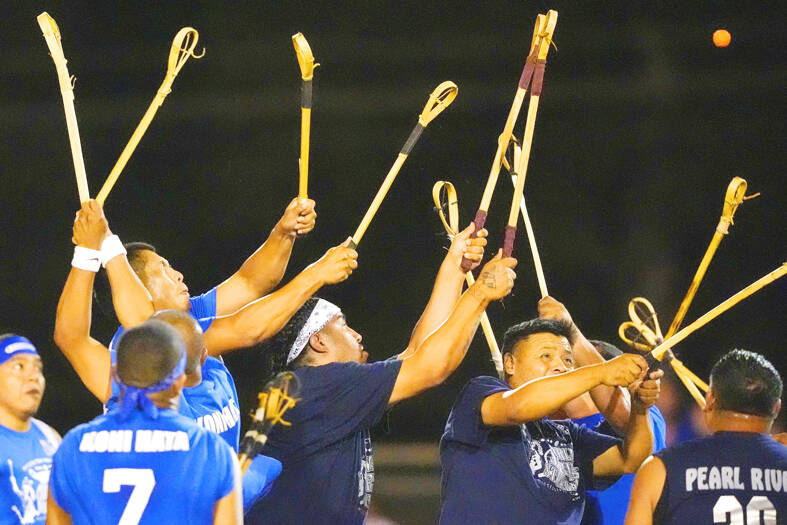
Photo: AP
The Mississippi Band of Choctaw Indians has been producing some of the country’s best players for generations. A team from Mississippi will almost certainly be the one to beat in any tournament or exhibition game in the country.
As the July sun set on another sweltering day, hundreds of people gathered at the Choctaw Central High School football field and sat down on the Indian blankets they had draped across the metal seating. Others lined their folding chairs along the chain-link fence to get a glimpse of the action.
Stickball, known as ishtaboli in the Choctaw language, is played with 30 players on the field, each carrying two netted sticks called kabotcha and a small woven leather ball painted bright orange, called a towa.
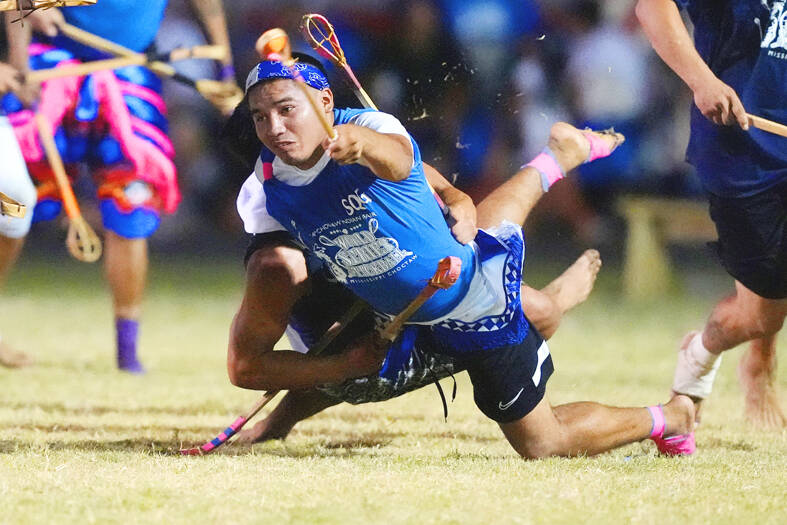
Photo: AP
Stickball fans say it remains pure. There are no pads, no timeouts and no mercy. Players typically do not even wear shoes. It is not uncommon for people to leave the stickball field with broken bones from full contact or gashes from taking a stick to the face. Any player possessing the ball can expect to be tackled or torn down by their jersey or breechcloth.
“It makes your heart just beat like a drum. Just the intensity of the sport,” Mississippi Band of Choctaw Indians Chief Cyrus Ben said. “At the end of the day, it doesn’t matter what color jersey or what team, it’s being Choctaw.”
Although the game is high-contact, it is so respected by the Choctaw, and so central to their cultural identity, that no hit is taken personally, no matter how intense. Players often slam each other so hard that their sticks go flying through the air and they simply get back up, nod to each other and race down the field after the ball.
Variations on stickball have traditionally been played by several tribal nations using rules created by the Mississippi Band of Choctaw Indians.
Players are not allowed to hit each other with their sticks, although that happens routinely when players huddle around a loose ball. Late and early tackles are prohibited and anything above the shoulders is off-limits.
Chief Ben, like many at the event, was given a pair of sticks as soon as he could walk. Some recall sleeping with them above their pillows and a ball underneath. Boys and girls play together in the youth tournaments the night before the men’s and women’s championship games every year at the Choctaw Indian Fair. All over town are children with sticks poking out of their backpacks.
The field is never empty. Children play stickball before every game — living out their fantasy of one day claiming victory on the same field. Between that, the snow-cone stand, and the almost fanatical way the assistant coaches scream from the sidelines, it is as familiar as any Friday night high-school football game.
This year, Koni Hata, last year’s men’s champions and one of the most dominant teams in the modern era of stickball, defended their dynasty in the men’s and women’s title games against neighboring Choctaw communities such as Pearl River and stickball powerhouse Bok Cito.
The finals started with the women’s championship, Bok Cito Ohoyo taking on Koni Hata Ohoyo, who were looking for their second threepeat in the past seven years. Scoreless at the end of regulation play, the game was decided in sudden death when Bok Cito Ohoyo center shooter Leia Phillips scored with a running midfield shot.
“I said: ‘Yeah, it’s my time to shine, this is my shot right here, you worked all year for this,’” Phillips said after the game.
The men’s game between Koni Hata and Pearl River was highly physical, and several skirmishes for the ball ended with sticks shooting through the air “like my nine-iron,” one announcer said.
Several players were treated by medics for a variety of injuries, including a bleeding eye and a gash across the forehead. Earlier in the tournament a player sustained a broken nose.
Pearl River had no trouble scoring during tournament play, racking up an impressive 41 points in their first three games. They scored in the first half, but the point was negated for having 31 players on the field. Koni Hata scored in the second half, but that point was also taken away for having too many players on the field.
However, Pearl River scored late in the fourth quarter and took home the ceremonial drum presented by Chief Ben.
As the Choctaw Indian Fair was winding down, Jackie Morris, the coach of the team from the community of Bok Cito, waited in line for a hot dog. He made sure that every passing Bok Cito player had a chance to sign the drum slung over his shoulder.
“This is what we play for,” he said, patting the trophy.
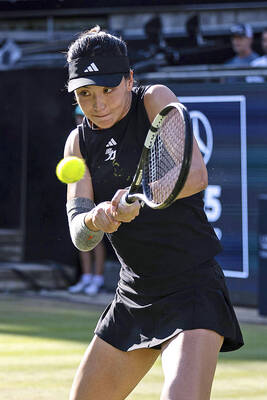
Twelve days after winning her second Grand Slam title at the French Open, Coco Gauff fell at the first hurdle on grass in Berlin on Thursday as beaten Paris finalist Aryna Sabalenka advanced to the quarter-finals. Recipient of a first round bye, American Gauff lost 6-3, 6-3 to Chinese qualifier Wang Xinyu as world number one Sabalenka beat Rebeka Masarova 6-2, 7-6 (8/6) in her second round tie. Winner of 10 main tour titles, including the US Open in 2023 and the WTA Finals last year, Gauff has yet to lift a trophy in a grass-court tournament. “After I won the first

Sergio Ramos on Tuesday outfoxed two Inter players and artfully headed home the first goal for Monterrey at the FIFA Club World Cup. The 39-year-old Ramos slipped through the penalty area for the score just as he did for so many years in the shirts of Real Madrid and Spain’s national team, with whom he combined smarts, timing and physicality. Ramos’ clever goal and his overall defensive play at the Rose Bowl were major factors in Monterrey’s impressive 1-1 draw against the UEFA Champions League finalists in the clubs’ first match of the tournament. “There is always a joy to contribute to the

Aaron Civale got a little wild in the right-hander’s first start for the Chicago White Sox two days after he was traded by the Milwaukee Brewers. Civale on Sunday walked four of the first seven hitters he faced in a 2-1 loss to the Texas Rangers. The 30-year-old finished with four walks, one off his career high, while allowing six hits and two runs in five innings. He threw 65 strikes and 39 balls. Chicago trailed 2-1 when he was replaced by Dan Altavilla to start the sixth. “Not the cleanest,” Civale said. “It’s been a whirlwind of a week. First couple

DOMINANT JUVENTUS: Randal Kolo Muani and Francisco Conceicao both scored braces as Juventus made a statement in their opener with a big win over Al-Ain Phil Foden on Wednesday scored two minutes into the match and later had an assist to lead Premier League powerhouse Manchester City past Moroccan club Wydad AC 2-0 at the FIFA Club World Cup. City broke Wydad’s five-man defensive line early when Foden scored on a deflected cross by goalkeeper El Mehdi Benabid. Jeremy Doku doubled City’s lead in the 42nd minute off a corner-kick from Foden. Shortly afterward, an animal-rights advocate ran onto the field to protest Morocco’s treatment of stray dogs and cats. The man was tackled by security workers and escorted out of Lincoln Financial Field, which was just over


 RSS
RSS