


Afghan rider Sarwar Pahlawan blinked away pain from the fresh stitches between his eyes as his buzkashi team chased victory in a tournament for an ancient sport still steeped in risk, but now offering modern-day rewards.
Played for centuries in Afghanistan’s northern steppes, the national sport at the heart of Afghan identity has evolved from a rough, rural pastime to a professionalized phenomenon flush with cash.
“The game has changed completely,” the horseman, soon to turn 40, said after returning home victorious from the tournament final in the northern city of Mazar-i-Sharif earlier this month.
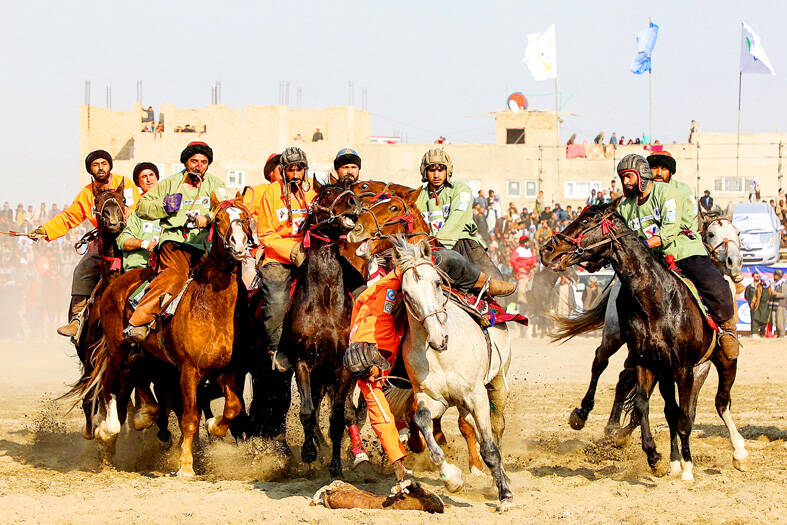
Photo: AFP
After 20 years as a buzkashi rider, or “chapandaz,” Sarwar welcomes the changes to the game, which is played across Central Asia and features elements akin to polo and rugby.
“They used to pay us with rice, oil, a carpet or a cow,” he said, but today the chapandaz have professional contracts.
The best players can earn US$10,000 per year, with winning teammates sharing US$35,000, three camels and a car offered by sponsors after clinching the title.
Traditionally, buzkashi is played with the headless body of a goat.
Today, more often a 30kg leather sack stands in for the carcass that riders try to pull from a fray of horses and drop in a “circle of justice” traced on the ground after doing a lap of the arena at full gallop with competitors in hot pursuit.
Training has changed, too, as the national league’s top teams have evolved.
Robust horsemen no longer hang from trees or split wood to build muscle — they lift weights in gyms.
“Before, when we returned from a tournament, cold water was poured on our shoulders, now we have hammams [bath houses] and saunas,” said Sarwar, known as “the lion” for his strength.
Being one of the league’s best players has also filled Sarwar’s coffers.
“I didn’t even have a bike, and now I have a car. I had almost no sheep and now I have many. I had no house, and now I have two,” he said.
However, he remains “a simple man,” he said, adding that between tournaments, he cultivates his land and raises his sheep.
Oil tycoon Saeed Karim is the biggest financier of the new buzkashi.
The Afghan businessman set up the winning team that bears his company’s name, Yama Petroleum, five months ago.
He acquired the two best chapandaz in the country, including Sarwar, and about 40 competition horses, which can cost up to US$100,000 each.
“In this team, we invested around a million dollars in horses, riders, stables and other equipment,” Karim said.
“I just want to serve my people,” he said. “When my team wins, it’s an honor for me.”
It can cost about US$300,000 a year to take care of the team’s stallions, fed on barley, dates, carrots and fish oil, as well as 15 riders and 20 grooms.
For the comfort of his men — who commonly sustain broken ribs, fingers and legs — Karim had a four-hectare ranch built for recuperation and stabling horses.
Taliban authorities, who banned the sport between 1996 and 2001, have allowed it since returning to power in 2021.
“Buzkashi is this nation’s passion,” Buzkashi Federation president Ghulam Sarwar Jalal said. “The Taliban know that it makes people happy, that’s why they authorize it.”
They also collect taxes from the professional league, started in 2020, which includes 13 teams from 10 provinces.
The influx of money has transformed buzkashi.
“More fans come because they know there are more good horses and good teams have been added to the field,” Karim said.
Ten thousand men filled the Mazar-i-Sharif stadium for the final, braving Taser shocks or blows from club-wielding Taliban authorities tasked with holding back the crowds.
“We want to make it a sport as colorful as football or cricket,” Jalal said. “The more commercial it is, the more international it will become.”
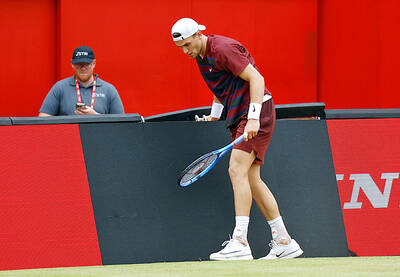
While British star Jack Draper spent the past week trying to find rhythm and comfort in his first grass tournament of the season at the Queen’s Club Championships in London, Jiri Lehecka on Saturday bulldozed everything in his path. After more than two furious hours of battle, their form was reflected in the final scoreline as Lehecka toppled a frustrated Draper, the second seed, 6-4, 4-6, 7-5 to reach the biggest final of his career, against Carlos Alcaraz. Lehecka is also the first Czech to reach the men’s title match at Queen’s since Ivan Lendl lifted the trophy in 1990. Draper, who

Top-ranked Aryna Sabalenka staged a “crazy comeback,” saving four match points before beating Elena Rybakina 7-6 (6), 3-6, 7-6 (6) in the quarter-finals of the Berlin Open on Friday. Sabalenka was 6-2 down in the final-set tie-breaker, but won six straight points to reach her eighth semi-final of the season. “Elena is a great player and we’ve had a lot of tough battles,” Sabalenka said. “I have no idea how I was able to win those last points. I think I just got lucky.” “I remember a long time ago when I was just starting, I won a lot of matches being down

The Canterbury Crusaders edged the Waikato Chiefs 16-12 in an intense Super Rugby Pacific final battle in Christchurch yesterday to claim their 15th title in 30 years of the Southern Hemisphere competition. Hooker Codie Taylor scored a try and Rivez Reihana contributed 11 points from the kicking tee as the most dominant team in Super Rugby history extended their perfect home playoff record to 32 successive matches since 1998. The Chiefs, who were looking for a first title since 2013, scored first-half tries through George Dyer and Shaun Stevenson, but were unable to register a point after the break and fell to
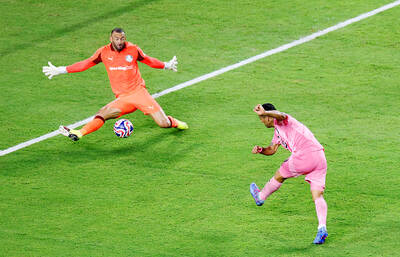
REUNION: Former Barcelona players Luis Suarez, Lionel Messi, Sergio Busquets, Jordi Alba and Miami coach Javier Mascherano are to face their former coach Luis Enrique Inter Miami’s Lionel Messi faces a tantalizing reunion with former club Paris Saint-Germain in the FIFA Club World Cup last 16 after both sides on Monday progressed to the knockout phase. Miami drew 2-2 with Palmeiras to go through second in Group A, after the Brazilian side fought back from two goals down to seal top spot. They now face an all-Brazil clash against Botafogo, who lost 1-0 to Atletico Madrid, but progressed from Group B in second at the expense of the Spaniards. Champions of Europe PSG won the group with a 2-0 victory over Seattle Sounders, paving the


 RSS
RSS