


For the four Iraqi athletes who have made it to Tokyo, there is no realistic talk of medals. Having overcome war, politics and the COVID-19 pandemic, their dream is simply to participate.
With state financial support cut off by political infighting for most of the run-up to the Games and their locked-down foreign coaches unable to offer more than virtual advice, Iraq’s small squad of Olympians made almost entirely by their own efforts.
Right up to November of last year, when a new national Olympic head was elected, watched over by the International Olympic Committee (IOC) by video link, Iraq’s participation in the Games was in doubt.
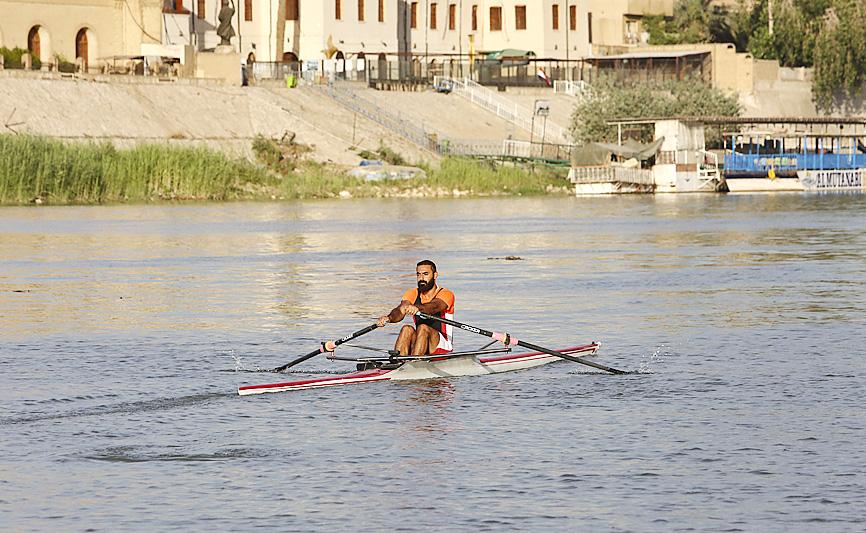
Photo: AFP
A nearly two-year battle for control of the National Olympic Committee’s US$25 million budget had seen Iraq ostracized by the IOC and its athletes deprived of the monthly stipends they rely on to prepare for competitions.
Despite the loss of state financial support and the difficulties of traveling to qualifying events during the pandemic, two Iraqi hopefuls managed to qualify for Tokyo.
Rower Mohammed Ryadh, 27, would take part in the men’s single sculls for the second Games in a row.
He has no illusions about his medal chances after his French coach of the past nine years, Vincent Tassery, was prevented by restrictions linked to the pandemic from traveling to Baghdad for the rower’s training sessions on the Tigris.
“I have a French trainer and because of COVID he hasn’t been able to come to Iraq, so he sends me instructions by e-mail that I have to work on by myself,” Ryadh said at his makeshift training base on the river bank.
“So the goal is just to take part in the Olympic Games. We both know it’s not worth even thinking about a medal,” the rower added.
To date, Iraq has won just a single Olympic medal — a silver for weightlifting in Rome in 1960 — but it is not for want of trying.
At the 2016 Rio Games, 21 Iraqi athletes competed in an array of disciplines including soccer, judo, boxing and athletics, as well as rowing.
This year, just one other Iraqi apart from Ryadh qualified as of right — sprinter Dana Hussein, 35, for the women’s 200m.
Hussein left it until the middle of last month to claim her berth with a qualifying time of 22.51 seconds, as she took gold in the pan-Arab athletics championship in Tunis. Two other Iraqis were handed wildcard slots after coming close to their qualifying scores — 400m specialist Taha Hussein and shooter Fatima Abbas.
The four makes up Iraq’s smallest squad of Olympians since its Games in London in 1948.
Iraq’s Olympians were all children when former Iraqi president Saddam Hussein’s long years in power came to an end in the US-led invasion of 2003.
The country’s Olympic movement is only now recovering from the brutal two-decade grip of his eldest son, Uday Hussein, who allegedly tortured athletes he deemed to have underperformed.
The committee Uday Hussein headed was dissolved by the US-led occupation authority after the invasion, along with all of the other instruments of Saddam Hussein’s rule.
The manner of its dissolution, and that Saddam Hussein’s Iraq took part in multiple Olympics before his overthrow, left a question mark over the legitimacy of the body that replaced it.
That cleared the way for the Iraqi Ministry of Youth and Sports to launch a campaign to oust it in February 2019, leaving athletes in financial limbo as the rump committee battled for control with a commission appointed by the ministry.
A new committee was finally set up last year, when in November it held fresh elections to the IOC’s satisfaction and Iraq returned to the Olympic fold.
Little of the state funding filters down to help individual athletes cover the travel and training costs involved in qualifying.
“What’s sad is that you go to these qualifying events and our authorities really don’t care,” Dana Hussein said.
“It’s taken me 18 months of effort to book my place in Tokyo. I myself had to pay many of the costs of getting training abroad because the athletics federation has very limited means,” she said.
Dana Hussein called for the Iraqi authorities to draw up a long-term plan for the investment in sports infrastructure the country was deprived of during decades of war and international sanctions.
“We need a long-term roadmap — money, equipment and a modern sports infrastructure,” she said.
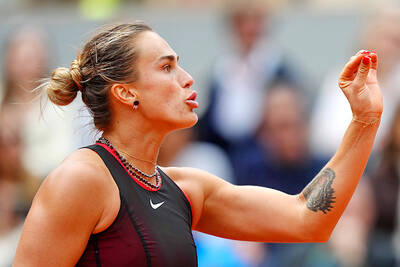
After letting another big lead slip with an error-strewn performance at the French Open on Wednesday, top-ranked Aryna Sabalenka felt like getting as far away from the courts as possible. “Just want to quit tennis right now,” Sabalenka said after wasting a lead of a set and two breaks in a 3-6, 7-5, 6-0 loss to Diana Shnaider in the women’s singles quarter-finals. “We’ll see in few days. Hopefully I’ll get back on track mentally.” Sabalenka’s wait for a first French Open title continues despite the four-time major winner leading 4-1 in the second set and being two points from victory while
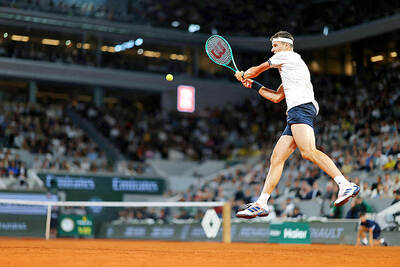
BIG NAMES GONE: Zverev is the clear favorite for a maiden Grand Slam title, reaching semi-finals for the fifth time in six years and finishing second on three occasions Alexander Zverev on Tuesday breezed past Rafael Jodar to stay on course for an elusive Grand Slam title at the French Open, while Jakub Mensik halted Joao Fonseca’s scintillating run in the quarter-finals. Zverev, the highest-ranked player left in the men’s draw, put an end to Spanish teenager Jodar’s impressive Roland Garros debut, easing into the semi-finals with a 7-6, (7/3), 6-1, 6-3 win. The 29-year-old Zverev is the clear favorite for a maiden Grand Slam title. He has finished runner-up on three occasions, including at the 2024 French Open. “I want to win the matches that are ahead of

For some, Cristiano Ronaldo remains the essential spearhead for Portugal’s FIFA World Cup bid, while others believe his presence would prevent Roberto Martinez’s strong side from flourishing. The debate around the five-time Ballon d’Or winner rages on, as it did at UEFA Euro 2024 and four years ago in Qatar — yet Ronaldo endures, ready to play in a record sixth World Cup. The 41-year-old remains a global superstar despite swapping the European elite for Saudi Arabia’s Al-Nassr, and is the leading men’s international goalscorer with 143 strikes. With 25 of those coming in 30 games under Martinez, the coach
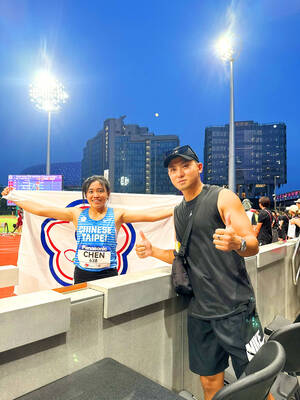
Taiwanese sprinter Chen Yi-cen on Friday won the silver medal in the women’s 400m final at the Asian U20 Athletics Championships in Hong Kong, with a time of 53.16 seconds. Chen, 15, was the youngest among the eight finalists, and her performance also met the qualifying standard of 53.50 seconds for the Nagoya Asian Games in Japan in September and October. Chen first made her mark at the National Games in Tainan in 2023, at the age of 13, winning the women’s 400m final in 55.55 seconds to become the youngest gold medalist in the history of the event. Meanwhile,


 RSS
RSS