


Uncertainty grips next year’s postponed Tokyo Olympic Games: Will there be fans or empty stadiums in 14 months? How will thousands of athletes, staff members and technical officials travel, be housed and stay safe amid the COVID-19 pandemic?
And the Tokyo Games are not the only event.
China, where COVID-19 was first detected, is to hold three mega-sports events in the year after the Tokyo Olympics are set to close.
Photo: EPA-EFE
The World University Games in Chengdu, China, are to open, with up to 8,000 athletes, only 10 days after the Tokyo Games close.
Next come the Beijing Winter Olympics beginning on Feb. 4, 2022, and the Asian Games in Hangzhou, China, from Sept. 10.
The previous edition of the Asian Games, hosted by the Indonesian cities of Jakarta and Palembang in 2018, drew 11,000 athletes and featured more sports than the Olympic Games.
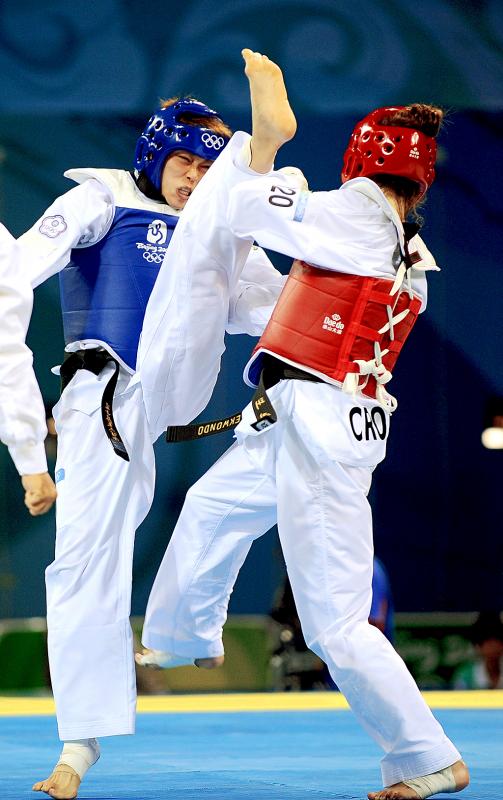
Photo: Jung Yeon-je, AFP
A fourth major event, soccer’s 24-team Club World Championship, was to open in China in June next year, but it has been postponed because of scheduling conflicts created by the pandemic.
China is a go-to country for these mega-events, through expertise gained from the 2008 Beijing Olympics and because it absorbs the massive costs.
The country spent at least US$40 billion to organize the 2008 Olympics, and there was no national debate since the authoritarian state prohibits voting or referendums.
Europeans and North Americans have repeatedly voted down referendums to host the Games.
China landed the 2022 Winter Olympics when several European bidders withdrew. Beijing won narrowly in a vote by the International Olympic Committee (IOC) against Almaty, Kazakhstan.
“Telling the citizens of Bavaria or Switzerland that another Winter Olympics would benefit them greatly doesn’t work,” said Jonathan Grix, who studies sports policy at Manchester Metropolitan University.
“Voters sense that citizens rarely benefit the most from such events,” Grix added. “Authoritarian states have no need to ask the populace, they have no need to compromise on policy, there is no political opposition (by definition) and most delivery services are state-run, ensuring the smooth running of the event.”
Japanese and IOC officials have given few details about how the Tokyo Olympics are to be staged, the cost of postponement or who is to pay for the delay, but they have teased the problems and floated tenuous solutions.
One thing has been decided: If the Games cannot open on July 23 next year, they are to be canceled.
In a joint news conference last weekend, WHO Director-General Tedros Adhanom Ghebreyesus said that it would not be “easy” to make the Olympics a safe global gathering spot, but added with confidence: “I think it’s possible.”
IOC president Thomas Bach has been cautious in speculating how the Olympics can be held.
He has suggested a possible quarantine for athletes, hinted at limited fan access to venues, and has not ruled out events in empty stadiums.
Of course, Bach adds that empty stadiums is not his preferred solution.
IOC member John Coates, who oversees preparations for Tokyo, has been direct.
“We’ve got real problems because we’ve got athletes having to come from 206 different nations,” Coates said, speaking at a News Corp Australia digital forum. “We’ve got 11,000 athletes coming, 5,000 technical officials and coaches, 20,000 media. There are also about 4,000 working on the organizing committee and an expected 60,000 volunteers.”
Some scientists in Japan and elsewhere believe that a vaccine is needed to guarantee safety for athletes, while some have questioned whether young, healthy athletes should be a priority for vaccination.
Another challenge is guaranteeing the safety of fans, who have bought millions of tickets.
If there are no fans, will there be refunds? Will there be lawsuits?
Tickets provide at least US$800 million in revenue for local organizers, whereas the added cost of postponing the Tokyo Games has been estimated at US$2 billion to US$6 billion.
“Sponsors and business partners of the Games will have to keep investing extra money in their marketing programs for Tokyo if the games are postponed, potentially forcing them to reduce their budgets for the next Olympics,” former Chinese Olympic Committee secretary-general Wei Jizhong told the China Daily.
Sheena Greitens, who studies Asian politics at the University of Texas at Austin, said that large sports events give China high visibility and “can keep reporters focused on the sporting events rather than having them use their time in-country to dig around on other topics that might reflect poorly on the CCP [Chinese Communist Party].”
“They provide a way for China to boost its cultural and ‘discourse power’ globally,” Greitens added.

Taiwan’s men’s table tennis team won bronze on Saturday at this year’s International Table Tennis Federation World Team Table Tennis Championships in London, matching the country’s best-ever finish at the regular tournament. Consisting of Lin Yun-ju, Taiwan’s top-ranked player at world No. 7, Feng Yi-hsin, Kuo Guan-hong, Hong Jing-kai and Hsu Hsien-chia, the team won bronze after losing 0-3 to Japan in the semifinals. In the opening match, 24-year-old Lin played the first game against world No. 3 Tomokazu Harimoto 11-5, but ultimately lost the next three closely contested games 9-11, 10-12 and 10-12. Feng then faced world No. 8 Sora Matsushima in

Taiwanese fire dancer Yang Li-wei advanced to the final of Britain’s Got Talent this weekend after receiving a Golden Buzzer during her live semi-final performance. Yang, a member of Taiwan’s Coming True Fire Group, awed judges and audiences with a high-intensity fire performance featuring flaming umbrellas, fire swallowing and spinning metal structures balanced with her legs. Judge Simon Cowell praised Yang as a star, while guest judge KSI reacted with amazement before pressing the Golden Buzzer, sending her to the finals. The dance group wrote on social media that the Golden Buzzer was “the highest honor” on the talent show, adding: “Twenty-three years

Memphis Grizzlies forward Brandon Clarke, 29, has died, the NBA team said in a statement on Tuesday, while the family of Jason Collins, the first openly gay man to play in a major US pro sports league, announced the former Grizzlies and Brooklyn Nets player had died after a battle with brain cancer. “We are heartbroken by the tragic loss of Brandon Clarke,” the Grizzlies said in a statement posted on social media. “Brandon was an outstanding teammate and an even better person whose impact on the organization and the greater Memphis community will not be forgotten.” The statement did not provide

As Super Rugby fast approaches its playoff season it finds itself racing toward a reckoning with many issues that threaten the southern hemisphere tournament. A group of stakeholders met in the New Zealand city of Christchurch late last month to address problems that are making the future of the 31-year-old competition increasingly tenuous. The discussion was made more urgent by the decision by the owners of Moana Pasifika to fold the Auckland-based club for financial reasons. That followed the closure of the Melbourne Rebels at the end of the 2024 season, likewise because of financial difficulties. Problems addressed included player retention as more


 RSS
RSS