


It is known as the “May 19 Incident” and by some estimations it still haunts China’s national soccer team 35 years on.
On May 19, 1985, China were stunned 2-1 at home by neighbors Hong Kong, then still under British rule, on one of the most infamous nights in Chinese soccer history.
It is notorious not just because China’s hopes of qualifying for the FIFA World Cup for the first time ended in calamity. After the match, fans in Beijing rioted, smashing up vehicles, attacking buses, and threatening foreign journalists and diplomatic staff.
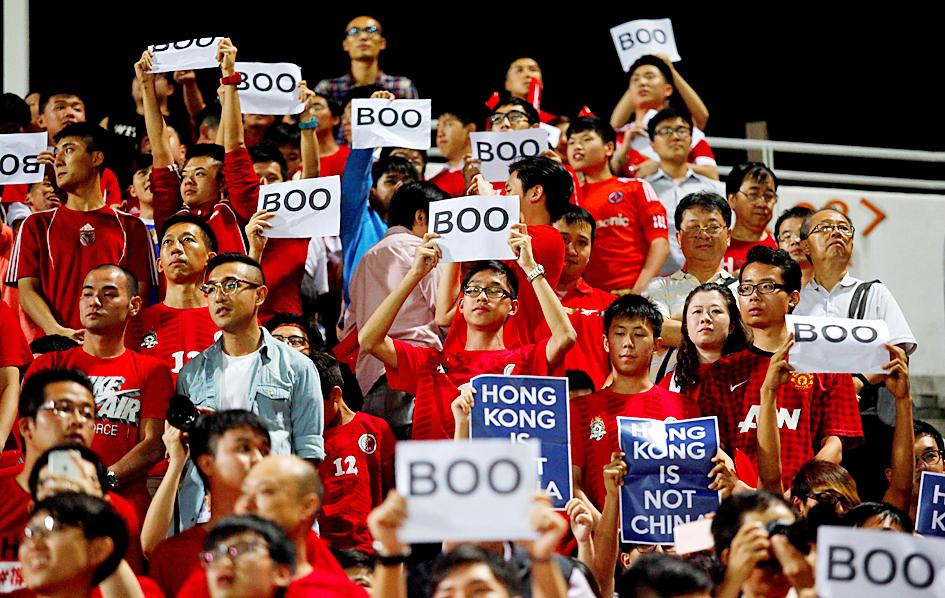
Photo: AFP
It began an intense rivalry between the two teams which has continued to this day, despite the UK handing Hong Kong back to China in 1997.
Recent World Cup qualifying matches between the two sides have been bad-tempered affairs, with Hong Kong fans jeering the Chinese national anthem, which their team shares.
It was a Sunday night and China needed only a draw to reach the next stage of qualifying for the 1986 FIFA World Cup in Mexico.
They were expected to easily beat the minnows from Hong Kong, but in front of 80,000 fans at the Workers’ Stadium a complacent China’s hopes of reaching the finals collapsed.
With a lineup regarded as one of China’s strongest in 40 years, they were level 1-1 at halftime, but conceded in the 60th minute when Hong Kong defender Ku Kam-fai smashed in the winner.
As their World Cup hopes faded in the drizzle, Chinese supporters became frustrated by what they saw as Hong Kong’s playacting and reluctance to attack.
Cries of “Hong Kong cowards” rang out and the full-time whistle was greeted with stunned silence, followed by the stamping of feet, then fury.
“In 1984 then-British prime minister Margaret Thatcher visited Beijing and the Joint Declaration was signed, so the victory we had in the qualifiers not only meant a lot for football, but also in history,” then-Hong Kong coach Kwok Ka-ming said ahead of the 35th anniversary of his team’s momentous victory.
Losing was one thing, but doing so to “little brother” Hong Kong made it even worse.
“After we won and wanted to return to the changing room, the spectators began to hurl stuff onto the field, so we couldn’t make it back to the changing room and had to shelter,” Kwok said.
Outside the stadium hundreds of fans, some drunk, rioted. Some were armed with stones, bricks and bottles, according to reports, and the atmosphere took on a distinctly anti-foreign flavor.
“An AFP [Agence France-Presse] correspondent taking photos was accosted by a hostile crowd of more than a hundred people, the police making no effort to intervene,” an AFP report said. “The crowd, apparently acting on the orders of plainclothes police, did not allow the correspondent to leave until they grabbed his film.”
Other foreign reporters were spat at, threatened and had their vehciles attacked, while a staff member of the French embassy also had his vehicle targeted.
The hooliganism lasted about two hours, with “several dozen cars” and buses damaged. A taxi driver attempting to protect his vehicle was beaten up.
About 30 police officers were injured and 127 people were arrested.
Xinhua news agency called it the most serious incident in Beijing since the founding of the People’s Republic of China in 1949.
AFP reported that foreign residents and diplomatic circles were concerned about “a surge” in xenophobia and police failure to protect the victims.
The fallout was no less ugly for China’s national team, who went into hiding for several days and made a public apology.
China coach Zeng Xuelin quit and later recalled the episode as “a nightmare.” The Chinese Football Association chairman resigned six months later.
Hong Kong College of Professional and Continuing Education lectrurer Lee Chun-wing said that there are two theories why fans reacted like they did.
Hong Kong media critical of China blamed xenophobia, but Lee — whose research interests include Hong Kong’s soccer history — said that buses carrying locals were also targeted.
China in the 1980s was undergoing vast economic changes, so another explanation is that fans took the opportunity to protest against price reform which had led to inflation.
China reached the FIFA World Cup finals in 2002, but today are 76th in the world rankings, a long way from Chinese President Xi Jinping’s ambition to become a soccer super power.
“Probably the players and fans have always been haunted by the defeat whenever China plays a do-or-die match since then,” Lee said.

After letting another big lead slip with an error-strewn performance at the French Open on Wednesday, top-ranked Aryna Sabalenka felt like getting as far away from the courts as possible. “Just want to quit tennis right now,” Sabalenka said after wasting a lead of a set and two breaks in a 3-6, 7-5, 6-0 loss to Diana Shnaider in the women’s singles quarter-finals. “We’ll see in few days. Hopefully I’ll get back on track mentally.” Sabalenka’s wait for a first French Open title continues despite the four-time major winner leading 4-1 in the second set and being two points from victory while
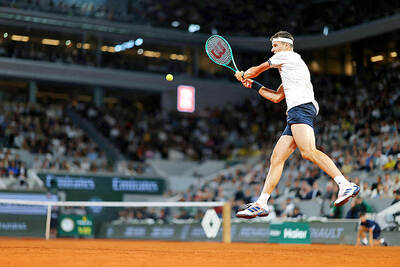
BIG NAMES GONE: Zverev is the clear favorite for a maiden Grand Slam title, reaching semi-finals for the fifth time in six years and finishing second on three occasions Alexander Zverev on Tuesday breezed past Rafael Jodar to stay on course for an elusive Grand Slam title at the French Open, while Jakub Mensik halted Joao Fonseca’s scintillating run in the quarter-finals. Zverev, the highest-ranked player left in the men’s draw, put an end to Spanish teenager Jodar’s impressive Roland Garros debut, easing into the semi-finals with a 7-6, (7/3), 6-1, 6-3 win. The 29-year-old Zverev is the clear favorite for a maiden Grand Slam title. He has finished runner-up on three occasions, including at the 2024 French Open. “I want to win the matches that are ahead of
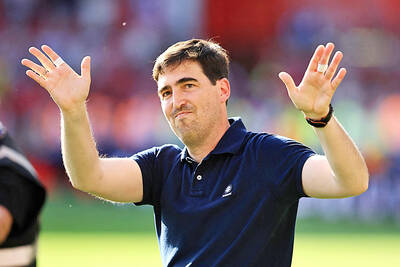
Liverpool are in advanced talks with former AFC Bournemouth manager Andoni Iraola as they seek a replacement for Arne Slot, reports said on Tuesday. Iraola has emerged as Liverpool’s top target to replace Slot, who was sacked on Saturday last week after a turbulent second season in charge. Liverpool have reportedly agreed a deal in principle to bring the Spaniard, who left Bournemouth at the end of this season, to Anfield. Sporting director Richard Hughes was heavily involved in hiring Iraola during his time at Bournemouth and is again spearheading the recruitment of the highly rated coach. The Reds are

KNICKS TAKE LEAD: San Antonio put on a 9-0 run to be up 95-94 with just over 2 minutes to play, but the rest of the game belonged to the New York Knicks It was past five minutes through the third quarter of Game 1 of the NBA Finals on Wednesday and the New York Knicks’ 11-game winning streak was in major jeopardy. The Knicks missed nine of their first 10 shots in the early part of the period and trailed the San Antonio Spurs by 14 points. They were floundering. Then something crazy happened. The Knicks found new life from an unlikely source: The Spurs. New York rallied to tie the game by the end of the period, gave up the lead briefly late in the fourth quarter, and pulled away late for a 105-95


 RSS
RSS