


Keyshawn Davis took several weeks to choose his path to boxing stardom after the Tokyo Olympics were postponed.
Thanks to the COVID-19 pandemic, the top professional prospect on the US Olympic qualification team was suddenly facing nearly a year without an amateur fight that mattered.
He could wait 16 months for his shot at gold in Tokyo, or he could accept one of several lucrative offers to begin his professional career immediately.
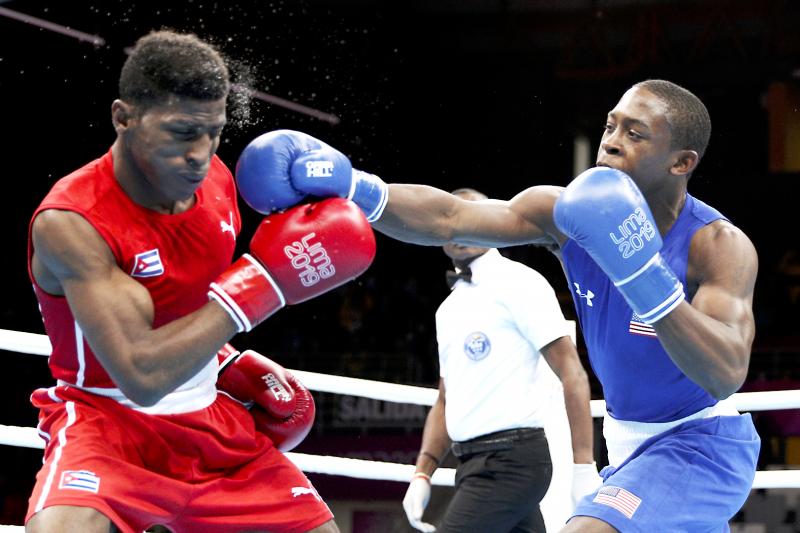
Photo: AP
When Davis began his deliberation, the 21-year-old lightweight was leaning toward the pros. After speaking to family, coaches and his fellow fighters, he decided to keep his Olympic flame burning.
“It’s just hard to say no to the Olympics,” Davis said from his home in Virginia. “That’s like passing up a deal right in front of your face that makes a lot of sense.”
Every member of the US team has agreed. Even with an extra year to wait, Davis and his 12 teammates are all still focused on Tokyo and the rewards of the Olympic experience.
The Olympic postponement could have caused upheaval for many Western nations’ teams in an amateur sport that frequently loses its brightest talents to the pros, even in normal Olympic cycles.
However, US head coach Billy Walsh has managed to keep his whole team together for next year by selling his boxers on the promise of brighter professional futures if they show a little patience.
“We’ve always had that challenge,” said Walsh, the Irish coach who has restored the fractious US program to respectability in his five years in charge.
“Since I came here, we’ve turned that around a piece. We’ve given the guys the vision of first becoming an Olympic champion, as all the greats did back in the day, and using that for a platform to launch your professional career,” he said.
After decades of the pro game’s predation and innumerable scandals, amateur boxing is no longer the marquee Olympic event that catapulted Cassius Clay, Sugar Ray Leonard and Oscar de la Hoya to international athletic superstardom.
Yet, Olympic experience still turns heads within the sport — and it remains an enormously valuable commodity to boxing promoters, who pay higher prices for fighters they can promote with “Olympian” perpetually affixed to them like a new first name.
If a boxer manages to come home with gold, the game changes even more. Just ask two-time gold medalists Vasyl Lomachenko or Claressa Shields, who established thriving pro careers and claimed world title belts within months of their Olympic triumphs.
“You can go now, and you’re going to have to take 20-odd fights to fight for a world title,” Walsh told his fighters recently. “You go get an Olympic gold, or if you have those Olympic rings on your shoulder, that will fast-track you to world title fights. You’re a name. You’re known. You’re an Olympian.”
Davis also relied on advice from Shakur Stevenson, the 2016 Olympic silver medalist who trained with Davis on the way to the Rio de Janeiro Games.
With his Olympic fame, Stevenson got a title shot in his 10th pro fight and won a world championship in his 13th bout in fall last year.
“He’s always the first person I call, because he was the one who helped me get on this road to the Olympics,” Davis said. “He was the one that was telling me: ‘Just wait it out.’ And after a while, just going back and thinking about it, he was right.”
Stevenson emphasized the jump in competition when Davis moves from fighting fellow amateurs to seasoned professionals. Davis has the skill to win plenty of fights, but needs experience that the Olympic cycle can provide.
Still, nobody knows when that cycle will spin again.
Walsh and the US fighters realize that no major competitions are likely to happen until next year, so they are staying sharp for now with virtual workouts distributed on an app by their strength and conditioning department.
When it is safe for the team to gather in Colorado Springs, Colorado, Walsh will do it.
“Boxers are used to being in training camp and having a goal at the end of it,” Walsh said. “When that goal is taken away, it leaves them open to all sorts of things and ideas, so we try to give them that bit of structure. When you get to a certain age, six months isn’t long. For a 20-year-old, it seems like forever.”
With his decision made, Davis already has a broad perspective on the months ahead. He is staying sharp in the gym, but he also has plans that would benefit his ultimate goal of becoming a significant, well-known pro fighter.
“Mainly I want to work on my outside things,” Davis said of the upcoming year. “When the coronavirus starts to clear up, I’m going to start talking to these kids, going to these high schools, going to these YMCAs. Start reaching out to these kids and start touching more people outside boxing. I just want to build my brand more.”

NO HARD FEELINGS: Taiwan’s Lin Hsiang-ti and Indonesia’s Dhinda Amartya Pratiwi embraced after fighting to a tense and rare 30-29 final game in their Uber Cup match The Taiwanese men’s team on Wednesday fought back from the brink of elimination to defeat Denmark in Group C and advance to the quarter-finals of the Thomas Cup, while the women’s team were to face South Korea after press time last night in the Uber Cup quarter-finals in Horsens, Denmark. In the first match, Taiwan’s top shuttler Chou Tien-chen faced a familiar opponent in world No. 3 Anders Antonsen. It was their 16th head-to-head matchup, with the Dane taking his fourth victory in a row against former world No. 2 Chou, winning 21-14, 13-21, 21-15 in 1 hour, 22 minutes. The

Marta Kostyuk’s maiden WTA 1000 title in Madrid came on Saturday thanks to her power, poise and a pair of unexpected lucky shorts. The world No. 23 beat eighth-ranked Mirra Andreeva 6-3, 7-5 in under 90 minutes to secure the most prestigious trophy of her career, her third professional singles title and second in less than a month after Rouen. Yet as the 23-year-old Ukrainian posed for photographs at the Caja Magica, it was not just the silverware that caught the eye. Held alongside her team and her two dogs, Kostyuk showed off a piece of black men’s underwear, prompting

Throwing more than US$5 billion at a divisive new tour and walking away after five seasons does not look like good business, but LIV Golf was not all bad news for Saudi Arabia. Oil-funded LIV, which poached top stars and sent golf’s establishment into a tailspin, helped push the conservative kingdom into global view — one of its key aims, experts said. The exit, confirmed on Thursday after weeks of speculation, does not signal a flight of Saudi money from sport, even after the Middle East war that sparked Iranian attacks around the Gulf, they said. “Saudi Arabia is not

Anastasia Potapova on Wednesday turned tennis heartbreak into history by becoming the first lucky loser to reach a WTA 1000 semi-final with her thrilling 6-1, 6-7 (4/7), 6-3 victory over Karolina Pliskova at the Madrid Open, as Taiwan’s Hsieh Su-wei exited in the women’s doubles quarter-finals. The Russian-born Austrian, who lost in qualifying last week, has capitalized on her unexpected main draw entry and stunned former world No. 1 Pliskova in a roller-coaster clash despite squandering three match points. Potapova’s run has included impressive victories over former French Open champion Jelena Ostapenko and world No. 2 Elena Rybakina. Asked if she had thought


 RSS
RSS