


During a lull in Afghanistan’s never-ending war, before the fighting season resumes once again in the spring, Taliban fighters recall laying down their Kalashnikovs and, for a brief moment, enjoying a game of cricket.
The sport is the only one that most of the fighters enjoy, commanders say, with matches attracting hundreds of spectators from Taliban-controlled villages when there is no fighting. They are also fans of the increasingly successful national team.
“I love cricket,” said Mullah Badruddin, a Taliban commander in Khogyani District of Nangarhar, on the border with Pakistan, where a tournament organized by the militants at the start of last winter drew large crowds.
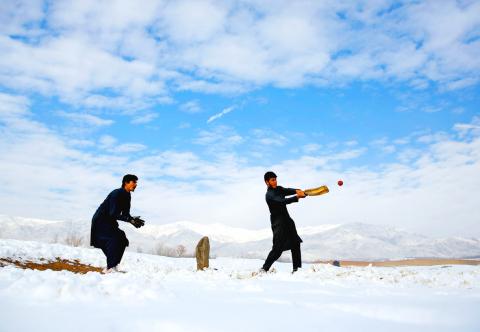
Photo: Reuters
“When Afghanistan play against another team, we listen to the radio with great interest and we also check for scores on social media and follow those on Facebook who give live updates,” he said.
First played in Afghanistan by British troops in the 19th century, the game was adopted by Afghans in the refugee camps of cricket-loving Pakistan, where more than 3 million fled a Soviet invasion and civil war in the 1980s and 1990s, and has since made huge strides in the country, particularly among ethnic Pashtuns in the eastern border provinces.
The Taliban banned games such as cricket and soccer in the early years of their austere rule, because they believed sport kept men away from prayers, but later became more tolerant of cricket, former Afghan national cricketer Hasti Gul said.
From there — despite at least two attacks claimed by the Islamic State group — cricket now rivals soccer for popularity in a country that has long been cut off from international sport.
Admitted as a full member of the International Cricket Council in 2017, Afghanistan last month won its first five-day Test match against Ireland after making steady progress in the lower levels of the international game.
However, it is in the dynamic, shorter form of the sport that Afghans have had the most impact.
Players such as spin bowler Rashid Khan or big-hitting batsman Mohammad Nabi Esakhil have become undisputed stars of the Indian Premier League and Twenty20 cricket.
Unlike soccer, which offends the sensibilities of some very conservative Muslims because it is normally played in shorts, cricket is played in long sleeves and trousers, in line with traditional dress codes. It also bears some resemblance to traditional Afghan children’s games involving throwing and using sticks to hit smaller sticks or balls.
However, not everyone is on board the cricket bandwagon.
For many Persian-speaking Tajiks and Hazaras, cricket is a sport for Pashtuns, the dominant ethnic group from the south and east of the country that has provided almost all kings and presidents throughout Afghan history.
“I have no interest and don’t know anything about cricket,” said Ahmad Jawad, a shopkeeper in Parwan, a mainly Tajik province north of Kabul. “It’s a Pashtun game with Pashtun players, so let them enjoy their game.”
Sadiq and Gul — brothers who, like many teammates, learned their cricket in Pakistan — and other players struggled to convince Tajik commanders from the Northern Alliance that swept into Kabul in 2001 to allow them to continue playing the game.
“Palace officials told us to join Afghan guard units and forget about cricket,” said Gul, who recalled having to cancel a provincial tournament in Kabul in 2005 after losing a fistfight with soccer players who wanted to use the pitch.
Now, the Indian Premier League is beamed into homes all over the country and the World Cup looms.
“We literally had no support from the government for so many years before they have realized we could bring glory to our country,” he said. “Now everyone loves cricket and we are so proud to raise our national flag on the world stage.”

After letting another big lead slip with an error-strewn performance at the French Open on Wednesday, top-ranked Aryna Sabalenka felt like getting as far away from the courts as possible. “Just want to quit tennis right now,” Sabalenka said after wasting a lead of a set and two breaks in a 3-6, 7-5, 6-0 loss to Diana Shnaider in the women’s singles quarter-finals. “We’ll see in few days. Hopefully I’ll get back on track mentally.” Sabalenka’s wait for a first French Open title continues despite the four-time major winner leading 4-1 in the second set and being two points from victory while

BIG NAMES GONE: Zverev is the clear favorite for a maiden Grand Slam title, reaching semi-finals for the fifth time in six years and finishing second on three occasions Alexander Zverev on Tuesday breezed past Rafael Jodar to stay on course for an elusive Grand Slam title at the French Open, while Jakub Mensik halted Joao Fonseca’s scintillating run in the quarter-finals. Zverev, the highest-ranked player left in the men’s draw, put an end to Spanish teenager Jodar’s impressive Roland Garros debut, easing into the semi-finals with a 7-6, (7/3), 6-1, 6-3 win. The 29-year-old Zverev is the clear favorite for a maiden Grand Slam title. He has finished runner-up on three occasions, including at the 2024 French Open. “I want to win the matches that are ahead of

For some, Cristiano Ronaldo remains the essential spearhead for Portugal’s FIFA World Cup bid, while others believe his presence would prevent Roberto Martinez’s strong side from flourishing. The debate around the five-time Ballon d’Or winner rages on, as it did at UEFA Euro 2024 and four years ago in Qatar — yet Ronaldo endures, ready to play in a record sixth World Cup. The 41-year-old remains a global superstar despite swapping the European elite for Saudi Arabia’s Al-Nassr, and is the leading men’s international goalscorer with 143 strikes. With 25 of those coming in 30 games under Martinez, the coach

Taiwanese sprinter Chen Yi-cen on Friday won the silver medal in the women’s 400m final at the Asian U20 Athletics Championships in Hong Kong, with a time of 53.16 seconds. Chen, 15, was the youngest among the eight finalists, and her performance also met the qualifying standard of 53.50 seconds for the Nagoya Asian Games in Japan in September and October. Chen first made her mark at the National Games in Tainan in 2023, at the age of 13, winning the women’s 400m final in 55.55 seconds to become the youngest gold medalist in the history of the event. Meanwhile,


 RSS
RSS