


When rising NBA star Donovan Mitchell needed a suit for the ESPY Awards this year in Los Angeles, he went to a dapper gentleman named Andrew Jang.
The result was a jacket covered in a white spiderweb pattern, including an arachnid on his upper back where all the lines converged.
Mitchell’s nickname has been “Spida” since he was a kid.
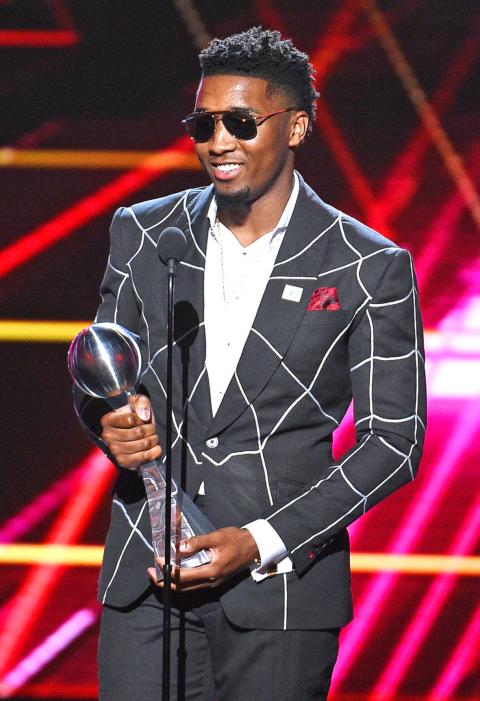
Photo: AFP
The one-of-a-kind outfit was from a label called Adriaen Black, which has quietly become the go-to for athletes looking for something flashy at the next awards show, celebrity benefit or fan event.
Regular humans cannot have one, unless they are draining three-pointers for the Golden State Warriors or catching passes downfield for the New England Patriots.
Jang’s custom suits, which typically cost between US$1,500 and US$4,000, can be found draped over athletes everywhere.
Jang’s label has worked with about 800 athletes and 40 teams.
Fashion has become essential to pro sports as athletes care more about how they telegraph their personalities.
However, nowhere in the world of sports has style been as deeply ingrained as the NBA. The bowels of arenas, where the players walk from their vehicles to the locker room, have become something of a concrete catwalk.
Russell Westbrook, arguably the pinnacle of fashion consciousness for the league, has been followed by dozens of other players eager to portray themselves as fast-break fashionistas.
Donovan Mitchell is 191cm, 97.5kg, and was one of the best rookies in pro basketball last year. When he was playing college hoops at Louisville, he never wore a suit and did not care about fashion. Whenever he tried on something off the rack, the sleeves ended up being too short.
All that changed when he got to the NBA.
“I didn’t have the money to care about fashion,” Mitchell said of his college days. “I was always like: ‘Who needs it?’ But when I was able to get involved in fashion, it became a way to express yourself.”
On a hot summer day in New York City, Jang is buttoned-up in a blue three-piece suit, sipping coffee as he strides into his office in the Garment District, a onetime global manufacturing hub that still serves a few designers and industry workers.
Jang is unlike more traditional tailors in that he will fit athletes pretty much anywhere. Most of his brethren are locked into a region, but most athletes are not — they are traveling all the time.
He has met up with Kansas City Chiefs safety Eric Berry right before the Super Bowl and Sacramento Kings guard Iman Shumpert at a restaurant in San Diego, California. Lots of fittings happen at airport bathrooms. He measures entire teams in locker rooms and brings along his whole staff to help.
For someone who works with athletes daily, Jang knows surprisingly little about sports.
“I can’t tell you players’ names or faces. There’s a team I walked into that all wore name tags. One: to kind of make fun of me, but two: because they knew I had no idea who the hell they were,” Jang said.
Still, Jang has something in common with many of his clients: He did not get into fashion until a few years ago.
Born in South Korea, he was orphaned at the age of one and later adopted by a family in Iowa. He considered himself a “backroads kid” with no inclination toward fashion.
He had wear khakis and a button-down when he went to Wayne State University in Michigan — for dentistry.
His big break in fashion was dumb luck. Jang said he liked to go to nice parties, but back then could not afford to buy the right clothes, so he would hunt through secondhand stores to find blazers and try to tailor them himself.
“My first five or six blazers, everything was horrible,” he said.
He found a velour jacket for about US$20, took the whole thing apart and tried to make it his. He made a mistake and had to use duct tape to finish the job.
Nevertheless, it worked: At the party, someone said that Jang was the best-dressed person she had ever seen and wanted to hire him as a stylist.
Being a tailor for athletes only came into focus when a sports agent contacted Jang out of nowhere. The agent represented three NBA players he had worked with before and asked if Jang wanted to dress more of his clients. He said no way.
“Sports aren’t my thing,” Jang said, adding that players had a reputation for being terrible to work with.
He does not think that any more.
After Jang dressed Skal Labissiere in a bright magenta blazer with gray slacks for the 2016 NBA Draft, he earned shout-outs from ESPN. That was also the day he officially started his company.
Fast forward two years, and Adriaen Black has worked with more than half of all NBA and NFL teams. This year, he will be working with his first five MLB teams.
Once he got big, the pressure to sell clothes to everyday rich people became more intense, Jang said.
“We get people that can afford anything they want, and they knock on my door pretty consistently and say: ‘I’ll pay you three times what the athletes do,’” Jang said. “I’m like, sorry, you’re not an athlete. I’m not going to make you my custom clothes.”
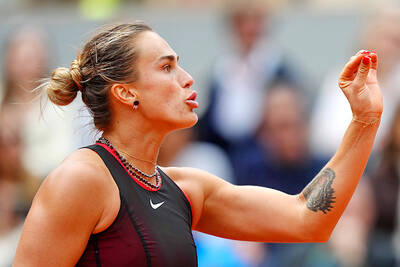
After letting another big lead slip with an error-strewn performance at the French Open on Wednesday, top-ranked Aryna Sabalenka felt like getting as far away from the courts as possible. “Just want to quit tennis right now,” Sabalenka said after wasting a lead of a set and two breaks in a 3-6, 7-5, 6-0 loss to Diana Shnaider in the women’s singles quarter-finals. “We’ll see in few days. Hopefully I’ll get back on track mentally.” Sabalenka’s wait for a first French Open title continues despite the four-time major winner leading 4-1 in the second set and being two points from victory while

BIG NAMES GONE: Zverev is the clear favorite for a maiden Grand Slam title, reaching semi-finals for the fifth time in six years and finishing second on three occasions Alexander Zverev on Tuesday breezed past Rafael Jodar to stay on course for an elusive Grand Slam title at the French Open, while Jakub Mensik halted Joao Fonseca’s scintillating run in the quarter-finals. Zverev, the highest-ranked player left in the men’s draw, put an end to Spanish teenager Jodar’s impressive Roland Garros debut, easing into the semi-finals with a 7-6, (7/3), 6-1, 6-3 win. The 29-year-old Zverev is the clear favorite for a maiden Grand Slam title. He has finished runner-up on three occasions, including at the 2024 French Open. “I want to win the matches that are ahead of

For some, Cristiano Ronaldo remains the essential spearhead for Portugal’s FIFA World Cup bid, while others believe his presence would prevent Roberto Martinez’s strong side from flourishing. The debate around the five-time Ballon d’Or winner rages on, as it did at UEFA Euro 2024 and four years ago in Qatar — yet Ronaldo endures, ready to play in a record sixth World Cup. The 41-year-old remains a global superstar despite swapping the European elite for Saudi Arabia’s Al-Nassr, and is the leading men’s international goalscorer with 143 strikes. With 25 of those coming in 30 games under Martinez, the coach

Taiwanese sprinter Chen Yi-cen on Friday won the silver medal in the women’s 400m final at the Asian U20 Athletics Championships in Hong Kong, with a time of 53.16 seconds. Chen, 15, was the youngest among the eight finalists, and her performance also met the qualifying standard of 53.50 seconds for the Nagoya Asian Games in Japan in September and October. Chen first made her mark at the National Games in Tainan in 2023, at the age of 13, winning the women’s 400m final in 55.55 seconds to become the youngest gold medalist in the history of the event. Meanwhile,


 RSS
RSS