


Tran Nguyen Nhat An’s folly was League of Legends, a fantasy fight game that consumed her for 18 hours a day until she joined a school for troubled teenagers that features the real-world hard knocks of Vietnam’s homegrown martial art.
With no telephone or console and 5:30am wake-up calls, the 16-year-old initially struggled to adjust to the rigors of life at the boarding school on the outskirts of Ho Chi Minh City.
She also did not take to vovinam, the acrobatic, high-kicking martial art created in the 1930s by borrowing elements of kung fu and other Asian disciplines, but she had little choice.
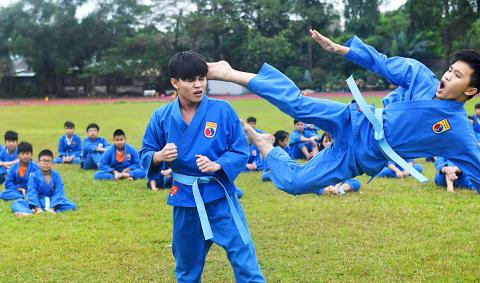
Photo: AFP
An is among about 300 teens at the Research Institute for Vovinam and Sport Development (IVS), where the physical and emotional control demanded by vovinam is used to wean kids off screens and addictions to booze and drugs, and to ease depression.
After a few dark weeks, An finally started to emerge from her malaise.
“I was just depressed in my room. I never exercised, I never talked to anyone... Here I can talk to everybody,” she said. “I practice [vovinam], exercise, so my health is getting better. Maybe that’s helping my emotions getting better, too.”
Millions of young people like An are glued to online gaming in Vietnam, where about 30 percent of the population of 93 million have smartphones and about half have Internet access.
Although no nationwide official data on gaming addiction exists, pediatric psychiatrist Lam Hieu Minh said he has seen a rise in visits from kids hooked on screens, who usually suffer from anxiety and sleeping disorders, attention deficit issues and even depression and eating disorders.
Sport can be an important part of treatment.
“Physical activities such as martial arts are very good for children to help them get healthy entertainment and meet friends,” Minh said.
IVS was set up in 2009 by vovinam Master Pham Quang Long to treat unruly young people aged from 13 to 19.
Inspired by a Soviet educator who ran orphanages based on the principles of collective education and character-building work for children, Quang adopted a similarly tough-love approach.
There are about 1,000 kids enrolled at all five IVS campuses, where tuition costs about US$330 a month and pupils are allowed a visit by parents once a month.
Students must adhere to a strict schedule from dawn until bedtime at about 10pm that includes academic courses, music lessons and physical exercise.
Most days, that includes vovinam.
“They have to overcome [personal] difficulties by practicing martial arts. It gets rid of old habits and laziness,” IVS deputy director Dang Le Anh said. “Military discipline and martial arts help the student to become better and better.”
Early vovinam protagonists were inspired by nationalist movements during the French occupation, eager to learn self-defense and develop a uniquely Vietnamese martial art, but the sport was forced underground in the 1950s by French rulers who wanted to extinguish nationalist sentiment of any kind.
It reemerged in the 1970s, eventually becoming a global movement. Today, there are vovinam federations all over the world.
Nguyen Quang Hieu said the sport has transformed him from a gaming-addicted rebel to a disciplined young man. Before he arrived at the school three years ago, he was gaming for up to 14 hours a day, leaving the house for long stretches and spending countless hours at Internet cafes.
“I live an orderly life now and I don’t try to disobey my parents,” said Hieu, who now competes in vovinam tournaments. “I’ve given up games and become a new person.”

After letting another big lead slip with an error-strewn performance at the French Open on Wednesday, top-ranked Aryna Sabalenka felt like getting as far away from the courts as possible. “Just want to quit tennis right now,” Sabalenka said after wasting a lead of a set and two breaks in a 3-6, 7-5, 6-0 loss to Diana Shnaider in the women’s singles quarter-finals. “We’ll see in few days. Hopefully I’ll get back on track mentally.” Sabalenka’s wait for a first French Open title continues despite the four-time major winner leading 4-1 in the second set and being two points from victory while

BIG NAMES GONE: Zverev is the clear favorite for a maiden Grand Slam title, reaching semi-finals for the fifth time in six years and finishing second on three occasions Alexander Zverev on Tuesday breezed past Rafael Jodar to stay on course for an elusive Grand Slam title at the French Open, while Jakub Mensik halted Joao Fonseca’s scintillating run in the quarter-finals. Zverev, the highest-ranked player left in the men’s draw, put an end to Spanish teenager Jodar’s impressive Roland Garros debut, easing into the semi-finals with a 7-6, (7/3), 6-1, 6-3 win. The 29-year-old Zverev is the clear favorite for a maiden Grand Slam title. He has finished runner-up on three occasions, including at the 2024 French Open. “I want to win the matches that are ahead of

For some, Cristiano Ronaldo remains the essential spearhead for Portugal’s FIFA World Cup bid, while others believe his presence would prevent Roberto Martinez’s strong side from flourishing. The debate around the five-time Ballon d’Or winner rages on, as it did at UEFA Euro 2024 and four years ago in Qatar — yet Ronaldo endures, ready to play in a record sixth World Cup. The 41-year-old remains a global superstar despite swapping the European elite for Saudi Arabia’s Al-Nassr, and is the leading men’s international goalscorer with 143 strikes. With 25 of those coming in 30 games under Martinez, the coach

Taiwanese sprinter Chen Yi-cen on Friday won the silver medal in the women’s 400m final at the Asian U20 Athletics Championships in Hong Kong, with a time of 53.16 seconds. Chen, 15, was the youngest among the eight finalists, and her performance also met the qualifying standard of 53.50 seconds for the Nagoya Asian Games in Japan in September and October. Chen first made her mark at the National Games in Tainan in 2023, at the age of 13, winning the women’s 400m final in 55.55 seconds to become the youngest gold medalist in the history of the event. Meanwhile,


 RSS
RSS