


Two athletes at the Taipei Summer Universiade painted a picture of what it is like to travel the world on the swimming circuit, giving a glimpse into a life of rigorous training and lofty goals, while hinting that there was more to them than just well-honed speed machines in the water.
Brazil’s Alessandra Marchioro and Betina Lorscheitter compete at opposite ends of the swimming spectrum.
Marchioro was on the cusp of selection for the Olympics in Rio de Janeiro last year in the 50m sprint, while Lorscheitter takes on others over 10km, once swimming 25km in competition.
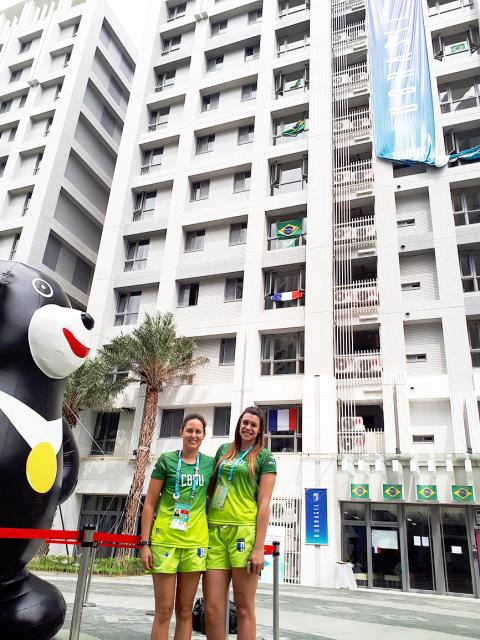
Photo: Grant Dexter, Taipei Times
Marchioro raced in the women’s 4x100m relay on Sunday, placing fifth in a time of 3 minutes, 41.52 seconds (Canada took gold in 3:39.21).
She is in the water at the National Taiwan Sport University Arena in Taoyuan today for the 50m breaststroke and freestyle heats, with the finals later in the day.
Taiwan’s Huang Mei-chien is in Heat 5 of the freestyle event, two races before the Brazilians, and Liao Man-wen swims in the race after her in the breaststroke.
However, they said their experience of Taiwan was limited and they did not have much of an opportunity to meet Taiwanese.
“We don’t feel something more than the [Athletes’] Village and the arena,” Lorscheitter said on Wednesday. “Just Village and swimming pool.”
“We have one day before we leave. We’re going to visit the o grande building,” she said, referring to Taipei 101.
“I spent all my money on a taxi” going to Raohe Night Market in Taipei’s Songshan District, Marchioro said, but insisted she did not want to try milk tea.
“The food here is very different from Brazil,” she said.
Their preparations for competition leave little time for anything else, even as they circle the globe every few months chasing qualification and medals.
The pair had just a brief time to spend speaking with the Taipei Times and described their typical day as “waking up really early, training, eating and getting some sleep.”
Even knowledge about the performances of the athletes in their wider Brazilian delegation were limited.
“We just hear the results, even of our own team.” Lorscheitter said.
The swimmers described starting their sport at a young age, and the same was true for Brazilian judoka Barbara Timo.
“I started in judo at eight years old at a gym close to home,” Timo said by e-mail yesterday. “At 12, I moved to a bigger club, Flamengo.”
“I am in the process of building. Each result has a special taste and prepares me for my biggest goal: An Olympic medal,” she said.
“Timo won gold in the women’s 70kg division on Monday, beating Japan’s Saki Niizoe.
“I lost to her two times before, so I studyied her and trained to get the victory,” Timo said.
This focus on sport was apparent among other athletes.
When it came to sightseeing, the Dutch seemed to have the best deal.
“We’re going on a tour to see some popular places in Taiwan,” said Tessa Vermeulen, who was swimming in the women’s 200m backstroke, 4x100m freestyle relay, 100m backstroke, 50m backstroke, 50m freestyle and 4x100m medley relay for the Netherlands.
However, that was just a one-day trip, while news like who was leading the medal count was a mystery to many.
Middle-distance runners Rachael Aubry and Jenna Westaway — who ran in the semi-finals of the 800m last night, but missed tonight’s final — and Claire Sumner, who placed eighth with a time of 34:41.24 in the 10,000m final (Daria Maslova of Kyrgyzstan won gold in a time of 33:19.27) guessed Australia — “they have a big team” — or China — “that was closer” — when asked who headed the medal table.
It was South Korea at the time.
It was a surprise to them (“Wait, what?”) to hear that the evening before, their rivals to the north were top of the table, although North Korea had slipped back since then.
It was another surprise to hear that Taiwan were doing well.
They were enthusiastic about the chance of seeing the nation beyond the fences of the Athletes’ Village.
“We definitely will be. We’ve got to focus on our races before we explore the city,” they said. “We’ve got to grab some true Taiwanese food that is not from the food court [the Village’s dining hall].”
“Oh, and we thought we might go for a hike,” they said. “And some night clubs.”
The Brazilian swimmers also delved into some politics, having noticed the gigantic sign in view on the walk toward the dining hall.
“I saw like a [sign] saying ‘Taiwan is not Chinese,’” Lorscheitter said.
The jet-setting lifestyle of a top-level athlete seems not geared toward an in-depth experience of the cultures of the places they visit.
“There is a World Cup [for] open water and we travel like seven, eight [competitions] per year.” Lorscheitter said.
Marchioro said: “I don’t want this career for my life.”
“She would like to do medicine in university,” Lorscheitter supplied after a discussion in Portuguese.
“I don’t have time to study,” Marchioro added.
Taipei residents might have seen groups of well-toned young people walking the touristy parts of their city; that phenomenon is likely to increase as the medals are won or lost and their short time here ends.
However, while the Athletes’ Village in New Taipei City’s Linkou District, like the events facilities, seem in top order and Taipei has given its visitors a grand stage to perform on, it is not clear that the city has put itself in the spotlight.
The Universiade needs a theme and structure.
When the Games’ Web site did not know who was leading the medals table, what hope did Hungarian judoka Akos Bartha have on his way back from lunch?
Small things like regularly updating the Village on which nation was ahead in terms of gold medals might create more of a healthy disunity among the athletes and coaching staff.
Taiwan is showing that it can host such large-scale events: There are not the reports of unfinished sports venues, missing toilets and political instability that arose in Brazil and Sochi, Russia, for previous summer and winter Olympics, and the efforts here have not relied on the exploitation of workers.
The Village had a community feel — probably the result of the army of volunteers on hand.
It just might be a stretch to expect the delegations to allow their athletes to be distracted with “unnecessary sightseeing.”
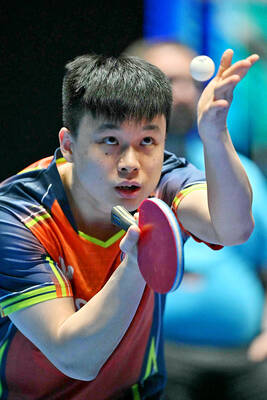
Taiwan’s men’s table tennis team won bronze on Saturday at this year’s International Table Tennis Federation World Team Table Tennis Championships in London, matching the country’s best-ever finish at the regular tournament. Consisting of Lin Yun-ju, Taiwan’s top-ranked player at world No. 7, Feng Yi-hsin, Kuo Guan-hong, Hong Jing-kai and Hsu Hsien-chia, the team won bronze after losing 0-3 to Japan in the semifinals. In the opening match, 24-year-old Lin played the first game against world No. 3 Tomokazu Harimoto 11-5, but ultimately lost the next three closely contested games 9-11, 10-12 and 10-12. Feng then faced world No. 8 Sora Matsushima in

Lin Yun-ju on Thursday handed Taiwan two key victories as they advanced to the semi-finals of the ITTF World Team Table Tennis Championships Finals in London. The Taiwan men’s table tennis team beat Sweden 3-2 in five singles matches. The 24-year-old Lin, Taiwan’s top-ranked player at world No. 7 and nicknamed the “Silent Assassin,” opened the tie by defeating world No. 2 Truls Moregard 3-0 (11-8, 11-9, 13-11) before clinching the deciding fifth match with a 3-0 (11-8, 11-9, 11-5) win over Anton Kallberg to hand his team the overall victory. Kuo Guan-hong put Taiwan up 2-0 with a 3-2 (4-11, 11-8, 8-11,

Taiwanese fire dancer Yang Li-wei advanced to the final of Britain’s Got Talent this weekend after receiving a Golden Buzzer during her live semi-final performance. Yang, a member of Taiwan’s Coming True Fire Group, awed judges and audiences with a high-intensity fire performance featuring flaming umbrellas, fire swallowing and spinning metal structures balanced with her legs. Judge Simon Cowell praised Yang as a star, while guest judge KSI reacted with amazement before pressing the Golden Buzzer, sending her to the finals. The dance group wrote on social media that the Golden Buzzer was “the highest honor” on the talent show, adding: “Twenty-three years

As Super Rugby fast approaches its playoff season it finds itself racing toward a reckoning with many issues that threaten the southern hemisphere tournament. A group of stakeholders met in the New Zealand city of Christchurch late last month to address problems that are making the future of the 31-year-old competition increasingly tenuous. The discussion was made more urgent by the decision by the owners of Moana Pasifika to fold the Auckland-based club for financial reasons. That followed the closure of the Melbourne Rebels at the end of the 2024 season, likewise because of financial difficulties. Problems addressed included player retention as more


 RSS
RSS