


An ancient contact sport rooted in Indian mythology and said to date back 5,000 years, kabaddi is proving a knockout at the Asian Games as its popularity spreads.
Fans in South Korea enthusiastically turned out to watch the game, which requires yoga-like breathing skills as two seven-player teams send a raider into their enemy’s half of the court to tag an opponent before returning to safety — in just one breath.
Attackers chant “kabaddi, kabaddi” to prove they are not inhaling, the top players capable of doing it for several minutes.
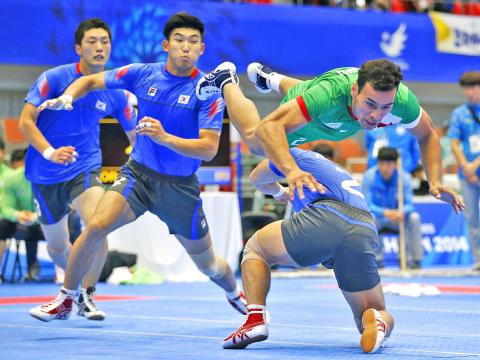
Photo: Reuters
However, India coach Balwan Singh, whose team rule the roost on the world stage, said that kabaddi can be a perilous business.
“Everyone loves kabaddi — it is more popular than cricket,” he said in an interview. “It’s very thrilling, very exciting. In India, everyone stops to watch kabaddi — children and old people. But it’s also dangerous. You can break bones very easily.”
The epic poem Mahabharata tells of a doomed raid on an enemy camp by the heir of the Pandava kings, while legend has it that Indian princes played the game as a courting ritual to show off their strength and win their brides.
Originating in rural India, the country has captured all six men’s Asian Games gold medals in kabaddi since it first appeared in 1990 — including double gold in Guangzhou four years ago, when the ladies made their debut.
However, other teams, including Pakistan and Bangladesh, are slowly catching up.
“Pakistan and Bangladesh are stronger, but we just get stronger too,” Singh said. “There is no enjoyment without competition. It’s a tough sport and you have to be brave. It is man-to-man combat.”
Kabaddi, which was demonstrated at the 1936 Berlin Olympics, is also used by British army troops as a technique to keep fit.
“It makes your stomach strong, your kidneys, heart, breathing,” Singh said. “You get more oxygen into your lungs. It’s a combination of wrestling, judo, boxing, rugby, athletics.”
While a Western kabaddi invasion is unlikely anytime soon, a recent professional league attracted 435 million television viewers in India. More than 80 million were glued to their screens for last month’s championship game, more than the figures for the World Cup or Wimbledon finals.
As their raiders entered enemy territory during a 30-15 mugging of Bangladesh, bobbing from side to side like a boxer looking for the right moment to strike, his teammates stood around sharing a joke. However, it is not for the faint-hearted. When they catch a raider, they pounce, cobra-like, and gleefully pile on him as if in a school playground.
“Kabaddi is in the Indian DNA,” Malaysia team manager Engaittaraman Padmanathan said. “India has two sports — cricket and kabaddi. In Malaysia, everyone plays football. It is a developing sport in Malaysia. We used to play it in the evenings — 30, 40, 50 years ago.”
“We have targeted fourth place at this Asian Games,” he added. “But we would like the silver in Jakarta in 2018.”
Kabaddi, also known as “kodikodi” in Pakistan, “hadudu” in Bangladesh and “baibalaa” in Maldives, has already reached East Asia, with Japan and host nation South Korea entering teams in the Asian Games.
“I first tried kabaddi four years ago and something just clicked,” South Korean women’s captain Jo Hyu-na said. “I’ve seen people break bones and get knocked out. I love it. At the last Asian Games, we just put a team in with about two months of preparation, but we want a silver medal this time. I think we have opportunities.”
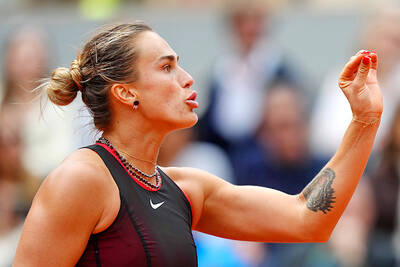
After letting another big lead slip with an error-strewn performance at the French Open on Wednesday, top-ranked Aryna Sabalenka felt like getting as far away from the courts as possible. “Just want to quit tennis right now,” Sabalenka said after wasting a lead of a set and two breaks in a 3-6, 7-5, 6-0 loss to Diana Shnaider in the women’s singles quarter-finals. “We’ll see in few days. Hopefully I’ll get back on track mentally.” Sabalenka’s wait for a first French Open title continues despite the four-time major winner leading 4-1 in the second set and being two points from victory while
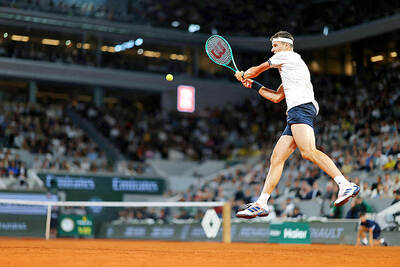
BIG NAMES GONE: Zverev is the clear favorite for a maiden Grand Slam title, reaching semi-finals for the fifth time in six years and finishing second on three occasions Alexander Zverev on Tuesday breezed past Rafael Jodar to stay on course for an elusive Grand Slam title at the French Open, while Jakub Mensik halted Joao Fonseca’s scintillating run in the quarter-finals. Zverev, the highest-ranked player left in the men’s draw, put an end to Spanish teenager Jodar’s impressive Roland Garros debut, easing into the semi-finals with a 7-6, (7/3), 6-1, 6-3 win. The 29-year-old Zverev is the clear favorite for a maiden Grand Slam title. He has finished runner-up on three occasions, including at the 2024 French Open. “I want to win the matches that are ahead of

For some, Cristiano Ronaldo remains the essential spearhead for Portugal’s FIFA World Cup bid, while others believe his presence would prevent Roberto Martinez’s strong side from flourishing. The debate around the five-time Ballon d’Or winner rages on, as it did at UEFA Euro 2024 and four years ago in Qatar — yet Ronaldo endures, ready to play in a record sixth World Cup. The 41-year-old remains a global superstar despite swapping the European elite for Saudi Arabia’s Al-Nassr, and is the leading men’s international goalscorer with 143 strikes. With 25 of those coming in 30 games under Martinez, the coach
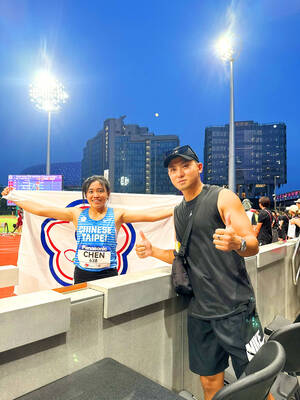
Taiwanese sprinter Chen Yi-cen on Friday won the silver medal in the women’s 400m final at the Asian U20 Athletics Championships in Hong Kong, with a time of 53.16 seconds. Chen, 15, was the youngest among the eight finalists, and her performance also met the qualifying standard of 53.50 seconds for the Nagoya Asian Games in Japan in September and October. Chen first made her mark at the National Games in Tainan in 2023, at the age of 13, winning the women’s 400m final in 55.55 seconds to become the youngest gold medalist in the history of the event. Meanwhile,


 RSS
RSS