


Mareike Fuerst had Argentina’s colors painted on one cheek, Germany’s on the other, and was draped in her home country’s flag — but planned to stash it beneath her Lionel Messi jersey for the trip home.
The 19-year-old teacher was one of scores of Germans living in Argentina who descended on La Muzza Inspiradora, a dive bar and pizzeria in Buenos Aires that threw a Germany-themed party for Sunday’s World Cup final.
The crowd inside exploded into a deafening celebration when Mario Goetze scored the extra-time goal that made Germany the new world champions, drenching each other in beer, lifting each other on their shoulders and violently swinging the small bar’s hanging light fixtures.
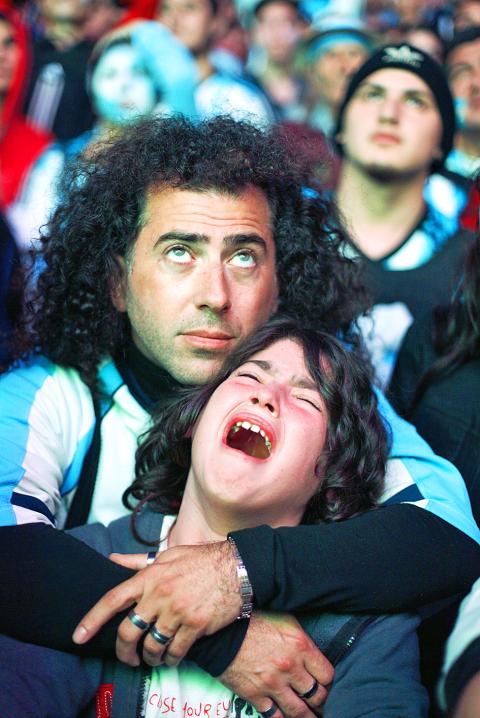
Photo: Reuters
However, they had to hold their joy inside once out on the street, where some briefly got into a scuffle with furious Argentine fans, until the dozens of police posted outside the bar broke them up.
“I’m a little bit afraid. That’s why I put my Argentina shirt on, which I bought today,” said Fuerst, who moved to the Argentine capital a year ago to teach German.
She was at the bar with her Argentine boyfriend, who had left in disgust.
“Ugh,” she said when asked how he was taking Argentina’s 1-0 loss. “We’re probably not going to talk to each other for about a day, but it will be fine.”
The bar became known as the top spot for German expatriates to watch the World Cup by hiring German caterer Michael Schnirch to serve up bratwurst, schweinebraten, currywurst and hand-twisted pretzels.
Schnirch, who moved to Buenos Aires nine years ago after falling in love with an Argentine woman he met on a beach in Chile — now his wife — launched his career as a caterer in an effort to bring a little of his native Bavaria to Argentina.
“I missed German sausages, so I decided to start making them myself — first for events and for the embassy, and then for restaurants,” the 35-year-old said.
Singing “Deutschland” and wearing the jerseys of Bastian Schweinsteiger, Lukas Podolski and Andre Schuerrle, about 100 Germans began descending on the bar hours before the match.
Lifting glasses of Quilmes, the ubiquitous Argentine beer, they made cheery toasts of “Prost” and gathered around the small bar’s five TVs to watch the game.
The bar tried to strike a neutral tone, putting up balloons in Argentina’s sky blue and white along with streamers in the yellow, red and black of the German flag, but the clients, many of whom were already several beers into the party by the time the match began, exuberantly popped the balloons.
By halftime, the bar was out of beer, its more than 100 liters of stock too little for the thirsty German fans.
German Ambassador to Argentina Bernhard Graf von Waldersee was among those in the crowd.
“It was extremely exciting to be in Argentina at the moment when my home country and my host country faced each other in the World Cup final in Brazil,” he said outside the bar after the match. “It was a great game.”
That was all he had time to say before about two dozen rowdy Argentine fans started moving toward the bar and his security detail whisked him away in a waiting car.
“Sons of bitches,” a woman shouted at the top of her lungs in Spanish as a brief fight broke out between the Argentines and Germans, before police dragged them apart.
The atmosphere soon calmed and the Argentines dispersed as police closed off the street.
Argentina has had a close relationship with Germany for much of its history.
It was a top destination for German migrants during the late 19th and early 20th centuries, when the young South American nation had one of the fastest-growing economies in the world.
Former Argentine president Juan Domingo Peron, the towering figure of 20th century Argentina, was close with German leaders and during World War II remained neutral until the conflict was nearly finished.
After the war, the country developed a reputation as a haven for Nazi fugitives, including Adolf Eichmann and Josef Mengele, but the vast majority of Argentines with German roots are the descendants of immigrants who moved to the new world in search of opportunity.
Along with Italian descendants, the children of those immigrants today make up one of the country’s main demographic groups, but when it comes to soccer, the relationship is a bitter rivalry — especially for Argentina, who have now lost their last two World Cup finals to Germany.

NO HARD FEELINGS: Taiwan’s Lin Hsiang-ti and Indonesia’s Dhinda Amartya Pratiwi embraced after fighting to a tense and rare 30-29 final game in their Uber Cup match The Taiwanese men’s team on Wednesday fought back from the brink of elimination to defeat Denmark in Group C and advance to the quarter-finals of the Thomas Cup, while the women’s team were to face South Korea after press time last night in the Uber Cup quarter-finals in Horsens, Denmark. In the first match, Taiwan’s top shuttler Chou Tien-chen faced a familiar opponent in world No. 3 Anders Antonsen. It was their 16th head-to-head matchup, with the Dane taking his fourth victory in a row against former world No. 2 Chou, winning 21-14, 13-21, 21-15 in 1 hour, 22 minutes. The

Marta Kostyuk’s maiden WTA 1000 title in Madrid came on Saturday thanks to her power, poise and a pair of unexpected lucky shorts. The world No. 23 beat eighth-ranked Mirra Andreeva 6-3, 7-5 in under 90 minutes to secure the most prestigious trophy of her career, her third professional singles title and second in less than a month after Rouen. Yet as the 23-year-old Ukrainian posed for photographs at the Caja Magica, it was not just the silverware that caught the eye. Held alongside her team and her two dogs, Kostyuk showed off a piece of black men’s underwear, prompting
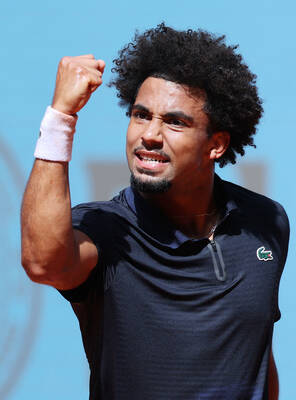
Tennis players are facing an unexpected opponent at the Madrid Open. A stomach virus or food poisoning has affected Iga Swiatek, Coco Gauff, Marin Cilic and others, raising concerns. World No. 1 Aryna Sabalenka avoided an upset by Naomi Osaka on the court on Monday and said she is trying to avoid illness by sticking to a diet of chicken breasts, rice and salad. The rumor among the players was bad shrimp tacos were to blame. Sabalenka knocked on wood for luck and said, “So far, so good. I heard that I have to avoid those tacos,” she laughed, adding “I stick to the

Throwing more than US$5 billion at a divisive new tour and walking away after five seasons does not look like good business, but LIV Golf was not all bad news for Saudi Arabia. Oil-funded LIV, which poached top stars and sent golf’s establishment into a tailspin, helped push the conservative kingdom into global view — one of its key aims, experts said. The exit, confirmed on Thursday after weeks of speculation, does not signal a flight of Saudi money from sport, even after the Middle East war that sparked Iranian attacks around the Gulf, they said. “Saudi Arabia is not


 RSS
RSS