


In a remote Himalayan valley, an archer and a shooter are calmly preparing for a trip of a lifetime to represent Bhutan at the London Olympics, but winning is not the main target.
Archer Sherab Zam and shooter Kunzang Choden, both 28-year-old women, are the only two athletes to represent the remote kingdom at the 2012 Games, competing on wildcard entries allocated to ensure all 204 National Olympic Committees (NOC) can take part, even if no athletes have qualified.
Neither Sherab nor Kunzang expect to win medals for Bhutan, an impoverished, largely Buddhist country between India and China which only opened up to foreigners in 1974, banned TV until 1999 and uses happiness to measure its success.
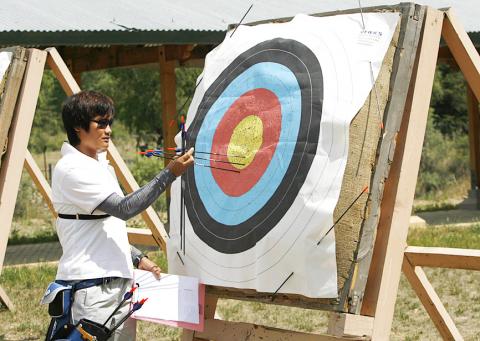
Photo: Reuters
However, they head to London carrying a nation’s pride and will join thousands of other dedicated athletes at the Olympics who go largely unnoticed, except by their own country.
Competing against highly funded athletes with state-of-the-art equipment from richer countries is tough, but Sherab and Kunzang — who do not own a bow or rifle — are both realistic and their aim is to try to beat their personal best.
“Participation is more important than winning a medal,” Sherab said over coffee in Thimphu, which claims to be the only world capital without a traffic light.
“Bhutan is just a small country of just 700,000 [people]. There is a lot of pressure on us, but we must be realistic about our chances. We just want to do well,” Kunzang added.
While top world athletes like Usain Bolt and Michael Phelps are the faces most people associate with the Olympics, it is athletes like Sherab and Kunzang who represent the majority of the 10,500 athletes at the Games and embody the Olympic spirit.
“The most important thing in the Olympic Games is not to win, but to take part, just as the most important thing in life is not the triumph, but the struggle,” the Olympic creed states.
With huge amounts of money being injected into sports in many countries, the divide between rich and poor nations is getting wider. Poorer nations struggle to attract and retain athletes as even the top performers struggle to make a living from their sport.
Bhutan Olympic Committee (BOC) secretary-general Sonam Karma Tshering said it was getting harder for small NOCs to get into the Olympics, as they did not want to send athletes without a chance of competing well.
Bhutan is always among the countries with the fewest athletes at the Olympics. In Beijing, Bhutan was one of six nations to send just two competitors. The South Pacific island nation of Nauru sent only one.
“So many athletes have become superhuman and it is hard to match that, despite our athletes having sheer passion and enthusiasm,” Sonam said over a traditional Bhutanese meal of rice and curry in a Thimphu restaurant.
“But our government is starting to realize the benefit of sport to address the growing issues we have with the youth [such as unemployment of 9.2 percent] ... So we are trying to identify and fund sports where we have potential in the future,” he added.
It is the eighth time that Bhutan, a country about the size of Switzerland, will compete in archery at the Olympics, the only event it has taken part in so far. Its entries have always been on wildcards, as no athlete has qualified for the Games.
It made sense that archery was the first event Bhutan entered at the 1984 Los Angeles Olympics, as archery is the national sport and a national obsession, steeped in myths and legends dating back to the times of the Buddha.
Every weekend tournaments are held with village teams, in traditional dress and wielding bamboo bows, heckling as arrows are fired and celebrating with traditional songs and a leg-kicking dance if they hit the target.
Sherab, from Dagana district, said she dabbled in traditional archery as a child, but it was only when she saw an advertisement in the local newspaper in 2005 and tried out for a spot in the nation’s archery team that she took it seriously.
She was been taken under the wing of the Bhutan Archery Federation which, aided by the BOC, sponsors promising archers although the pay is minimal.
Now she is one of 12 archers in Bhutan’s national team and is coached by Tshering Chhoden, who competed at the 2004 Athens Games and is the only Bhutanese archer to qualify for the second round.
“In Bhutan you can’t make any money from sport, so people drop out and our team has suffered,” said Tshering, who herself quit archery in 2005, but was asked to return in 2007 as a coach.
She says funding remains a major issue especially for high-cost sports like archery and shooting where a modern, carbon-fibre bow can cost about US$1,500 — a full year’s wage for many Bhutanese.
She laughed as she explained how Korean archers would ditch arrows with a slight split while she would glue up any flaws.
“As an athlete from Bhutan you can’t expect miracles, as we can’t afford to compete on the same level. The more experience and exposure you get can make a huge difference in shooting and archery, as the more you practice the more you can control your nerves,” she said.
Kunzang, from Thimphu, joined the national shooting team in 2004 after seeing women competing on TV and beating men.
“It is a sport where women can do better than men, as we are not so muscular and tend not to shoot with the same intensity,” said Kunzang, whose husband was a national archer and is now her coach. She has two children, aged 12 and seven.
Both Sherab and Kunzang are practicing six to eight hours a day preparing for London. Both have spent time training abroad — Sherab in South Korea and India, and Kunzang in Germany and Bangladesh — but neither has visited the UK before.
“I really want to see [Tower] Bridge as that is the image of London we always saw as children,” Sherab said, adding that a sight of Prince William and his wife, Kate, would be an added bonus.

After letting another big lead slip with an error-strewn performance at the French Open on Wednesday, top-ranked Aryna Sabalenka felt like getting as far away from the courts as possible. “Just want to quit tennis right now,” Sabalenka said after wasting a lead of a set and two breaks in a 3-6, 7-5, 6-0 loss to Diana Shnaider in the women’s singles quarter-finals. “We’ll see in few days. Hopefully I’ll get back on track mentally.” Sabalenka’s wait for a first French Open title continues despite the four-time major winner leading 4-1 in the second set and being two points from victory while

BIG NAMES GONE: Zverev is the clear favorite for a maiden Grand Slam title, reaching semi-finals for the fifth time in six years and finishing second on three occasions Alexander Zverev on Tuesday breezed past Rafael Jodar to stay on course for an elusive Grand Slam title at the French Open, while Jakub Mensik halted Joao Fonseca’s scintillating run in the quarter-finals. Zverev, the highest-ranked player left in the men’s draw, put an end to Spanish teenager Jodar’s impressive Roland Garros debut, easing into the semi-finals with a 7-6, (7/3), 6-1, 6-3 win. The 29-year-old Zverev is the clear favorite for a maiden Grand Slam title. He has finished runner-up on three occasions, including at the 2024 French Open. “I want to win the matches that are ahead of

For some, Cristiano Ronaldo remains the essential spearhead for Portugal’s FIFA World Cup bid, while others believe his presence would prevent Roberto Martinez’s strong side from flourishing. The debate around the five-time Ballon d’Or winner rages on, as it did at UEFA Euro 2024 and four years ago in Qatar — yet Ronaldo endures, ready to play in a record sixth World Cup. The 41-year-old remains a global superstar despite swapping the European elite for Saudi Arabia’s Al-Nassr, and is the leading men’s international goalscorer with 143 strikes. With 25 of those coming in 30 games under Martinez, the coach

Taiwanese sprinter Chen Yi-cen on Friday won the silver medal in the women’s 400m final at the Asian U20 Athletics Championships in Hong Kong, with a time of 53.16 seconds. Chen, 15, was the youngest among the eight finalists, and her performance also met the qualifying standard of 53.50 seconds for the Nagoya Asian Games in Japan in September and October. Chen first made her mark at the National Games in Tainan in 2023, at the age of 13, winning the women’s 400m final in 55.55 seconds to become the youngest gold medalist in the history of the event. Meanwhile,


 RSS
RSS