


In 1983, a 16-year-old boy joined a North Korean athletic squad, dreaming of becoming an Olympic judo champion — but defeat to a South Korean athlete saw him sentenced to hard labor in a coal mine instead.
Now, 45 years old and living as a defector in the South Korean capital of Seoul, Lee Chang-soo is past the age when he can dream of Olympic glory himself, but believes that one of his three sons could claim that title, hopefully by beating an athlete from the repressive North.
“It’s definitely Olympic gold medal,” Lee said of his vivid dream that one day one of his sons would win.
“I want to show them the man that was so tortured has raised his sons this well and will not just stand down. That is a start of my revenge,” he said, his accent still flecked with traces of its North Korean origin despite 20 years in South Korea.
At his peak, Lee had enjoyed all the privileges of an elite athlete in a Stalinist country, from Mercedes Benz cars, the prized membership of the Workers Party of Korea and financial rewards.
“Those who won any medal were given an apartment,” Lee said, recalling his team’s “glorious return” from Kobe, Japan, after winning three gold medals from the 1985 Summer Universiade.
Lee started winning local competitions and swiftly moved on to the international stage, winning a bronze medal at the 1989 World Judo Championships in the former Yugoslavia and a silver medal at the Beijing Asian Games in 1990.
However, with North Korea boycotting the 1984 Los Angeles and 1988 Seoul Olympics, Lee missed his chance at the Games and then came disaster in the form of defeat to an athlete from South Korea, a country with which the North remains technically at war.
Lee said defeated North -Koreans — especially those who lose to South Koreans — are forced to work in gulags where rights group Amnesty International says 200,000 citizens are forced to work with little food under threat of execution.
“I was sent to a coal mine for the first time because I lost against a South Korean in the Beijing Asian Games. Then I was sent to work in a boiler room just because I talked back to the deputy chairman of the squad,” Lee said.
However, not all of Lee’s luck had run out and he had one admirer who was powerful enough to ensure that the talented athlete could compete again, in the form of Jang Song-thaek, the uncle of North Korea’s new leader Kim Jong-un.
At the time, Jang was practically in charge of the sports department and he was known as a generous boss who helped athletes, although he kept a low profile low.
“Athletes liked Jang Song-thaek very much. If they voted for a president, he would be elected,” Lee said of the 65-year-old, who is now vice chairman of the National Defense Commission, the supreme leadership council of North Korea.
Having escaped another trip to the gulag, Lee was in no mood to go back and in 1991 at a competition in Spain, he chose to defect.
“I was thinking: ‘Why should I win? If I win a medal, it belongs to North Korea, not me.’ So I lost on purpose and looked for ways to escape,” he said.
Unable to punish Lee directly, the North Korean regime punished his family, sending his older brother to a lumber camp where he died and the rest of his family to a coal mine.
“There’s nothing I can do for now,” Lee said as he tried to stem his tears.
Now married to a former Taiwanese national judoka, whom he met at international games, Lee runs a small judo class where his three sons train.
Hopes are highest for 17-year-old Lee Moon-jin, Lee Chang-soo’s second son, who won a gold medal at a local youth championships in 2010.
“I’ve never regretted coming to South Korea. I will make my sons win an Olympic gold medal and make North Korea the one who regrets,” Lee Chang-soo said.

Greek swimmer Kristian Gkolomeev was the only athlete to “beat” a world record on Sunday at the Enhanced Games, winning the men’s 50m freestyle at the divisive competition where athletes were free to take performance-enhancing substances. His time of 20.81 seconds — which is not considered official — came in the final event of the night in Las Vegas, sparing the blushes of organizers who made claims that multiple world records would be surpassed due to a sophisticated doping regime. Gkolomeev, who was wearing a synthetic “supersuit” long banned at events such as the Olympics, outpaced Australia’s Cameron McEvoy’s 20.88 set in

Fred Kerley is competing unaugmented against drug-fuelled athletes at this weekend’s Enhanced Games and still hopes to race in the 2028 Olympics, the suspended former 100m world champion said on Friday. Arguably the biggest name at the divisive event in Las Vegas, where doping is permitted, the US sprinter said he had chosen not to take any of the banned substances including testosterone and steroids that his competitors have been using. “I don’t need it. God gave me fast feet for a reason. And I’m here to showcase my talent,” Kerley said. Kerley last September became the first US competitor and first track
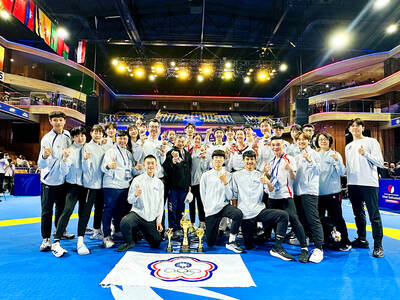
VICTORY ABROAD: The team took home a fistful of medals and secured spots for the autumn’s Asian Games, scheduled for September in Nagoya Taiwan’s women’s team captured the overall title at the Asian Taekwondo Championships in Mongolia on Sunday, finishing with two golds, one silver and one bronze medal. The strong showing, led by gold medalists Wang Chieh-ling and Chang Jui-en secured the full quota of available spots for Taiwan at the Asian Games in Nagoya, Japan, in September. Wang opened Taiwan’s medal run by winning gold in the women’s under-46kg class on Thursday, the first day of competition. Liu Yu-yun later earned a silver in the under-49kg class. On the final day on Sunday, Chang won Taiwan’s second gold medal in the under-62kg event, and
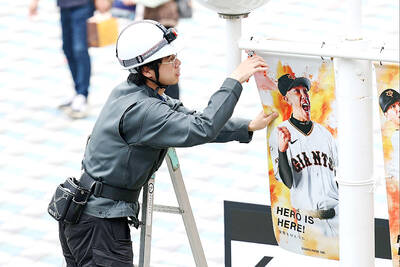
The manager of the Yomiuri Giants, one of Japan’s most popular baseball teams, resigned yesterday after he was arrested for allegedly physically attacking his teenage daughter. Shinnosuke Abe allegedly grabbed the 18-year-old and forced her to the floor at their home in central Tokyo on Monday evening, reported national broadcaster NHK and Kyodo News, citing unnamed police sources. “Leaving like this really means I’m causing you a lot of trouble, and I feel truly sorry about that,” Abe told a hastily arranged news conference, his eyes red with tears. The former star catcher, who is among baseball-obsessed Japan’s most recognized sports figures,


 RSS
RSS