


Brazil coach Dunga could not resist a dig when his team were drawn against former colonial power Portugal in Group G at the World Cup.
“We’re going to play against Brazil’s ‘B’ team,” he said after December’s draw in Cape Town.
The comment was a reference to the Brazilian-born players in Portugal’s team and implied they had changed allegiance because they could not make the grade with their homeland.
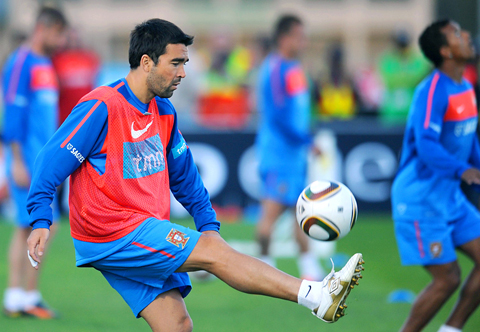
PHOTO: AFP
At least two of Portugal’s World Cup squad — midfielder Deco and forward Liedson — were born in Brazil and others may be lining up for other countries, including Cacau for Germany.
Rather than not being good enough for Brazil, these players have slipped through the cracks in a country which churns out enough top-class soccer players to make up three or four national teams.
Deco, who scored against Brazil on his Portugal debut in a friendly in 2003, angrily refuted suggestions that he was not worthy of wearing the gold shirt.
“With a career like mine, it would have been normal for me to have played for Brazil,” the Chelsea player told the Portuguese sports daily A Bola.
“There are players who have worn that shirt and haven’t achieved half of what I have. Playing for Brazil would be the most natural thing in the world for a player who won everything with Porto, was an uncontested first-team regular at Barcelona for four years and plays for one of the world’s biggest clubs,” Deco said.
“Of course, it’s a special match because I’m Brazilian and have been connected to Brazil all my life,” he said referring to the Group G clash with Brazil in Durban on June 25.
“It’s a different game to the others, but of course I want to win. I will defend the Portuguese shirt until the end ... and if I score no Brazilian can see this as a betrayal against the country where I was born,” he said.
Liedson was also looking forward to the challenge in South Africa.
“It will be spectacular,” he told FIFA.com. “I was born in Brazil and I really love my country, but I will give everything for Portugal to win. This game is like a final.”
The use of naturalized players has been a thorny subject in international soccer.
In the early days, rules were lax and European countries were able to poach players from South America.
In the 1960s, Alberto Spencer, who was born in Ecuador and played for Penarol in Uruguay, represented both countries and switched between them, playing competitive games for the former and friendlies for the latter.
FIFA tightened the rules in 2004 after Qatar tried to naturalize three Brazilians, while Brazilian-born players also popped up in the national teams of Croatia, Macedonia, Equatorial Guinea and Togo, many of them imported for the specific purpose of strengthening national teams.
Belgium, Costa Rica, Japan, Mexico and Tunisia have also used Brazilians in past World Cup finals and, three years ago, FIFA president Sepp Blatter said the World Cup could be swamped with Brazilian players.
“If we don’t stop the fast naturalization of players in some countries, this will be a real danger,” Blatter said. “There were 60 million footballers in Brazil, but only 11 places in their national team.”
Rules now state that players must have a clear connection to the country they want to play for or have lived there for at least two years.
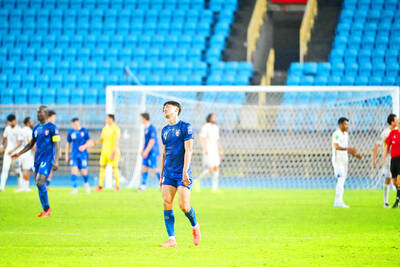
Yu Yao-hsing on Tuesday nabbed Taiwan’s only goal in the final round of qualifiers for the 2027 AFC Asian Cup, as they fell 3-1 to Sri Lanka at Taipei Municipal Stadium. Early goals from Sri Lanka in the first half left Taiwan struggling to get on the board, and Christopher Tiao’s own goal at 53 minutes sealed the team’s fate in the third round of qualifiers. While acknowledging that the defeat, Taiwan’s sixth in Group D, was disappointing, head coach Matt Ross said he saw reasons to stay positive about the team’s development. “There were lots of positive signs in terms of the

INDIGESTION: Italy failed to qualify for the World Cup for a third consecutive time after a 4-1 defeat to Bosnia on penalties in a loss Gattuso said was ‘difficult to digest’ Coach Graham Arnold on Tuesday challenged his players to “shock the world” after Iraq became the 48th and final team to qualify for the FIFA World Cup with a nerve-shredding 2-1 win over Bolivia in an intercontinental playoff in Mexico, as Bosnia and Herzegovina, Turkey, the Czech Republic, Sweden and the Democratic Republic of the Congo (DRC) also secured their places at the finals. Iraq, whose preparations were disrupted by the war in the Middle East, sealed their first appearance at the finals in 40 years and are to play in Group I against France, Senegal and Norway. Goals from Ali al-Hamadi

Teng Kai-wei, the only Taiwanese player on an opening-day roster in this year’s Major League Baseball (MLB) season, took his first win of the year with the Houston Astros in his season debut. Teng entered in relief in the top of the fifth inning against the Los Angeles Angels on Saturday, with the Astros trailing 5-0. He pitched 2-1/3 scoreless innings with two strikeouts, as Houston scored 11 runs during his outing to snatch an 11-9 comeback victory. The win is the Astros’ first of the season and the third of Teng’s MLB career. “It’s my first time pitching for the Astros, so
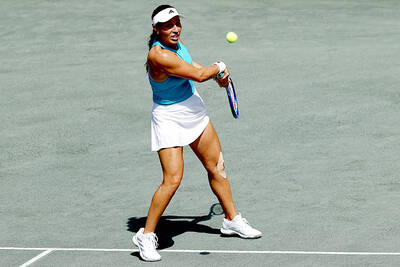
Top seeded Jessica Pegula on Friday once again fought back from a set down to reach the WTA Charleston Open semi-finals with a 3-6, 6-3, 6-2 win against Russia’s Diana Shnaider. Defending champion Pegula has lost the first set in all three of her matches at the tournament so far, but again dug deep to maintain her hopes of retaining the title. The world No. 5 from the US took 2 hours, 10 minutes to defeat 19th-ranked Shnaider, relying on a formidable service game that included eight aces. Shnaider battled well in the first two sets and broke early for a 2-0 lead


 RSS
RSS