


Ray Meyer, a Hall of Fame basketball coach at DePaul University who began his career by tutoring an awkward George Mikan, modern basketball's first superstar, and went on to win 724 games over 42 seasons, died Friday at an assisted-living residence outside Chicago, said Scott Reed, the university's sports information director. He was 92.
When Meyer arrived at DePaul in 1942, the Blue Demons played in the shadow of the Chicago elevated line at a drafty former theater known as the Old Barn. When he retired as coach in 1984, DePaul was a perennial national power showcasing its talent at the 17,500-seat Rosemont Horizon in the suburbs.
Meyer led DePaul to 20 postseason appearances, relying mostly on homegrown talent. He made his first out-of-state recruiting trip at age 69. His 1945 team won the National Invitation Tournament, and his 1943 and 1979 squads advanced to the Final Four of the National Collegiate Athletic Association tournament. When Meyer stepped down, his record of 724-354 placed him No. 5 in career victories among college coaches.
His son Joey, a former captain of the DePaul basketball team and his father's assistant coach for 13 seasons, succeeded Meyer as head coach and remained in that post for 13 years.
No change
Ray Meyer was present for 1,467 consecutive games over a 55-year span as DePaul's coach and as a basketball analyst for the program's radio broadcasts. He had coaching offers from the pros and other colleges, including his alma mater, Notre Dame, but he turned them down. His explanation, "I hate change."
But he adapted to changing times.
In his early coaching years, Meyer was so enraged by his team's poor play against Long Island University in a game at Madison Square Garden that he tore the coat hooks out of the locker room's plaster wall with his bare hands.
By the time he achieved his greatest success, in his final coaching years, he had tempered his gruffness and was known to flash a grandfatherly gap-toothed smile.
"Years ago you could rant and rave and shout and yell at 'em and scream at 'em," he said in the late 1970s. "If you do that today, they say, `That guy's nuts.' You reason more. You explain to 'em."
Meyer was born in Chicago, the son of a candy wholesaler and the youngest of 10 children. He planned to be a priest but turned to sports after starring in basketball at Chicago's Quigley Prep and St. Patrick's Academy, which won the 1932 Catholic high school national title.
He was co-captain of the Notre Dame basketball team as a junior and senior, and after serving as an assistant coach for the Irish, was named DePaul's head coach in April 1942. DePaul wanted Meyer to sign a three-year contract, but he insisted on a one-year agreement, at US$2,500. "I didn't know if I'd like the job," he recalled in his autobiography Coach (Contemporary Books, 1987), written with Ray Sons.
George Mikan
In Meyer's first season, he discovered a basketball hopeful who, like the coach, had once studied for the priesthood at Quigley Prep. The young man, a sophomore within an inch or so of his eventual 6-foot-10-inch height, had never played high school basketball. He wore thick glasses and had enrolled at DePaul only after being spurned by the Notre Dame coach because his basketball skills were primitive.
As Meyer put it in his memoirs, George Mikan was "raw material with little talent."
Meyer taught Mikan every aspect of the game and made him take hundreds of hook shots, both right-handed and left-handed, every day while keeping a towel wedged under his opposite arm to maintain proper form. "I was a slave driver, and he was a willing slave," Meyer recalled.
Mikan would rule the college game over the next three seasons and would then lead the Minneapolis Lakers to dominance in the National Basketball Association. He was voted the greatest basketball player in the first half of the 20th century in an Associated Press sports media poll.
With Mikan playing alongside his 6-foot-7 brother Ed, DePaul won the 1945 NIT championship.
During the 1950s, Meyer achieved a national presence by coaching the college all-star teams that toured each spring playing the Harlem Globetrotters.
In the early 1970s, DePaul's basketball fortunes declined. Joey Meyer was captain of his father's worst team, the 1970-71 squad, which went 8-17. But Ray Meyer's career flourished in the late 1970s and early 1980s with the arrival of the outstanding players Dave Corzine, Mark Aguirre and Terry Cummings.
In February 1979, Meyer joined John Wooden, Adolph Rupp and Frank McGuire as the only active coaches elected to the Basketball Hall of Fame. DePaul went to the NCAA tournament's Final Four that season, losing to Larry Bird's Indiana State team, 76-74, in the semifinals. Meyer's teams lost only one regular-season game in each of the following three seasons but never advanced beyond the first round of the NCAA tournament.
When DePaul opened the 1981-1982 season against Illinois-Chicago Circle, the Meyer family made sports history. Ray Meyer was coaching against his oldest son, Tommy, in what is believed to have been the first coaching meeting between a father and a son in college basketball. The elder Meyer's team prevailed 78-53.
Tommy, joey and bobby
Meyer is survived by three sons, all of whom played for him at DePaul -- Tommy, of Michigan, and Joey and Bobby, both of Chicago; and two daughters, Barbara, of Elk Grove Village, Illinois, and Patricia, of Chicago. His wife, Margaret, died in 1985.
Meyer left DePaul in September 1997, resigning as special assistant to the university's president as a protest to the forced resignation of his son Joey as DePaul's coach the previous April following a 3-23 season.
"I live with my family, and my family is kind of bitter about this whole thing," Ray Meyer told AP.
Meyer observed how the university would go on nicely without him. "I was only an employee," he said. "I wasn't the university."
But DePaul did not forget him. In June 1998, the university broke ground for a US$12 million Ray Meyer Fitness and Recreation Center. And a stretch of Belden Avenue outside the Meyer Center was renamed Ray Meyer Drive.

Greek swimmer Kristian Gkolomeev was the only athlete to “beat” a world record on Sunday at the Enhanced Games, winning the men’s 50m freestyle at the divisive competition where athletes were free to take performance-enhancing substances. His time of 20.81 seconds — which is not considered official — came in the final event of the night in Las Vegas, sparing the blushes of organizers who made claims that multiple world records would be surpassed due to a sophisticated doping regime. Gkolomeev, who was wearing a synthetic “supersuit” long banned at events such as the Olympics, outpaced Australia’s Cameron McEvoy’s 20.88 set in
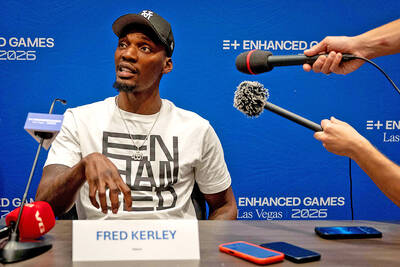
Fred Kerley is competing unaugmented against drug-fuelled athletes at this weekend’s Enhanced Games and still hopes to race in the 2028 Olympics, the suspended former 100m world champion said on Friday. Arguably the biggest name at the divisive event in Las Vegas, where doping is permitted, the US sprinter said he had chosen not to take any of the banned substances including testosterone and steroids that his competitors have been using. “I don’t need it. God gave me fast feet for a reason. And I’m here to showcase my talent,” Kerley said. Kerley last September became the first US competitor and first track
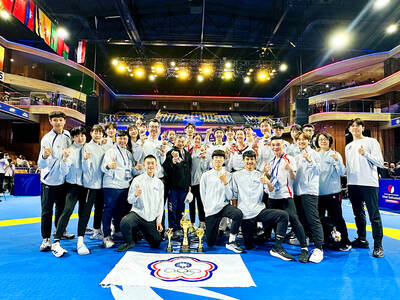
VICTORY ABROAD: The team took home a fistful of medals and secured spots for the autumn’s Asian Games, scheduled for September in Nagoya Taiwan’s women’s team captured the overall title at the Asian Taekwondo Championships in Mongolia on Sunday, finishing with two golds, one silver and one bronze medal. The strong showing, led by gold medalists Wang Chieh-ling and Chang Jui-en secured the full quota of available spots for Taiwan at the Asian Games in Nagoya, Japan, in September. Wang opened Taiwan’s medal run by winning gold in the women’s under-46kg class on Thursday, the first day of competition. Liu Yu-yun later earned a silver in the under-49kg class. On the final day on Sunday, Chang won Taiwan’s second gold medal in the under-62kg event, and
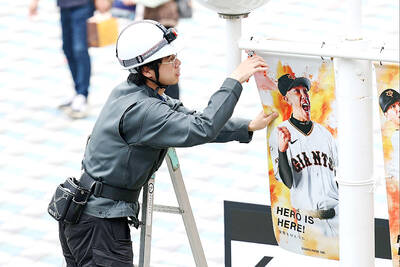
The manager of the Yomiuri Giants, one of Japan’s most popular baseball teams, resigned yesterday after he was arrested for allegedly physically attacking his teenage daughter. Shinnosuke Abe allegedly grabbed the 18-year-old and forced her to the floor at their home in central Tokyo on Monday evening, reported national broadcaster NHK and Kyodo News, citing unnamed police sources. “Leaving like this really means I’m causing you a lot of trouble, and I feel truly sorry about that,” Abe told a hastily arranged news conference, his eyes red with tears. The former star catcher, who is among baseball-obsessed Japan’s most recognized sports figures,


 RSS
RSS