


As the rescue team began clearing debris from the top of the Tunghsing building -- replacing the former method of digging from side to side -- it was decided that they should also use larger power shovels to increase productivity and speed. The new strategy was likely a factor in uncovering ten more bodies yesterday in the wreckage of Taipei's Tunghsing building (
It was the fourth day of rescue work after the 12-story building collapsed. Families and friends of those trapped in the wreckage retain little hope that they will be found alive. More emergency settlement services, funeral services and trauma treatment counseling has been offered by the Taipei City Government.
So far, 105 people have been rescued, 28 are dead and 50 remain trapped in the rubble.
At 7:10 am, the body of a 16- year-old girl, Lin Tzu-yu (
Her mother, one of the injured who was rescued five hours after the collapse, had been sitting in a wheelchair waiting for the return of her daughter. At the beginning of this year's Mid-Autumn Festival -- a day for family reunions -- this mother instead received the sad news of her daughter's death.
With the new rescue strategy in place, three workers used the power shovels beginning early yesterday to peel off the upper part of the building. By 1:32 pm the seventh body had been discovered, and the rescuers took a break. During this time a rescuer acted as spokesman to communicate with the relatives about the progress being made. He explained the slow process in uncovering the bodies that had been discovered, saying that had to be separated from furniture and other debris.
"It took us some time to separate them from the materials," he said.
Many relatives and friends suffered from sunstroke after waiting for long periods in the severe heat. A religious group, Buddha Light's International Association, provided traditional Chinese medical treatment. Blind volunteers from Taipei City Government's Bureau of Social Affairs helped those suffering from fatigue and depression by giving massages.
One relative of a trapped resident said he had been waiting there for two days.
Five people in the family of his brother were still buried under the shattered building, he said.
He said: "The building must have been jerry-built by the developer! We still think the remodeling work on the ground floor is partly responsible for the collapse."
Later in the evening, two more bodies were pulled out.
They were Wang Ching-shun (
Victims and residents of the Tunghsing building formed a committee to collectively handle funeral expenses and future compensation.
Taipei Mayor Ma Ying-jeou (馬英九) said yesterday afternoon that the government would provide more services for citizens victimized from the earthquake.
Those whose houses or apartments collapsed would be offered NT$200,000 subsidies and also given top priority for renting public housing.
Each death would be compensated NT$500,000.
As for citizens whose houses were found to be "dangerous" by the government and were evacuated from their buildings, an additional rental subsidy of NT$30,000 would also be provided.
So far, the government has received 440 cases reported from citizens suspecting the soundness of their building structure.
Experts have finished inspections on 256 cases, with 19 of the buildings so far found to be dangerous.
The government is also providing counseling for those suffering from the trauma associated with the loss of family members.
The project includes group treatment for residents temporarily settled at nearby hotels and a 24-hour telephone service.
The number is (02) 2726-2153. The counselling service can also be found on the World Wide Web at

‘NO SECURITY RISK’: The Railway Bureau reassured the public that the technicians’ activities were limited to technical guidance and did not involve sensitive systems The Railway Bureau yesterday said it had invited eight Chinese technicians to assist with an airport MRT construction project. The bureau issued the confirmation after an Internet user said Chinese nationals had entered the construction zone of Taiwan Taoyuan International Airport’s Terminal 3 project. They asked why “individuals from an enemy state” were allowed access to such a major national infrastructure project, which raised serious concerns over Taiwan’s industrial safety, sensitive systems and information security. The bureau’s Northern Region Engineering Branch Office said subcontractor Taiwan Handle Industrial Co (台灣手把工業) of the Taoyuan airport MRT’s “Contract No. CU05 Project A14 Station Civil, MEP &

A US uncrewed surface vessel (USV) encountered multiple Chinese warships during an autonomous transit of the Taiwan Strait, US defense company Seasats said in a statement on Wednesday. Seasats announced that a Lightfish USV had completed the first autonomous transit of the Taiwan Strait. Over five days, the USV traversed the entire length of the Strait while constantly monitoring surface vessel traffic, the company said. The Lightfish encountered multiple Chinese warships, one of which was a Chinese People’s Liberation Army Navy (PLAN) Type 056 corvette, it said. The Chinese vessels were operating “well within Taiwan’s exclusive economic zone without transmitting their identity via the
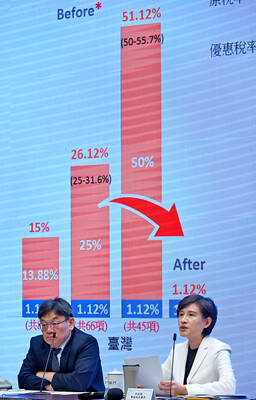
GREATER REACH? Auto parts and wood products would face tariffs of up to 15%, matching those targeting the EU, Japan and South Korea, Vice Premier said The US has announced that preferential tariff treatment for Taiwan’s non-semiconductor Section 232 goods would take effect retroactively from May 1, the Executive Yuan said yesterday. The US government yesterday posted a notice on the Federal Register’s public inspection Web site previewing tariff concessions for Taiwan under a memorandum of understanding (MOU) on Taiwan-US investment after two months of negotiations. The MOU signed on Jan. 15 stipulated three major preferential tariff arrangements: a 15 percent “reciprocal” tariff rate for Taiwan without stacking most-favored nation (MFN) rates; preferential Section 232 treatment for semiconductors and related products; and preferential Section 232 treatment for non-semiconductor

The National Chungshan Institute of Science and Technology yesterday showcased its locally developed variants of the Vision 60 robotic patrol dog, which it plans to deploy on the nation’s outlying territories in the South China Sea. The variants were produced under the Joint Lab project — created by the institute and domestic companies — and assembled with domestically produced motors, lenses and artificial intelligence (AI) systems alongside licensed tech from the US, Missile and Rocket Systems Research Division deputy director Jen Kuo-kang (任國光) told the media event at a military base in Taipei’s Dazhi (大直) area. Taiwan has built up its strengths


 RSS
RSS